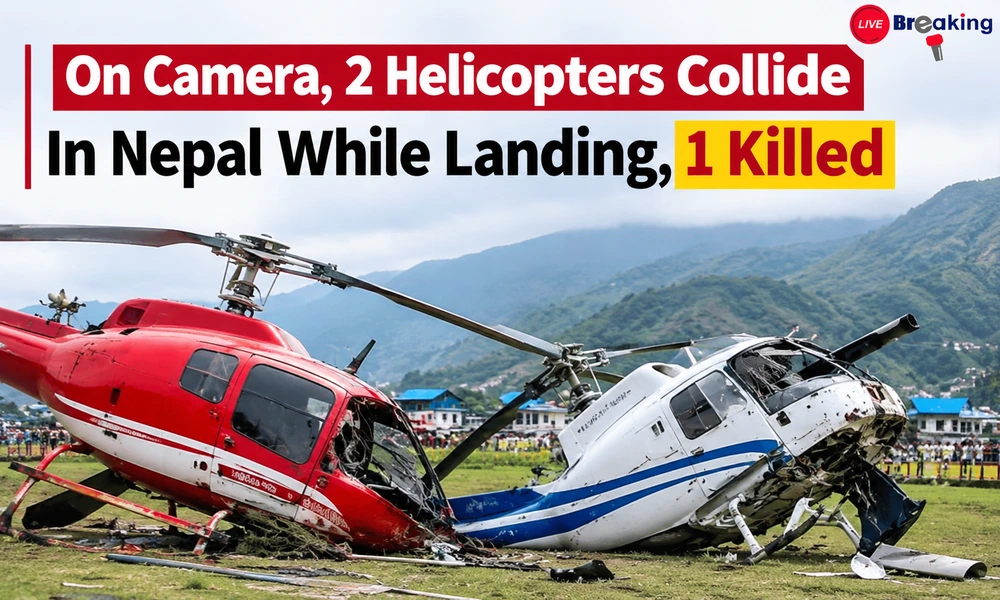
Nepal Helicopter Collision: 1 Dead as Two Choppers Crash During Landing
A shocking helicopter accident in Nepal’s Himalayan region has resulted in the death of an Indian national and injuries to other people after two helicopters collided while attempting to land at Pheriche in Solukhumbu district on Tuesday morning.
The incident took place at approximately 8:11 AM local time at the Pheriche helipad, situated in the Everest region. According to preliminary reports, the helicopters came into contact while approaching the landing area, causing both aircraft to crash.
The accident has attracted widespread attention after video footage apparently showing the collision began circulating on social media. The incident has also raised concerns about aviation safety in Nepal’s high-altitude tourist destinations, where helicopters play an important role in passenger transportation and emergency rescue operations.
Two Helicopters Collide During Landing in Nepal
According to preliminary information released by local authorities, the accident involved two helicopters operated by Fishtail Air and Air Dynasty.
Both aircraft were approaching the Pheriche landing area when their rotor blades reportedly struck each other. The collision caused the helicopters to lose stability and crash at the landing site.
The accident occurred in the Khumbu Pasang Lhamu Rural Municipality area of Solukhumbu district, a popular destination for trekkers and mountaineers travelling towards Mount Everest.
Initial reports indicate that the incident happened during the morning hours, when helicopter services are frequently used to transport passengers, tourists and essential supplies across the mountainous region.
Local police officials confirmed that the collision resulted in a fatality and injuries. Emergency assistance was subsequently arranged for the injured people.
Indian National Among Those Killed in the Helicopter Accident
One Indian national lost their life in the tragic accident, according to subsequent reports identifying the deceased as Vasanth Kumar.
The victim was reportedly travelling aboard the Fishtail Air helicopter when the collision occurred.
The accident also left other people injured. Reports identified a New Zealand national of Indian origin and a Nepali pilot among the injured, although information regarding their medical condition and treatment continued to develop as authorities gathered further details.
The injured were transported for medical assistance, with helicopter evacuation playing an important role in reaching medical facilities from the remote Himalayan location.
The incident has brought grief to the families of those involved and renewed attention to the risks associated with helicopter operations in mountainous terrain.
Viral Video Shows Moment of Helicopter Collision
A video reportedly showing the collision has surfaced on social media and attracted significant attention.
The footage appears to show two helicopters approaching the landing area before their rotor blades make contact. Following the impact, both aircraft lose control and come down onto the ground.
The visuals have prompted discussions about helicopter spacing, landing coordination and the challenges of operating multiple aircraft in confined mountain landing areas.
Read More: Shashi Tharoor Asked About Rahul Gandhi’s Foreign Trip. His “Travel Agent” Reply
However, footage circulating online should be treated cautiously until its authenticity and complete sequence are independently established. A short video alone cannot explain the technical circumstances that led to the collision.
Authorities will need to examine the aircraft, available flight records, communications and other relevant evidence before determining exactly what happened.
Emergency Rescue Operations Launched After the Crash
Following the accident, local authorities and aviation personnel initiated emergency response measures.
The remote location of Pheriche makes rescue operations particularly challenging. Unlike major cities, where ambulances and emergency services can quickly reach an accident site, many settlements in Nepal’s Everest region have limited road connectivity.
Helicopters are therefore essential for transferring injured people to locations where medical treatment is available.
Reports indicate that an injured person was airlifted to Lukla for initial medical assistance. Further evacuation and medical arrangements were also reported as authorities assessed the situation.
Local police personnel reached the area to assist with the response and collect information about the accident.
The authorities are also examining the circumstances surrounding the collision, including the movements of both aircraft before landing.
Why Is Pheriche Important for Mount Everest Tourism?
Pheriche is a well-known settlement in Nepal’s Khumbu region and an important stop for trekkers heading towards Everest Base Camp.
Located at a high altitude in the Himalayas, the settlement is frequently visited by climbers, trekking groups, guides and support teams.
The region’s difficult geography makes helicopter transportation particularly valuable. Helicopters are regularly used to move tourists, transport supplies and evacuate people experiencing altitude-related medical emergencies.
Read More: Mention Of Riots Outside India In CJP Leaders’ Plea Hearing In Delhi High Court
For many visitors, helicopter services offer an alternative to long and physically demanding journeys through mountain trails.
However, operating aircraft in this region requires careful planning. High altitude, limited landing space, changing weather and mountainous surroundings can create demanding conditions for pilots.
The Pheriche accident highlights why safety coordination is especially important when multiple helicopters operate near the same landing location.
Why Are Helicopter Operations Challenging in Nepal’s Himalayan Region?
Nepal’s Himalayan landscape is among the most demanding environments for aviation operations.
Unlike airports located on flat terrain, high-altitude helipads are often surrounded by mountains, valleys and uneven geographical features.
Several factors can complicate helicopter operations in such areas:
1. High-altitude conditions: Air density decreases at higher elevations, affecting helicopter performance and reducing available engine and rotor performance margins.
2. Unpredictable weather: Mountain weather can change quickly. Snowfall, strong winds, clouds and reduced visibility can make flying more difficult.
3. Limited landing space: Many mountain helipads have restricted space, requiring pilots to maintain precise control and coordination during landing.
4. Difficult terrain: Mountains, cliffs and narrow valleys can limit available flight paths and manoeuvring options.
5. Heavy tourist traffic: During busy trekking seasons, several helicopters may operate in the same region, making communication and landing coordination particularly important.
These factors do not establish the cause of the Pheriche accident. Only an official investigation can determine whether operational, technical, weather-related or other circumstances contributed to the collision.
Investigation Underway to Establish the Cause
The exact cause of the helicopter collision has not yet been officially established.
A detailed investigation will be important to determine how the two aircraft approached the helipad and what circumstances led to their rotor blades making contact.
Investigators may examine flight paths, communication records, aircraft maintenance information, pilot statements and physical evidence recovered from the crash site.
They may also assess visibility, weather conditions, landing procedures and coordination between the helicopter operators.
It is important not to draw conclusions about pilot error or mechanical failure before the findings are officially released.
The investigation could also provide useful information for improving helicopter safety procedures at busy high-altitude landing locations.
Nepal’s Tourism Industry Faces Fresh Aviation Safety Questions
Nepal attracts visitors from around the world because of its mountains, trekking routes and mountaineering opportunities. The Everest region remains one of the country’s most recognised international tourism destinations.
Helicopter services have become an important part of this tourism ecosystem. They help visitors reach remote locations, support mountain expeditions and provide emergency evacuation services.
At the same time, accidents involving aircraft can have serious consequences for passengers, pilots, tourism operators and rescue personnel.
The Pheriche collision is a reminder that safety procedures must remain a priority, particularly during busy trekking periods when helicopter movements can increase.
Aviation authorities and operators may review their operational arrangements as more information becomes available from the investigation.
Read More: “Might Be Crocodiles Here, But”: BJP MP Manoj Tiwari Takes Yamuna Dip, Declares It Clean
For travellers planning helicopter journeys in Nepal, the incident also underlines the importance of using authorised operators and following official aviation and safety instructions.
Conclusion
The collision involving two helicopters at Pheriche in Nepal’s Solukhumbu district has turned into a tragic incident for the international trekking community. One Indian national has reportedly lost their life, while other people sustained injuries.
As emergency response efforts and investigations continue, attention will remain focused on establishing how the two aircraft collided during landing.
The incident also highlights the unique aviation challenges of Nepal’s Everest region, where helicopters are essential for tourism, transportation and emergency evacuations.
Further official findings are expected to provide greater clarity about the accident and whether additional safety measures are required to prevent similar incidents in the future.
Nepal Helicopter Collision – Key Details
| Details | Information |
|---|---|
| Incident date | November 3, 2026 |
| Location | Pheriche, Solukhumbu, Nepal |
| Region | Mount Everest region |
| Helicopters involved | Fishtail Air and Air Dynasty |
| Accident | Collision during landing |
| Fatalities | 1 Indian national |
| Injured | Other passengers/crew members |
| Approximate time | 8:11 AM local time |
| Rescue location | Lukla and other medical facilities |
| Investigation | Underway |
Frequently Asked Questions (FAQs)
1. Where did the two helicopters collide in Nepal?
The two helicopters collided at the Pheriche helipad in Solukhumbu district, Nepal. The location is situated in the Khumbu region near Mount Everest and is frequently used by trekkers, mountaineers and helicopter operators.
2. How many people died in the Nepal helicopter collision?
One Indian national was reported killed in the November 3, 2026, accident. Other people, including a passenger and a Nepali pilot, were also reported injured.
Read More: Bombay HC on Imran Khan: ‘You Are Not an Indian Citizen’ Over SIR Protest
3. Which helicopter companies were involved in the accident?
The helicopters involved belonged to Fishtail Air and Air Dynasty. Both aircraft collided while approaching the Pheriche landing area in Nepal’s Everest region.
4. What caused the two helicopters to collide?
Preliminary reports indicate that the rotor blades of the two helicopters struck each other during landing. However, the exact cause of the accident has not yet been officially established and remains under investigation.
5. Is the Nepal helicopter collision video available online?
Footage reportedly showing the collision has circulated on social media. The video appears to capture the aircraft making contact before crashing. However, viewers should rely on verified footage and official investigation updates.
6. Why are helicopters commonly used near Mount Everest?
Helicopters are widely used in the Everest region to transport tourists, climbers, supplies and rescue teams. They are also important for evacuating people suffering from altitude sickness or other medical emergencies.
7. Where were the injured people taken after the accident?
Initial reports said an injured passenger was airlifted to Lukla for medical assistance. Subsequent reports also described further medical evacuation arrangements. Authorities were gathering additional information about the injured.