Manoj Tiwari Takes Yamuna Dip, Claims River Is Clean: What Data Says
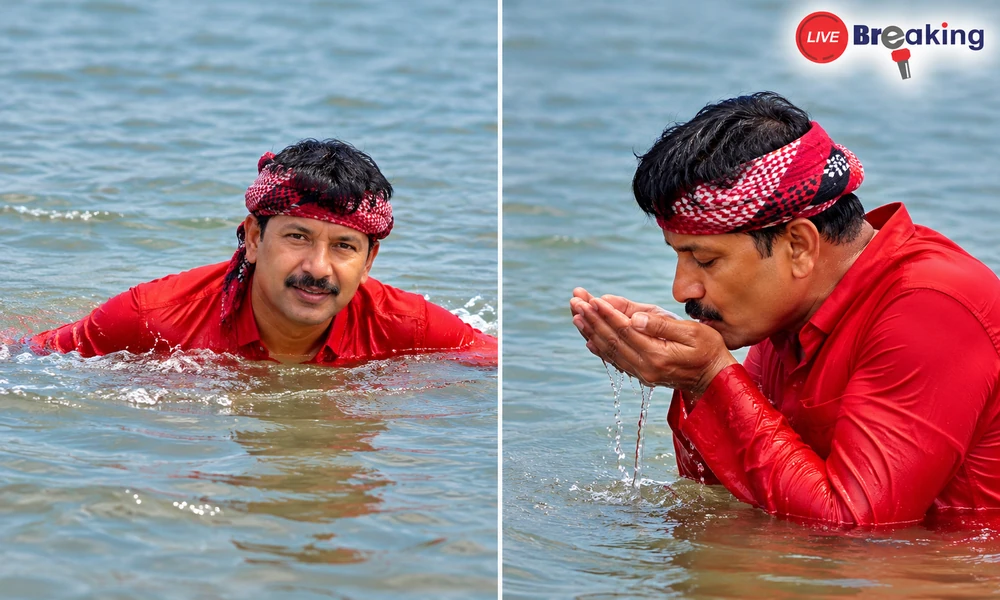
The condition of the Yamuna River in Delhi has once again become a major political and environmental talking point. On October 29, 2026, Bharatiya Janata Party (BJP) MP Manoj Tiwari took a dip in the Yamuna at Sonia Vihar Ghat and claimed that the river had become significantly cleaner under the BJP-led Delhi government.
The BJP leader also performed aachman, a traditional Hindu ritual involving the sipping of water, and praised the government’s efforts to improve the condition of the river. His action quickly attracted public attention, particularly because the Yamuna has remained one of Delhi’s most pressing environmental challenges for years.
However, the political celebration has been accompanied by questions about the actual quality of the river water. Monitoring figures cited in report suggest that although certain stretches have shown improvement, pollution levels at several locations remain considerably higher than the prescribed bathing-water standards.
The episode has therefore raised an important question: Has the Yamuna really become clean enough for people to bathe in, or is the improvement being overstated?
Manoj Tiwari Takes a Dip in Yamuna at Sonia Vihar
BJP MP Manoj Tiwari visited Sonia Vihar Ghat in Delhi on Thursday, October 29, where he took a dip in the Yamuna River and claimed that its condition had improved.
During his visit, Tiwari also drank a small amount of river water as part of the traditional aachman ritual. He credited the Rekha Gupta-led BJP government in Delhi for the improvement and argued that the river was moving towards becoming clean again.
Tiwari also pointed towards the presence of migratory birds near certain stretches of the Yamuna, suggesting that their arrival indicated an improvement in the river’s ecological condition.
In a social media post, he challenged former Delhi Chief Minister Arvind Kejriwal and Congress leader Rahul Gandhi to visit the river and take a dip themselves.
His remarks quickly became a subject of political discussion, with supporters highlighting the government’s efforts and opposition leaders questioning whether the river’s water was genuinely safe.
BJP Claims Yamuna Pollution Has Reduced by Half
The BJP has maintained that its government has made considerable progress in cleaning the Yamuna since coming to power in Delhi.
According to Manoj Tiwari, pollution levels have reduced significantly over the past year because of the cleaning initiatives undertaken by the state government.
He also claimed that the government had achieved substantial progress in approximately one-and-a-half years and that the remaining work would be completed over the next three years.
The Delhi BJP also highlighted its government’s performance, arguing that work completed in two years had achieved results that previous Congress and Aam Aadmi Party governments could not accomplish over a much longer period.
The party’s message is that the cleaning process is progressing and that the Yamuna could once again become suitable for religious activities, including Chhath Puja.
However, claims of improvement need to be evaluated against scientific water-quality measurements rather than political statements or isolated observations.
AAP Questions BJP’s Claims About Yamuna Cleanliness
The Aam Aadmi Party (AAP) strongly challenged the BJP’s claims following Tiwari’s visit.
AAP Delhi president and former minister Saurabh Bharadwaj argued that the stretch between Palla and Wazirabad has historically been comparatively cleaner than other sections of the river.
He also referred to Delhi Pollution Control Committee (DPCC) monitoring reports, claiming that the stretch had been cleaner during the previous AAP government.
Bharadwaj pointed out that major drains enter the Yamuna downstream, significantly increasing the pollution load.
He specifically highlighted the Najafgarh drain, which carries substantial wastewater into the river near Wazirabad.
According to his argument, the relatively cleaner condition of the upstream stretch does not necessarily demonstrate that the entire Yamuna passing through Delhi has become pollution-free.
Bharadwaj also questioned the government’s claims ahead of Chhath Puja and challenged Manoj Tiwari and Delhi Water Minister Parvesh Verma to drink water at Kalindi Kunj Ghat, a location further downstream.
The exchange has turned the Yamuna’s pollution problem into another political confrontation between the BJP and AAP.
What Does the Yamuna Pollution Data Actually Reveal?
While political parties continue to exchange accusations, water-quality data provides a more measurable picture of the river’s condition.
The pollution situation varies considerably across different stretches of the Yamuna in Delhi.
One important measurement is Biochemical Oxygen Demand (BOD). It indicates how much oxygen microorganisms require to break down organic material in water.
Higher BOD values generally suggest greater organic pollution and can indicate deteriorating water quality.
The prescribed bathing-water standard for BOD is 3 milligrams per litre (mg/l) or below.
However, several monitoring locations along the Yamuna have recorded readings significantly above this limit.
Yamuna BOD Levels at Different Locations
The figures reported show a significant difference between the upstream and downstream stretches.
| Monitoring location | BOD level |
|---|---|
| Palla | 2 mg/l |
| ISBT Bridge | 30 mg/l |
| ITO | 18 mg/l |
| Prescribed bathing standard | 3 mg/l or below |
The data indicates that Palla has a BOD reading within the prescribed bathing-water limit. However, the situation changes considerably at other monitoring points.
At ISBT Bridge, the BOD reading stands at 30 mg/l, which is ten times the prescribed limit.
At ITO, the recorded BOD level is 18 mg/l, six times higher than the bathing-water standard.
These figures highlight why improvement in one section of the river should not automatically be treated as proof that the entire Delhi stretch is clean.
Improvement at ITO, But Pollution Remains High
There is some positive news in the monitoring figures.
At ITO, BOD levels reportedly declined from 70 mg/l in July 2025 to 18 mg/l in September 2026.
This represents a considerable reduction in organic pollution.
However, the current reported level remains six times higher than the prescribed bathing-water standard.
This distinction is important. A reduction in pollution does not necessarily mean that water has become safe for bathing or religious activities.
Read More: In First Show Of Support, Rahul Gandhi Backs CJP Leaders Jailed For Protest
For residents and devotees, the actual water-quality measurements remain more important than declarations of improvement.
Faecal Coliform Levels Raise Additional Health Concerns
BOD is not the only parameter used to assess the quality of river water. Faecal coliform levels are another important indicator.
These bacteria are associated with contamination from human and animal waste. Their presence in high concentrations can indicate the possibility of harmful microbial contamination.
The faecal coliform count at ISBT Bridge stands at 35,000 MPN per 100 millilitres.
The upper desirable limit for bathing water is 2,500 MPN per 100 millilitres.
| Water quality parameter | Recorded figure at ISBT Bridge | Desirable bathing-water limit |
|---|---|---|
| Faecal coliform | 35,000 MPN/100 ml | 2,500 MPN/100 ml |
| BOD | 30 mg/l | 3 mg/l |
The reported faecal coliform level is approximately 14 times the desirable limit.
This raises concerns about the possible health risks associated with direct contact with contaminated water.
People exposed to polluted water may face risks of gastrointestinal infections and other waterborne illnesses, depending on the type and level of contamination.
For this reason, bathing in a river should not be considered safe simply because it looks cleaner or because a public figure has taken a dip.
Visual appearance and actual water quality are two different things.
Why Is the Yamuna Still Heavily Polluted in Delhi?
The Yamuna flows for approximately 52 kilometres through Delhi, but pollution is not distributed equally across the entire stretch.
The 22-kilometre section between Wazirabad and Okhla is particularly affected by pollution and has remained a major concern for environmental authorities.
Read More: India Selling More To US Despite Tariffs, But China Trade Gap Keeps Rising
One of the biggest reasons is the discharge of untreated or inadequately treated sewage into the river.
Several drains carrying domestic wastewater and other pollutants eventually enter the Yamuna. Industrial discharge, solid waste and insufficient sewage-treatment capacity also contribute to the problem.
As a result, the water quality can change significantly as the river travels through the city.
The relatively cleaner condition of the river near Palla cannot be used as evidence that the downstream stretches are equally clean.
Cleaning the Yamuna therefore requires a comprehensive approach that addresses pollution sources across the entire river system.
Government Announces Projects Worth Rs 8,941 Crore
Amid the ongoing debate, the government has announced several initiatives aimed at improving the Yamuna’s condition.
Union Home Minister Amit Shah recently launched 43 projects worth approximately Rs 8,941 crore for cleaning the river.
The projects are intended to strengthen the ongoing efforts to control pollution and improve the condition of the Yamuna.
The BJP government has also set an ambitious target of cleaning the Delhi stretch of the river by May 2029.
Delhi Water Minister Parvesh Verma has acknowledged that completely cleaning the Yamuna will require additional time.
He has indicated that the process could take approximately two-and-a-half to three years.
The government maintains that the stretch between Palla and Wazirabad has been cleaned, while work is continuing on the section between Wazirabad and Kalindi Kunj.
The success of these initiatives will ultimately depend on measurable improvements in water quality, sewage management and pollution control.
Can Devotees Safely Celebrate Chhath Puja in the Yamuna?
The Yamuna’s condition becomes particularly important during Chhath Puja, one of the major religious festivals celebrated in Delhi and other parts of northern India.
Thousands of devotees visit riverbanks and designated ghats to offer prayers to the Sun God.
Read more: 1 Million People, 20,000 Vehicles And Gridlock: Traders’ Note To Rahul Gandhi
The festival involves standing in water during religious rituals, making water quality a significant public-health concern.
Although the BJP has suggested that improvements in the river could allow people to celebrate Chhath Puja in the Yamuna, pollution measurements indicate that several stretches still require attention.
Authorities need to ensure that designated bathing locations meet appropriate water-quality requirements before encouraging large gatherings.
Regular testing, public disclosure of results and clear safety advisories are essential.
The government should also communicate which stretches are suitable for religious activities and which locations should be avoided.
What Needs to Be Done to Make the Yamuna Clean?
Cleaning the Yamuna requires more than temporary cleaning drives or visible improvements near selected ghats.
A long-term strategy should focus on eliminating pollution at its source.
Some of the most important steps include:
1. Improving sewage treatment: Delhi needs effective sewage-treatment infrastructure to prevent untreated domestic wastewater from entering the river.
2. Monitoring industrial discharge: Industries must follow environmental standards, with strict action against illegal disposal of untreated waste.
3. Cleaning major drains: Polluted drains entering the Yamuna should be intercepted and connected to appropriate treatment facilities.
4. Regular water-quality testing: Authorities should publish monitoring results for different stretches of the river so that residents can understand the actual situation.
Read More: Shashi Tharoor Asked About Rahul Gandhi’s Foreign Trip. His “Travel Agent” Reply
5. Preventing solid waste disposal: Plastic, household garbage and other waste should not be allowed to enter the river.
6. Coordinating between states: Since the Yamuna flows through multiple states, effective pollution control requires cooperation between different governments and agencies.
7. Protecting river ecology: Wetlands, natural riverbanks and aquatic habitats need protection as part of the river restoration process.
A successful cleaning programme must deliver sustainable results rather than short-term improvements before important political or religious events.
Political Debate Continues, But Yamuna’s Future Depends on Results
Manoj Tiwari’s visit to Sonia Vihar has once again brought the Yamuna’s pollution problem into the national spotlight.
The BJP is highlighting the improvements achieved under its government, while AAP is questioning the claims and pointing towards the condition of downstream stretches.
Both political parties have presented their arguments, but the most important question remains the actual condition of the river.
The reported reduction in BOD levels at ITO is an encouraging development. However, the continued high BOD and faecal coliform readings at certain monitoring points demonstrate that significant work remains.
The Yamuna is not just a political issue. It is an important environmental resource and has deep religious, cultural and historical significance for millions of people.
Read More: Mention Of Riots Outside India In CJP Leaders’ Plea Hearing In Delhi High Court
Ultimately, the success of any government should be measured by cleaner water, healthier river ecosystems and safer conditions for residents and devotees.
Until water-quality measurements consistently meet the required standards, declaring the entire Delhi stretch of the Yamuna clean would be premature.
Frequently Asked Questions (FAQs)
Q1. Why did BJP MP Manoj Tiwari take a dip in the Yamuna?
BJP MP Manoj Tiwari took a dip in the Yamuna at Sonia Vihar Ghat on October 29, 2026. He claimed that pollution levels had reduced because of the cleaning initiatives undertaken by the BJP-led Delhi government.
Q2. Is the Yamuna River clean in Delhi?
The Yamuna has shown improvement at certain locations, but several stretches remain polluted. According to monitoring figures cited, BOD levels at ISBT Bridge and ITO remain significantly above the prescribed bathing-water standard.
Q3. What is the BOD level of Yamuna water at ITO?
The reported BOD level at ITO was 18 mg/l in September 2026. Although this is an improvement from 70 mg/l in July 2025, it remains six times higher than the prescribed bathing-water limit of 3 mg/l.
Q4. What is the faecal coliform level in the Yamuna at ISBT Bridge?
The faecal coliform count at ISBT Bridge is 35,000 MPN per 100 millilitres, compared with the desirable bathing-water limit of 2,500 MPN per 100 millilitres.
Q5. What did AAP say about Manoj Tiwari’s Yamuna dip?
AAP leader Saurabh Bharadwaj questioned the BJP’s claims, arguing that the Palla-to-Wazirabad stretch has historically been comparatively clean. He also challenged BJP leaders to drink water at Kalindi Kunj Ghat.
Q6. What is the BJP government’s target for cleaning the Yamuna?
The BJP government has pledged to clean the Delhi stretch of the Yamuna by May 2029. The government has also announced multiple projects aimed at reducing river pollution.
Q7. Is Yamuna water safe for Chhath Puja?
Safety depends on the water quality at the specific ghat and the latest monitoring results. The reported pollution levels at some locations remain above bathing-water standards. Devotees should follow official safety advisories and use designated locations that have been tested and approved.