Rahul Gandhi Backs Jailed CJP Leaders After Jantar Mantar Protest
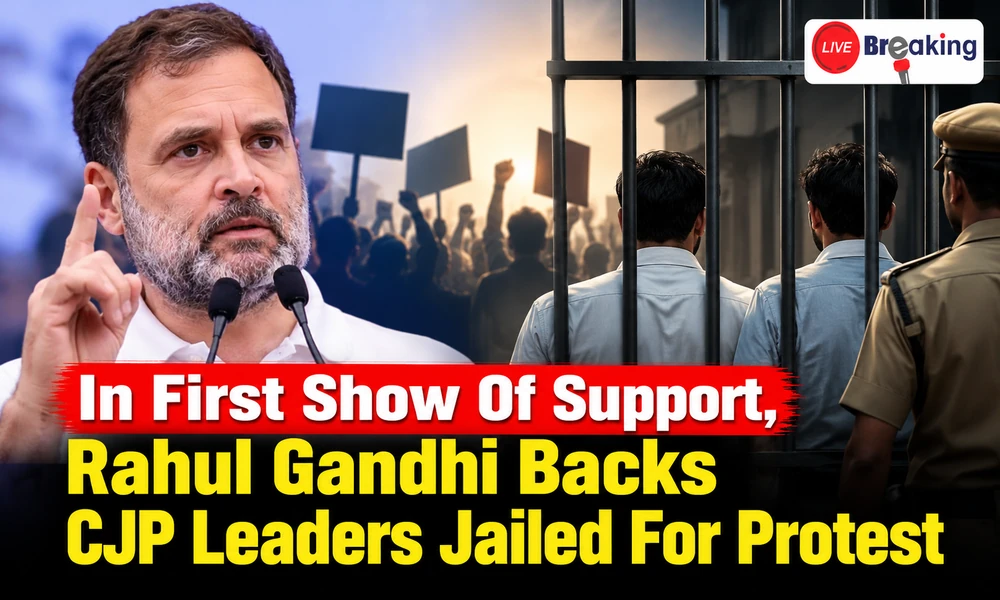
Congress leader and Leader of the Opposition in the Lok Sabha Rahul Gandhi has expressed support for Cockroach Janta Party (CJP) leaders Ashutosh Ranka and Saurav Das after they were arrested in connection with a protest at Delhi’s Jantar Mantar. His remarks have drawn attention to the ongoing political tensions surrounding demonstrations in the national capital and the future of the historic protest site.
According to a report published October 14, 2026, Ranka and Das were remanded to five days of judicial custody after being accused of trespassing at Jantar Mantar. The development followed a demonstration in which CJP members reportedly entered the area, waved the Indian national flag and raised slogans.
In a public statement posted on social media, Rahul Gandhi criticised the action against the protesters and argued that peaceful demonstrations involving the national flag should not result in young people being jailed. He also connected the incident to broader protests involving students, journalists, civil society groups and opposition parties.
The Congress leader’s intervention is significant because questions had previously been raised about the extent of his engagement with the CJP leadership during the wider protest campaign. His latest statement signals a more public expression of support for the group and places the issue of access to protest spaces at the centre of the political discussion.
Rahul Gandhi Condemns Arrest of CJP Leaders
Rahul Gandhi took to social media on Wednesday, October 14, to criticise the arrest of the two CJP leaders. He maintained that peaceful protest and the display of the national flag should not, by themselves, be treated as criminal acts.
His message also emphasised that demonstrations organised under different political or organisational banners could share a common objective: demanding constitutional rights and holding authorities accountable.
Gandhi further indicated that the Congress would oppose the decision to remove Jantar Mantar’s status as an official protest site. His remarks framed the dispute as a broader question about citizens’ ability to demonstrate publicly, rather than an issue involving only one political group.
The statement received a response from CJP founder Abhijeet Dipke, who thanked Gandhi for speaking out against the arrests. The exchange marked a public moment of support between the Congress leadership and the CJP.
However, the legal circumstances surrounding the arrests remain distinct from the political debate. The allegations reported in connection with the incident concern entry into a restricted or denotified protest area and compliance with bail conditions. The allegations should not be confused with a judicial finding of guilt.
Why Were Ashutosh Ranka and Saurav Das Arrested?
According to the report, CJP members entered Jantar Mantar early on Tuesday, October 13, by climbing a gate and barricades. The group reportedly waved the Tricolour and raised slogans before police detained its members.
Fourteen people were reportedly detained in connection with the incident. The police action followed an earlier detention linked to the group’s participation in protests in Delhi.
The report states that the CJP members had previously been released on bail after furnishing a bond containing a condition to maintain peace for one year. Police subsequently alleged that the latest demonstration violated the relevant bail conditions and involved trespassing.
On Wednesday morning, Ashutosh Ranka and Saurav Das were remanded to five days of judicial custody, according to the report.
The distinction between an arrest, an allegation and a final judicial determination is important. The police allegations and the court’s custody order form part of the legal process; they do not, on their own, establish guilt.
The incident has also raised questions about how restrictions on a protest site are communicated and enforced, particularly when political groups seek to organise demonstrations in a location historically associated with public dissent.
Jantar Mantar Denotification Becomes a Major Political Issue
Jantar Mantar in New Delhi has long been associated with demonstrations, political campaigns and public gatherings. Its role as a recognised protest location has made it an important venue for groups seeking visibility for their demands.
The Centre denotified Jantar Mantar as an official protest site on Monday, October 12, amid continuing demonstrations against Chief Election Commissioner Gyanesh Kumar.
The decision has become a point of contention because protesters and opposition leaders are debating the implications for public demonstrations in the capital.
Rahul Gandhi’s statement that Jantar Mantar belongs to the people of India reflects his opposition to the move. He also indicated that the Congress would challenge the decision politically.
Read More: ‘Head, Hands Almost Severed’: Dentist Treats Indian Pilot On flydubai Plane
The wider question is how authorities balance the management of public spaces, security requirements and citizens’ ability to assemble peacefully. Protest venues often require rules governing access, crowd control and public order. At the same time, restrictions on demonstrations can prompt concerns about whether citizens have adequate opportunities to express disagreement with government decisions.
The legal and administrative basis of the denotification, including its practical consequences for future demonstrations, will be important in assessing the dispute.
Opposition Leaders Rally Behind the CJP
Rahul Gandhi was not the only opposition figure to criticise the action against the CJP members. The report also noted expressions of support from leaders representing several opposition parties.
Aam Aadmi Party leader Arvind Kejriwal questioned the decision to jail the CJP leaders, while Trinamool Congress MP Abhishek Banerjee criticised the action in connection with the display of the national flag. DMK chief M.K. Stalin and Shiv Sena (UBT) leader Aaditya Thackeray also reportedly criticised the action.
The statements suggest that the incident has become part of a larger political argument involving protest rights, the use of public spaces and the relationship between opposition parties and civil society movements.
Nevertheless, public statements of support do not necessarily mean that all the parties share the same strategy or demands. Their participation in the debate should be understood as a series of political responses to the reported arrests.
For the opposition, the episode provides an opportunity to highlight questions of democratic participation and government accountability. For authorities, the legal questions surrounding entry into the site and compliance with bail conditions remain relevant to the case.
Did Rahul Gandhi Change His Approach Towards the CJP?
Gandhi’s public support has attracted attention because of earlier questions about his relationship with the CJP leadership.
Criticism had emerged over Gandhi’s interactions with CJP leaders during previous protest-related events. The report also noted that the CJP was not invited to a gathering organised by Gandhi for civil society representatives on Tuesday.
Gandhi had, however, included All India Students’ Association leader Neha Bora in a march alongside himself and Priyanka Gandhi in Delhi on Monday. Bora was also reportedly invited to the gathering attended by several civil society groups.
His latest statement backing the jailed CJP leaders could therefore be interpreted as an effort to communicate support for a wider protest movement, despite differences in the participation of individual organisations.
Whether this marks a lasting change in political coordination remains uncertain. A single public statement does not establish a permanent strategic shift, but it does demonstrate that Gandhi has chosen to speak directly about the CJP arrests.
Future developments, including any joint demonstrations, public meetings or coordinated political action, may offer a clearer indication of how the relationship evolves.
What Does the Incident Mean for Protest Rights in India?
The controversy highlights a broader issue in Indian public life: how the right to peaceful assembly operates alongside laws governing public order and access to public spaces.
Read More: ‘Create Fear In The Minds Of Culprits’: SC’s 5 Big Observations On Women Safety In Delhi
Peaceful protest is an important form of democratic participation. It allows citizens to communicate grievances, demand explanations from elected representatives and draw public attention to issues that might otherwise receive limited coverage.
At the same time, demonstrations are subject to applicable laws and lawful restrictions. Questions involving entry into restricted areas, bail conditions and police directions must be evaluated on the facts and legal provisions relevant to each case.
The CJP incident brings these competing considerations into focus. Political leaders have argued that the arrests raise concerns about freedom of expression and peaceful assembly, while the reported police allegations relate to trespassing and compliance with bail conditions.
A balanced assessment requires attention to both the circumstances of the demonstration and the legal grounds for the action taken. It also requires distinguishing between political criticism of an arrest and the legal determination of the allegations.
The future of Jantar Mantar as a protest venue will be an important part of this debate, particularly if opposition groups and civil society organisations continue to challenge its denotification.
What Happens Next?
The immediate focus remains on the legal proceedings involving Ashutosh Ranka and Saurav Das, along with the political response to their detention.
Further developments may include statements from the CJP leadership, additional reactions from opposition parties and clarification of the rules governing demonstrations at Jantar Mantar.
The denotification of the site could also remain a source of political disagreement. Any formal challenge or administrative clarification would help establish the available options for groups seeking to organise demonstrations in Delhi.
For now, Rahul Gandhi’s intervention has brought the CJP arrests into a wider national conversation. The episode connects a specific legal dispute with larger questions about opposition coordination, the management of public spaces and the place of peaceful dissent in a democratic society.
As the situation develops, it will be important to follow verified updates from the relevant authorities, court proceedings and the organisations involved.
Key Facts at a Glance
| Topic | Details |
|---|---|
| Main political figure | Rahul Gandhi |
| Organisation involved | Cockroach Janta Party (CJP) |
| Leaders named in the report | Ashutosh Ranka and Saurav Das |
| Location | Jantar Mantar, New Delhi |
| Reported protest date | October 13, 2026 |
| Rahul Gandhi’s response | Publicly criticised the arrests and supported the protesters |
| Reported court development | Five days of judicial custody for Ranka and Das |
| Reported police allegations | Trespassing and violation of bail conditions |
| Wider controversy | Denotification of Jantar Mantar as an official protest site |
| Other opposition figures mentioned | Arvind Kejriwal, Abhishek Banerjee, M.K. Stalin and Aaditya Thackeray |
Read More: RBI Hikes Repo Rate By 25 Basis Points To 5.5% Amid Rising Inflation
Frequently Asked Questions (FAQs)
1. Why did Rahul Gandhi support the CJP leaders?
Rahul Gandhi publicly criticised the arrests of Ashutosh Ranka and Saurav Das following a protest at Jantar Mantar. He argued that peaceful demonstrations and the display of the national flag should not result in young people being jailed, and connected the incident to wider concerns about constitutional rights.
2. Who are Ashutosh Ranka and Saurav Das?
Ashutosh Ranka and Saurav Das are CJP leaders named in the about the Jantar Mantar protest. They were reportedly arrested following a demonstration on October 13, 2026, and remanded to five days of judicial custody the next morning.
3. Why were the CJP leaders arrested?
According to the report, CJP members entered Jantar Mantar by climbing a gate and barricades, waved the national flag and raised slogans. Police reportedly alleged trespassing and a violation of bail conditions. The allegations are part of the legal proceedings and should not be treated as a final determination of guilt.
4. What is the Jantar Mantar protest controversy about?
The controversy centres on a protest involving CJP members and the Centre’s reported decision to denotify Jantar Mantar as an official protest site. Opposition leaders have criticised the move, raising broader questions about peaceful assembly, public spaces and citizens’ ability to demonstrate.
5. Which other opposition leaders supported the CJP?
The report also cited criticism of the action against CJP members from Aam Aadmi Party leader Arvind Kejriwal, Trinamool Congress MP Abhishek Banerjee, DMK chief M.K. Stalin and Shiv Sena (UBT) leader Aaditya Thackeray.
Read More: Pregnant Journalist Alleges Rahul Gandhi Pushed Her. Lies, Says Congress
6. Has Rahul Gandhi announced a permanent alliance with the CJP?
The reported statement demonstrates public support for the CJP leaders, but it does not establish a permanent political alliance. Further statements or joint political activities would be needed to determine whether the support develops into sustained coordination.
7. What happens after the CJP leaders are remanded to judicial custody?
The next steps depend on the legal proceedings and decisions of the relevant court. Updates should be verified through reliable news reports and official records rather than assumptions about the outcome of the case.
Conclusion
Rahul Gandhi’s support for the jailed CJP leaders has intensified political debate surrounding the Jantar Mantar protest and the Centre’s decision to denotify the site. While opposition leaders have framed the incident as a question of democratic rights and peaceful dissent, the police allegations concerning trespassing and bail conditions remain matters for the legal process.
The episode highlights the continuing tension between public protest, the regulation of public spaces and political accountability. Further legal developments and the response of the authorities will help clarify the implications of the case for the protesters and future demonstrations in Delhi.