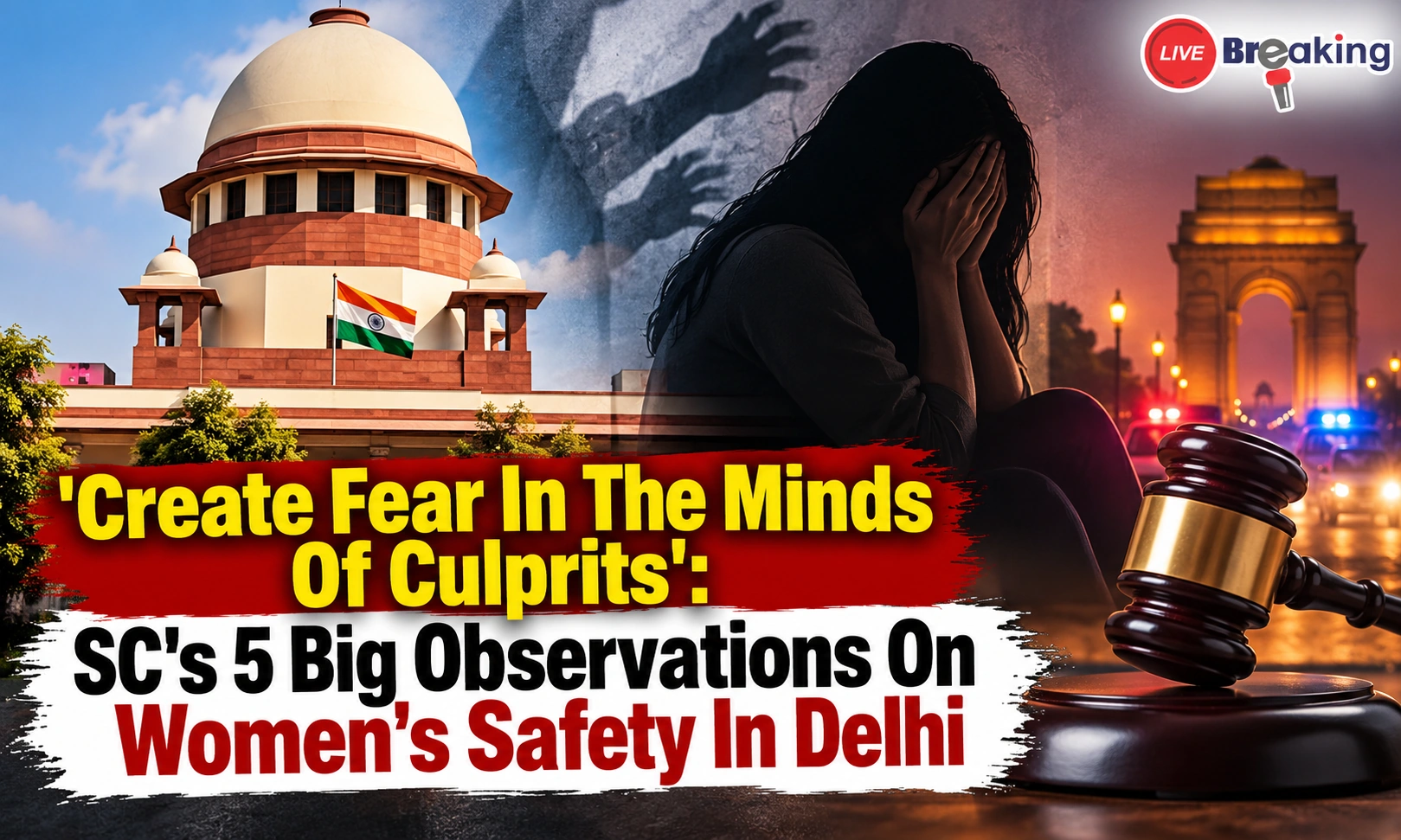
‘Create Fear In The Minds Of Culprits’: SC’s 5 Big Observations On Women Safety In Delhi
Women safety in the national capital has once again come under intense judicial scrutiny, with the Supreme Court stressing the need for stronger measures to ensure that women can live, work and travel without fear.
The court’s observations underline a broader concern: laws alone are not enough unless they are backed by effective enforcement, visible policing, quick investigation and a justice system that creates a genuine deterrent for offenders.
The Supreme Court’s emphasis on creating “fear in the minds of culprits” points towards the importance of deterrence. For women to feel safe in Delhi, potential offenders must know that crimes against women will be investigated seriously and that violations will have consequences.
The issue is particularly important in a city as large and densely populated as Delhi, where millions of people depend on public transport, roads, markets, workplaces and public spaces every day.
5 Big Observations From The Supreme Court On Women’s Safety
1. Strong deterrence is essential to prevent crimes
One of the central themes emerging from the Supreme Court’s observations is the need to ensure that criminals do not believe they can act with impunity.
The phrase “create fear in the minds of culprits” captures the principle of deterrence. The objective is not fear among ordinary citizens, but the knowledge among potential offenders that criminal conduct will attract swift and serious consequences.
Effective deterrence depends on several factors, including visible policing, prompt registration of complaints, professional investigation and timely prosecution.
If offenders believe that cases will take years to conclude or that victims may struggle to obtain justice, the deterrent effect of the law can weaken.
2. Women’s safety cannot depend only on policing
The Supreme Court’s concerns also highlight that women’s safety is a wider governance issue.
Police deployment is important, particularly in vulnerable locations, but safety also depends on street lighting, public transport, CCTV infrastructure, emergency response systems and the overall design of public spaces.
A woman should be able to travel to work, return home late, use public transport or walk through a public area without feeling that her safety is dependent solely on personal precautions.
This requires coordination between police authorities, civic agencies, transport authorities and the government.
3. Accountability must accompany responsibility
Another important principle is accountability.
Whenever a complaint involving women’s safety is received, authorities must respond appropriately and within a reasonable time. Delays in responding to complaints can increase the vulnerability of victims and undermine confidence in law enforcement.
Accountability also means examining whether existing mechanisms are actually working on the ground.
Authorities need to assess response times, investigation quality, deployment patterns and vulnerable areas rather than relying only on statistics showing the number of cases registered.
For women, the experience of seeking help is just as important as the existence of a formal complaint mechanism.
4. Public spaces must become safer for women
Women’s safety is not limited to homes or workplaces. Roads, railway stations, bus stops, markets, parks and other public areas also need to be examined from a safety perspective.
Poor lighting, isolated stretches, inadequate surveillance and limited police presence can make certain locations particularly vulnerable.
Read More: High Court Asks Meta To Remove Woman’s Morphed Images, CJP Leaders Get Notices
A safer Delhi requires authorities to identify such areas and take preventive measures before incidents occur.
Technology can play a role through CCTV networks, emergency communication systems and faster police response. However, technology must be supported by trained personnel and effective monitoring.
Simply installing cameras does not automatically make an area safe unless footage can be monitored and used effectively during investigations.
5. Justice must inspire confidence among victims
The ultimate test of a safety system is whether victims feel confident approaching authorities.
Women who experience harassment, assault or other forms of violence need accessible mechanisms through which they can report incidents without unnecessary obstacles.
The judicial system also has an important role in ensuring that victims do not lose faith because of prolonged proceedings.
A credible justice system should send two clear messages: victims will be heard, and offenders will be held accountable according to law.
That confidence is essential for encouraging reporting and strengthening the overall response to crimes against women.
Why The Supreme Court’s Observations Matter For Delhi
Delhi is India’s national capital and a major centre for education, employment, business, government and tourism. Women from across the country live and work in the city.
Consequently, the question of women’s safety has implications far beyond individual criminal cases.
Read More: Ujjain Shahi Masjid Clash: Tear Gas, Lathi Charge In Protesters vs Cops Over Ujjain Mosque Removal
A city can be considered truly safe only when women have the freedom to participate in public life without having to constantly calculate the risks associated with their movement.
The Supreme Court’s observations therefore bring attention to the need for a comprehensive approach rather than isolated measures.
What Can Authorities Do To Improve Women’s Safety?
| Area | Recommended Focus |
|---|---|
| Policing | Increase visibility and improve emergency response |
| Investigation | Ensure prompt, professional and victim-sensitive investigations |
| Public transport | Improve surveillance and security around transport points |
| Street safety | Address poorly lit and isolated areas |
| Technology | Use CCTV and emergency systems effectively |
| Justice | Reduce unnecessary delays and strengthen accountability |
| Victim support | Make reporting and assistance easier and more accessible |
| Prevention | Identify vulnerable locations and intervene proactively |
From Prevention To Justice: What A Safer Delhi Requires
A meaningful women’s safety strategy should begin before a crime occurs.
Authorities can use crime data and local intelligence to identify areas where incidents are more likely to occur. Police patrols can then be strengthened in those locations.
Public infrastructure should also be evaluated from a woman’s perspective. Is a bus stop adequately lit? Is there a safe route from the station? Can a person quickly contact emergency services? Is there adequate surveillance in crowded or isolated areas?
These questions can help shift the focus from reacting to crimes towards preventing them.
Read More: Asian Games 2026 LIVE Updates, Day 11: Gulveer Singh Wins Men’s 5000m Final Bronze
At the same time, prevention cannot replace justice. When an offence does occur, the response must be immediate and professional.
Why Deterrence Is Important In Women’s Safety
The concept of deterrence is particularly significant in cases involving crimes against women.
A potential offender’s perception of the likelihood of being identified, arrested, prosecuted and punished can influence criminal behaviour. This is why the justice system, police and prosecution agencies must work together.
The objective should be to create an environment where offenders understand that crimes against women will not be treated casually.
At the same time, deterrence must always operate within the framework of due process and the rule of law. The goal is effective enforcement, not arbitrary punishment.
Women’s Safety Is A Shared Responsibility
While governments and law-enforcement agencies carry primary responsibility for public safety, society also has a role.
Families, educational institutions, workplaces, transport providers and communities can contribute to creating safer environments.
Read More: ‘Head, Hands Almost Severed’: Dentist Treats Indian Pilot On flydubai Plane
Awareness about consent, respectful behaviour and legal rights should begin early. Workplaces and institutions should maintain effective complaint mechanisms and respond seriously to allegations of harassment.
Most importantly, women reporting harassment or violence should not be blamed for the incident.
A safer society is one in which responsibility rests on the offender rather than the victim.
Conclusion
The Supreme Court’s observations on women’s safety in Delhi highlight a fundamental principle: women must be able to exercise their rights and participate in public life without fear.
Creating fear in the minds of culprits requires more than strong statements. It requires effective policing, accountable institutions, better public infrastructure, professional investigations and a justice system that inspires confidence.
The challenge for Delhi is therefore to convert judicial concern into measurable action on the ground.
A safer capital will ultimately be one where women do not have to change their routes, schedules, careers or lifestyles because of fear—and where anyone who threatens their safety understands that the law will respond firmly and fairly.
Frequently Asked Questions
1. What did the Supreme Court say about women’s safety in Delhi?
The Supreme Court’s observations emphasised the importance of stronger deterrence, effective policing, accountability and measures that can improve women’s confidence in public safety mechanisms.
2. What does “create fear in the minds of culprits” mean?
The phrase refers to creating an effective deterrent so that potential offenders understand that crimes against women will attract serious legal consequences.
3. Why is women’s safety in Delhi an important issue?
Delhi is a major national capital where millions of people live, work, study and travel. Ensuring women’s safety is therefore essential for equal participation in public and economic life.
4. Can technology improve women’s safety?
Yes. CCTV systems, emergency communication tools and other technologies can assist prevention and investigation, but they are effective only when supported by trained personnel and proper monitoring.
5. What can make public spaces safer for women?
Better lighting, visible policing, safer public transport, surveillance, emergency response systems and identification of vulnerable locations can contribute to safer public spaces.
6. Why is accountability important in women’s safety cases?
Accountability helps ensure that complaints are handled seriously, investigations are conducted properly and victims can have greater confidence in law-enforcement and justice mechanisms.