

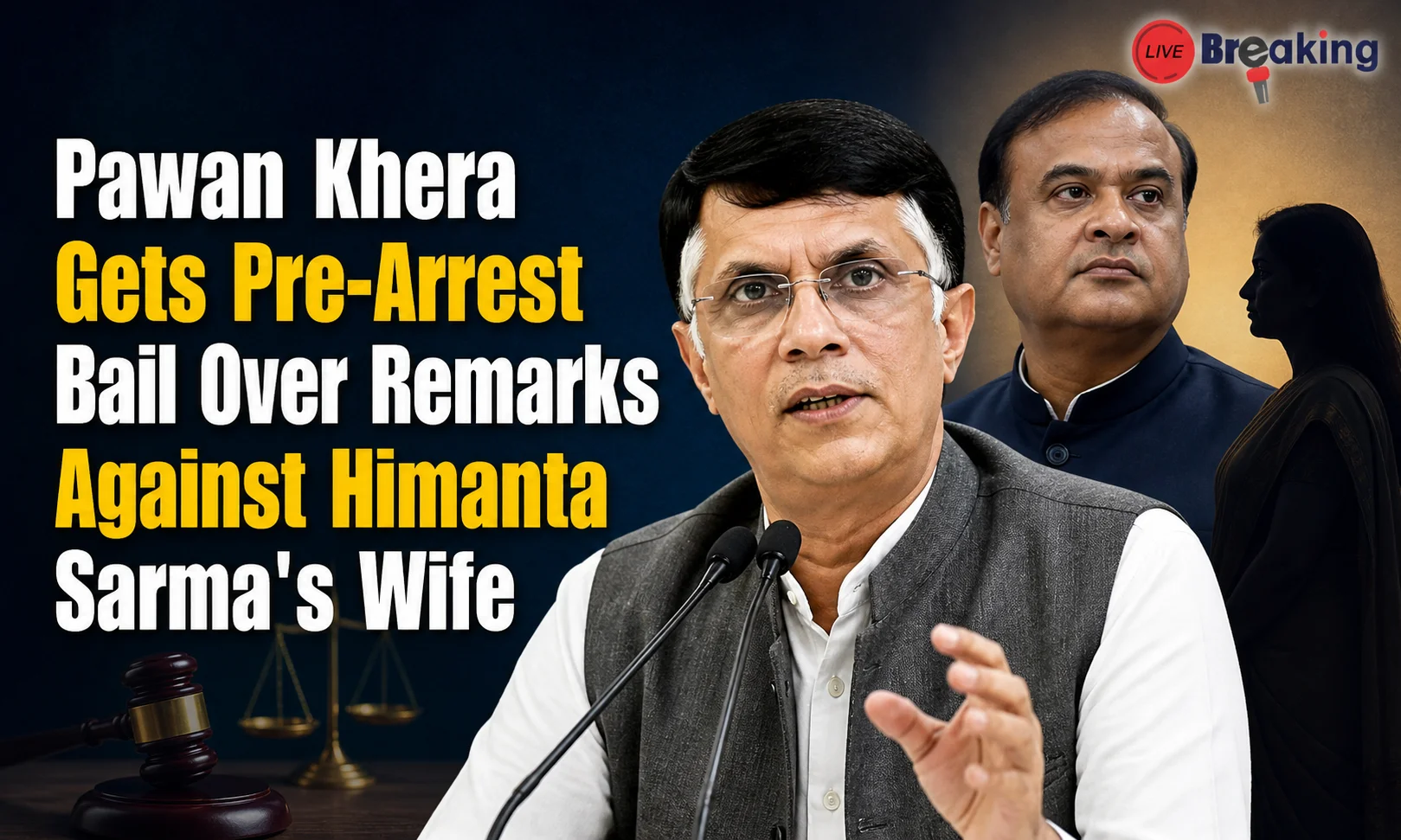
Pawan Khera Gets Pre-Arrest Bail Over Remarks Against Himanta Sarma’s Wife
In a significant development that has stirred both legal and political circles, the Supreme Court has granted anticipatory (pre-arrest) bail to Congress leader Pawan Khera. The relief comes in connection with a defamation and forgery case filed over remarks he made about Riniki Bhuyan Sarma, the wife of Assam Chief Minister Himanta Biswa Sarma.
The court’s decision offers temporary protection from arrest, while the investigation into the allegations continues. This case has become a flashpoint in the ongoing political tensions between the Congress party and the Bharatiya Janata Party (BJP).
What Led to the Case Against Pawan Khera?
The controversy began when Khera made public allegations regarding Riniki Bhuyan Sarma’s alleged financial and citizenship-related activities. These included claims about holding multiple foreign passports and possessing overseas assets.
These allegations were strongly denied by both Sarma and his wife, who termed them “malicious” and “fabricated.” Soon after, a complaint was filed, leading to an FIR by Assam Police on charges including defamation and forgery.
The issue quickly escalated into a major political controversy, especially given its timing around election narratives and heightened political rivalry.
Legal Journey: From High Court Setback to Supreme Court Relief
Before approaching the Supreme Court, Khera had sought anticipatory bail from the Gauhati High Court. However, his plea was rejected, increasing the likelihood of arrest.
Following this setback, Khera moved the Supreme Court, arguing that the case was politically motivated and that arrest was unnecessary. The apex court eventually granted him anticipatory bail, observing that personal liberty should not be compromised lightly.
The court also imposed certain conditions:
- Khera must cooperate with the investigation
- He must appear before authorities when required
- He cannot leave the country without permission
- He must not tamper with evidence or influence witnesses
Supreme Court’s Observations
During the proceedings, the Supreme Court made notable observations regarding the nature of the allegations and the need for custodial interrogation.
According to reports, the court indicated that the case did not necessarily require arrest and hinted that the allegations could be politically motivated.
This observation has added another dimension to the case, fueling debate about the misuse of legal mechanisms in political battles.
Read More: “Change Your Law”: Supreme Court To Centre Over Teen Pregnancy Termination
Political Reactions and Fallout
The ruling has triggered strong reactions across political lines:
- Congress Party: Welcomed the decision, calling it a victory for truth and justice. Party leaders reiterated that the case was politically driven.
- BJP Leaders: Maintained that the allegations made by Khera were serious and warranted investigation.
- Public Discourse: The case has intensified discussions on political accountability, free speech, and defamation laws in India.
The episode reflects how legal disputes can quickly turn into major political narratives, especially when high-profile leaders are involved.
Timeline of Key Events
| Date | Event |
|---|---|
| Early April 2026 | Allegations made by Pawan Khera |
| Mid-April 2026 | FIR filed by Assam Police |
| Late April 2026 | Gauhati High Court rejects bail plea |
| May 1, 2026 | Supreme Court grants anticipatory bail |
Read More: Chilling Mumbai Stabbing Video: Guard Pleads for Mercy Before Brutal Attack in Mira Road
Legal and Political Implications
This case is significant beyond the individuals involved. It raises broader questions such as:
- Freedom of Speech vs Defamation: Where should the line be drawn in political discourse?
- Use of Criminal Law in Politics: Are legal tools being used as political weapons?
- Judicial Safeguards: The role of courts in protecting individual liberty while ensuring accountability
The Supreme Court’s intervention underscores the judiciary’s role as a balancing force in politically sensitive cases.
What Happens Next?
While anticipatory bail provides immediate relief, it does not end the case. The investigation will continue, and Khera may still face trial depending on the findings.
The trial court retains the authority to impose additional conditions, and further legal proceedings are expected in the coming months.
Conclusion
The anticipatory bail granted to Pawan Khera marks a crucial moment in a politically charged legal battle. While the court has safeguarded his liberty for now, the case remains far from over.
Read More: Bengal Elections 2026: Polling Stopped At Few Bengal Booths After BJP Claims EVM Tampering
As investigations proceed, the outcome will likely have lasting implications on political discourse, legal accountability, and the interplay between law and politics in India.
FAQ
Q1: What is anticipatory bail?
Anticipatory bail is a legal provision that allows a person to seek bail in anticipation of arrest in a non-bailable offense.
Q2: Why was Pawan Khera granted bail?
The Supreme Court granted bail citing the importance of personal liberty and the lack of necessity for custodial interrogation.
Read More: Trump Photo With A Rifle And His ‘No More Nice Guy’ Warning For Iran
Q3: What are the charges against him?
He faces allegations of defamation and forgery linked to remarks about the Assam CM’s wife.
Q4: Can he still be arrested?
Not immediately. Anticipatory bail protects him from arrest as long as he complies with court conditions.
Q5: Is the case politically motivated?
Khera claims it is politically motivated, and the court also noted this possibility, though the investigation is ongoing.