Sonia Gandhi Targets BJP Over Democracy, Election Fairness and Vote Chori
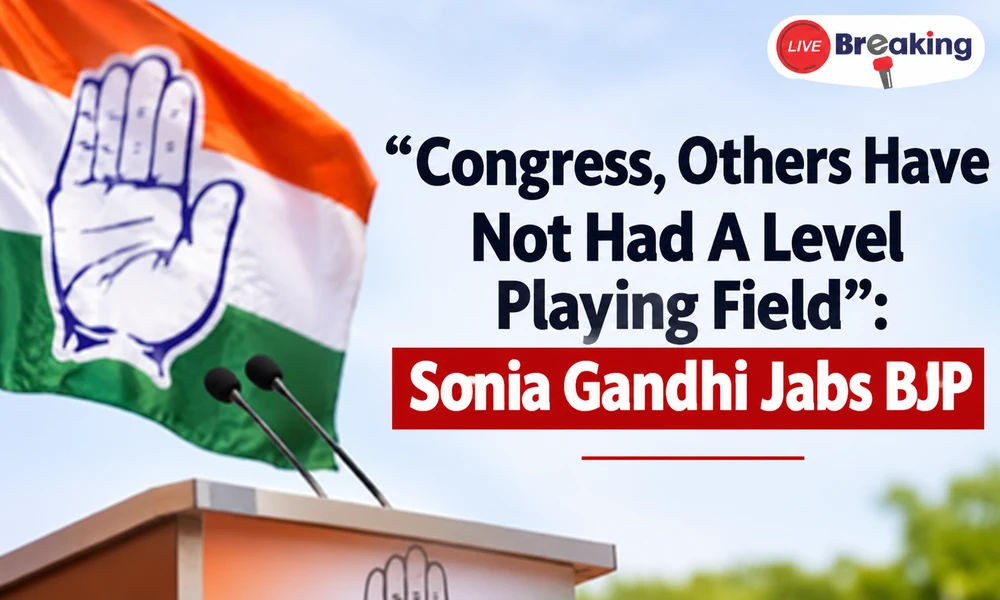
Senior Congress leader Sonia Gandhi has launched a fresh political attack on the Bharatiya Janata Party (BJP), alleging that opposition parties have not received a fair political environment since the BJP came to power at the Centre. She has also raised serious concerns about the functioning of democratic institutions, the Election Commission, media influence and the growing role of money power in Indian politics.
In a recent interview, Sonia Gandhi expressed confidence in the Congress party’s political future and said that the opposition was gradually making progress despite what she described as an uneven political playing field.
Her remarks have brought the debate over electoral transparency, democratic accountability and opposition unity back into the political spotlight, particularly as parties begin looking towards the 2029 Lok Sabha elections.
The Congress leader also alleged that several elections had been compromised, using the politically charged phrase “vote chori” to describe what her party considers electoral irregularities. However, these allegations remain contested and should be distinguished from independently established findings.
Sonia Gandhi Alleges Opposition Parties Face an Unequal Political Environment
Speaking about the political situation in India, Sonia Gandhi claimed that the Congress and other opposition parties have faced significant disadvantages during the BJP’s tenure in power.
She pointed towards what she described as the government’s influence over important institutions, particularly the Election Commission, along with mainstream media and financial resources.
According to Gandhi, political competition should be based on policies, public support and the performance of political parties. However, she argued that the current environment makes it difficult for opposition parties to compete on equal terms.
She also accused the ruling establishment of using religious issues and financial influence as political advantages.
Her comments reflect the Congress party’s broader criticism of the functioning of democratic institutions. The opposition has repeatedly called for greater transparency in electoral processes and stronger institutional independence.
The BJP, however, has consistently defended its political record and rejected allegations questioning the legitimacy of India’s democratic institutions.
‘Many Elections Have Been Stolen’: Sonia Gandhi Raises Vote Chori Issue
One of the strongest parts of Sonia Gandhi’s latest remarks concerned allegations of electoral manipulation.
She claimed that developments in recent months had made people increasingly aware of alleged irregularities in elections. The Congress has been using the term ‘vote chori’ as part of its political campaign against the BJP and has raised questions about electoral procedures.
The issue has gained attention amid opposition protests concerning the Special Intensive Revision (SIR) of electoral rolls.
The Congress and several opposition leaders have expressed concerns about the process, particularly regarding voter inclusion, deletion of names and the transparency of electoral roll revisions.
The party has also demanded greater accountability from the Election Commission and questioned certain decisions related to the management of elections.
It is important to note that political allegations of stolen elections do not, by themselves, establish that an election was unlawfully manipulated. Such claims require examination through documentary evidence, official responses and appropriate legal or institutional processes.
Nevertheless, the controversy has become an important political issue, with opposition parties arguing that public confidence in elections depends on transparency and accountability.
Special Intensive Revision of Electoral Rolls Becomes a Major Political Issue
The Special Intensive Revision of electoral rolls has emerged as one of the key points of disagreement between the Congress and the Election Commission.
Electoral roll revision is an important administrative exercise intended to maintain accurate voter lists. It can involve identifying eligible voters, correcting details, removing duplicate entries and updating records when individuals move or become ineligible.
However, opposition parties have questioned the manner in which certain revision exercises are being conducted.
The Congress has expressed concern that eligible voters could face difficulties if their names are removed or if verification procedures are not sufficiently transparent.
The party has also demanded stronger safeguards to ensure that every eligible citizen retains the right to vote.
The Election Commission’s role is particularly important in this debate because public confidence in elections depends significantly on the perceived independence and impartiality of the institution.
For the opposition, the central issue is whether electoral procedures are being implemented fairly. For election authorities, the challenge is to maintain accurate electoral rolls while ensuring that no eligible voter is unfairly excluded.
Sonia Gandhi Says Congress Is Becoming Stronger Despite Political Challenges
Despite criticising the BJP, Sonia Gandhi expressed optimism about the Congress party’s future.
She acknowledged that the party had experienced significant electoral setbacks over the past decade. The Congress lost the 2014 and 2019 Lok Sabha elections and remained behind the BJP in the 2024 general election.
However, Gandhi argued that the party had demonstrated considerable resilience.
She praised Congress workers and leaders for continuing their political activities at the grassroots level, including in villages and districts across the country.
According to her, the party remains committed to constitutional values and democratic principles despite the political challenges it faces.
Gandhi also indicated that the Congress was working with like-minded political parties to strengthen opposition cooperation.
Her remarks suggest that the party sees political coordination and grassroots mobilisation as important elements of its strategy ahead of the next general election.
Opposition unity could become particularly important in constituencies where multiple parties compete against the BJP and risk dividing the anti-incumbency vote.
However, building a united political front is not always straightforward. Regional parties have different political priorities, leadership structures and electoral interests. Reaching agreements over seat-sharing and common campaign strategies could therefore remain a major challenge.
BJP Leaders Hit Back, Recall the 1975 Emergency
Sonia Gandhi’s comments about democratic institutions and political freedom received a sharp response from BJP leaders.
Union Law Minister Arjun Ram Meghwal questioned the Congress leader’s criticism and referred to the Emergency imposed by former Prime Minister Indira Gandhi in 1975.
Meghwal argued that the period represented a major setback for Indian democracy, when opposition leaders were detained and press freedom faced restrictions.
He also defended the Narendra Modi government’s record, maintaining that democracy had been strengthened during the BJP’s years in power.
Union Minister Giriraj Singh also criticised the Congress, recalling the Emergency and questioning the party’s political record.
The BJP’s response has brought historical political controversies back into the current debate.
The Emergency remains one of the most significant and controversial periods in India’s political history. It lasted from June 1975 to March 1977 and involved the suspension of several civil liberties, restrictions on the press and the detention of political opponents.
Sonia Gandhi also addressed the Emergency in her interview, discussing the circumstances surrounding the decision and acknowledging that excesses had taken place. She referred to Indira Gandhi’s subsequent public expression of regret and apology.
The exchange demonstrates how both parties continue to use historical events and political records to challenge each other’s claims about democracy and governance.
Sonia Gandhi’s Remarks Put the 2029 Lok Sabha Elections in Focus
With the next Lok Sabha elections expected in 2029, Sonia Gandhi’s remarks have added another dimension to the political conversation.
Read More: “Might Be Crocodiles Here, But”: BJP MP Manoj Tiwari Takes Yamuna Dip, Declares It Clean
The Congress leader expressed optimism that voters could eventually favour a return to what she described as proper governance.
She suggested that people were becoming increasingly aware of the challenges facing democratic institutions and that the political atmosphere could change in the coming years.
For the Congress, the immediate challenge is to convert public dissatisfaction and opposition coordination into electoral gains.
The party will need to strengthen its organisation, improve communication with voters, develop clear policy positions and build effective alliances with regional parties.
The BJP, meanwhile, will seek to defend its political record and maintain its electoral support through governance initiatives, organisational strength and its national political narrative.
The 2029 election is still some distance away, and several political developments could influence the outcome. Economic conditions, employment, inflation, welfare policies, regional issues and leadership will all play important roles.
Consequently, the current debate over electoral fairness is likely to remain one part of a much broader political contest.
Why the Debate Over Democratic Institutions Matters
The controversy surrounding Sonia Gandhi’s comments goes beyond the political rivalry between the Congress and BJP.
India is the world’s largest electoral democracy, and public confidence in elections is essential for the legitimacy of its political system.
Independent institutions, transparent electoral procedures, a free media environment and equal political opportunities are important elements of a functioning democracy.
Read More: Bombay HC on Imran Khan: ‘You Are Not an Indian Citizen’ Over SIR Protest
Political parties are entitled to question government decisions and raise concerns about electoral procedures. At the same time, allegations must be supported by credible evidence and examined through appropriate institutional mechanisms.
The Election Commission also has an important responsibility to communicate its decisions clearly and ensure that electoral procedures are applied consistently.
Similarly, political parties across the spectrum must demonstrate their commitment to democratic principles through their actions, internal functioning and respect for constitutional institutions.
Ultimately, voters are likely to judge political parties not only by their allegations against opponents but also by their policies, performance and ability to address public concerns.
Conclusion
Sonia Gandhi’s latest remarks have once again intensified the political confrontation between the Congress and BJP. Her allegations concerning the lack of a level playing field, electoral transparency and institutional independence have placed democratic accountability at the centre of the political discussion.
The BJP has rejected her criticism and responded by highlighting the Congress’s historical record, particularly the Emergency of 1975.
As India moves towards the 2029 Lok Sabha elections, questions surrounding electoral transparency, opposition unity, institutional independence and governance are likely to remain important political issues.
Read More: On Camera, 2 Helicopters Collide In Nepal While Landing, 1 Killed
Whether the Congress can translate its criticism into meaningful electoral gains will depend on its organisational strength, public outreach and ability to work with other opposition parties.
For now, Sonia Gandhi’s comments have added fresh momentum to the ongoing political debate over the state of Indian democracy.
Important facts at a glance
| Topic | Key information |
|---|---|
| Congress leader | Sonia Gandhi |
| Political target | Bharatiya Janata Party (BJP) |
| Main allegation | Opposition parties lack a level playing field |
| Major concern | Electoral transparency and institutional independence |
| Electoral controversy | Special Intensive Revision (SIR) |
| BJP response | Leaders recalled the 1975 Emergency |
| Union minister responding | Arjun Ram Meghwal |
| Other BJP leader responding | Giriraj Singh |
| Next Lok Sabha elections | 2029 |
| Main political theme | Democracy, vote chori allegations and opposition unity |
Frequently Asked Questions (FAQs)
1. What did Sonia Gandhi say about the BJP?
Sonia Gandhi alleged that the Congress and other opposition parties have not had a level playing field since the BJP came to power. She raised concerns about institutional independence, media influence, political funding and electoral transparency.
2. Why has Sonia Gandhi raised the issue of vote chori?
She referred to alleged electoral irregularities and claimed that recent developments have increased public awareness of the issue. The Congress has demanded greater transparency in electoral processes.
3. What is the Special Intensive Revision (SIR) of electoral rolls?
SIR is an exercise undertaken to review and update electoral rolls. It aims to maintain accurate voter lists by verifying voter information and updating eligible entries. Opposition parties have raised concerns about transparency and possible voter exclusion.
4. How did the BJP respond to Sonia Gandhi’s remarks?
BJP leaders, including Arjun Ram Meghwal and Giriraj Singh, criticised her comments and recalled the Emergency imposed by the Congress government in 1975.
5. What did Sonia Gandhi say about the Congress party’s future?
She expressed optimism about the party’s prospects, praised its grassroots workers and said that the Congress was working with like-minded opposition parties.
6. When will the next Lok Sabha elections take place?
The next regular Lok Sabha general election is expected in 2029, subject to the constitutional and electoral schedule.
7. Why is the level playing field debate important?
A level playing field is important because democratic elections should provide political parties with fair opportunities to communicate with voters, campaign and compete without improper institutional or financial advantages.