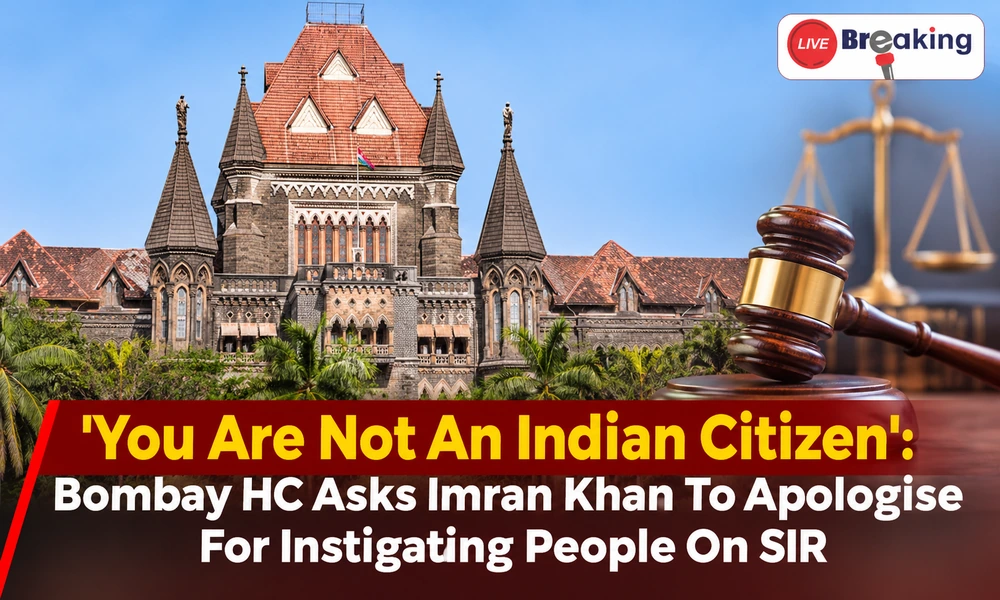
‘You Are Not An Indian Citizen’: Bombay HC Asks Imran Khan To Apologise For Instigating People On SIR
The controversy surrounding actor Imran Khan and his alleged involvement in protests related to the Special Intensive Revision (SIR) of electoral rolls has attracted significant attention. The Bombay High Court’s reported remarks, including the statement, “You are not an Indian citizen”, have brought the actor’s citizenship status and participation in a politically sensitive public demonstration under the spotlight.
The matter raises important questions about the rights and responsibilities of foreign nationals and Overseas Citizens of India (OCI) cardholders participating in public demonstrations in India. It also highlights the legal boundaries between freedom of expression, political participation and the regulations governing foreign nationals.
The development comes against the backdrop of protests over the Election Commission’s SIR exercise, which has become a politically contentious issue. While supporters argue that electoral roll revision is necessary to maintain accurate voter records, critics have raised concerns about possible exclusion of eligible voters and the transparency of the process.
Why Is Imran Khan’s Citizenship Becoming a Major Issue?
Imran Khan, the Bollywood actor and nephew of actor Aamir Khan, became part of the controversy following a protest held at Mumbai’s historic August Kranti Maidan on October 10, 2026.
The demonstration was linked to the wider agitation against Chief Election Commissioner Gyanesh Kumar. Protesters were demanding accountability over the functioning of the Election Commission and concerns surrounding the SIR exercise.
According to reports, Imran Khan was briefly detained by Mumbai Police during the incident. His participation attracted political attention after BJP leader Kirit Somaiya filed a complaint questioning why a person who was not an Indian citizen had participated in the demonstration.
The complaint brought the actor’s citizenship status and the rules applicable to foreign nationals into the discussion.
Police subsequently initiated action, and the Foreigners Regional Registration Office (FRRO) issued a notice directing Khan to leave India by October 28, 2026.
However, Khan challenged the notice before the Bombay High Court, arguing that the action against him was arbitrary and legally unjustified. He also disputed the allegations concerning his involvement with the protest organisers.
The Tribune+2
Bombay High Court’s Intervention in the Imran Khan Case
The Bombay High Court became involved after Imran Khan approached it against the FRRO’s October 14 departure notice.
During proceedings on October 27, the Central government’s counsel sought additional time. Senior advocate Venkatesh Dhond, representing Khan, highlighted that the notice required his client to leave India by October 28.
The government’s Additional Solicitor General, Anil Singh, assured the court that no coercive action would be taken against the actor until the next hearing.
Read More: India Selling More To US Despite Tariffs, But China Trade Gap Keeps Risingjj
The division bench comprising Chief Justice Mahesh Chandra Tripathi and Justice Advait Sethna consequently directed that the impugned notice remain in abeyance until November 2, 2026.
This provided temporary relief to Khan and allowed him to remain in India while his legal challenge was pending.
The court’s intervention did not amount to a final decision on the legality of the FRRO notice or the allegations against the actor. Those issues remained subject to further judicial consideration.
What Is the SIR Controversy and Why Has It Become Politically Sensitive?
The Special Intensive Revision, commonly known as SIR, is an exercise undertaken by the Election Commission of India to review and update electoral rolls.
The objective of electoral roll revision is to ensure that voter lists remain accurate and include eligible voters while addressing duplicate, outdated or otherwise ineligible entries.
However, the exercise has generated political debate in several parts of the country.
Opposition parties and critics have raised concerns about the verification process, documentation requirements and the possibility that eligible voters could be excluded from electoral rolls. Supporters of the exercise argue that accurate voter lists are essential for transparent and credible elections.
Read more: 1 Million People, 20,000 Vehicles And Gridlock: Traders’ Note To Rahul Gandhi
The issue has therefore moved beyond an administrative exercise and become part of a wider political debate about electoral transparency and democratic participation.
The protest in Mumbai was connected to this broader controversy, with demonstrators expressing dissatisfaction with the Election Commission’s functioning and demanding the resignation of Chief Election Commissioner Gyanesh Kumar.
What Does the Law Say About OCI Cardholders and Political Participation?
One of the central questions in the Imran Khan controversy concerns the legal position of Overseas Citizens of India cardholders.
An OCI card provides certain immigration and residency-related privileges to eligible foreign citizens of Indian origin. However, it does not confer Indian citizenship.
OCI cardholders are not entitled to several political rights available to Indian citizens, including voting in Indian elections or contesting parliamentary and legislative elections.
The distinction between Indian citizenship and OCI status is important because the legal rights of an Indian citizen and a foreign national are not identical.
The government also has powers under immigration legislation to regulate the entry, presence and departure of foreign nationals in India.
Read More: Shashi Tharoor Asked About Rahul Gandhi’s Foreign Trip. His “Travel Agent” Reply
In Khan’s case, authorities invoked provisions of the Immigration and Foreigners Act, 2025, while issuing the departure notice. His petition challenged the action and raised questions about procedural fairness and the legal basis of the decision.
Imran Khan Challenges the FRRO Notice in Court
Following the issuance of the departure notice, Imran Khan approached the Bombay High Court seeking relief against the government action.
His petition described the notice as illegal, arbitrary, disproportionate and unjustified. He argued that the authorities had acted without giving him an adequate opportunity to present his position.
Khan also maintained that he had no association, affiliation or connection with the organisations responsible for organising the protest.
His legal challenge reportedly sought the cancellation of the departure notice and protection against coercive action while the case remained pending.
Another important aspect of the matter was the separate show-cause notice issued by the FRRO concerning the possible cancellation of his OCI status.
The actor’s legal challenge has therefore raised two significant issues: the legality of the direction asking him to leave India and the procedure governing the continuation or cancellation of his OCI status.
What Happens Next in the Imran Khan Case?
The next important development is the Bombay High Court hearing scheduled for November 2, 2026.
The court is expected to consider the pending legal challenge concerning the FRRO’s decision and hear the submissions of the parties.
Read More: Mention Of Riots Outside India In CJP Leaders’ Plea Hearing In Delhi High Court
The outcome could have implications for the actor’s continued stay in India and the legal questions surrounding the exercise of immigration powers.
It is important to distinguish between temporary judicial protection and a final judgment. Keeping the departure notice in abeyance does not automatically invalidate the government’s decision or establish that the actor has committed no violation.
Similarly, the allegations made against Khan should not be treated as established facts unless they are supported by findings or evidence accepted by the appropriate authority.
The case has attracted attention because it involves a public personality, a politically sensitive protest and questions about the rights of foreign nationals residing in India.
Ultimately, the court’s consideration of the matter will be important in determining how the relevant immigration provisions apply to the circumstances.
Key Details of the Imran Khan-SIR Controversy
| Particular | Details |
|---|---|
| Actor involved | Imran Khan |
| Court | Bombay High Court |
| Protest date | October 10, 2026 |
| Protest location | August Kranti Maidan, Mumbai |
| Main issue | Protest linked to SIR and CEC Gyanesh Kumar |
| Political complainant | BJP leader Kirit Somaiya |
| Government authority | Foreigners Regional Registration Office |
| Notice date | October 14, 2026 |
| Original departure deadline | October 28, 2026 |
| Legal development | Departure notice kept in abeyance |
| Next hearing reported | November 2, 2026 |
| Main legal question | Legality of the departure notice and OCI-related proceedings |
Conclusion: Imran Khan Controversy Puts Citizenship and SIR Debate in Focus
The controversy involving Imran Khan has become an important talking point in the ongoing debate surrounding the SIR exercise, political demonstrations and the legal rights of foreign nationals in India.
The Bombay High Court proceedings have brought attention to the distinction between Indian citizenship and OCI status, while also raising questions about the manner in which immigration authorities exercise their powers.
For now, the actor has received temporary protection against coercive action under the departure notice while his legal challenge remains pending.
The November 2 hearing is an important development to watch. The eventual outcome could clarify the legal issues surrounding the FRRO’s action and the actor’s position under the applicable immigration laws.
Frequently Asked Questions (FAQs)
1. Why did the Bombay High Court question Imran Khan over the SIR protest?
The controversy arose after Imran Khan was allegedly involved in a demonstration at Mumbai’s August Kranti Maidan on October 10, 2026. The protest was connected to demands concerning Chief Election Commissioner Gyanesh Kumar and the SIR exercise. His citizenship status became a major issue following a complaint by BJP leader Kirit Somaiya.
2. Is Imran Khan an Indian citizen?
Reports concerning the case identify Imran Khan as a US citizen holding an Overseas Citizen of India (OCI) card. OCI status does not mean that an individual holds Indian citizenship.
3. Why was Imran Khan issued a Leave India Notice?
The FRRO issued a notice on October 14, 2026, directing the actor to leave India by October 28. The action followed allegations concerning his participation in a protest against Chief Election Commissioner Gyanesh Kumar.
4. Did Imran Khan challenge the FRRO notice?
Yes. Imran Khan approached the Bombay High Court, challenging the departure notice as arbitrary and legally unjustified. He sought protection against coercive action and challenged the government’s decision.
Read More: “Might Be Crocodiles Here, But”: BJP MP Manoj Tiwari Takes Yamuna Dip, Declares It Clean
5. Did the Bombay High Court stop Imran Khan’s deportation?
The Bombay High Court kept the FRRO’s Leave India Notice in abeyance until November 2, 2026, after the Centre assured the court that no coercive action would be taken until the next hearing. This was temporary relief, not a final judgment.
6. What is the full form of SIR?
SIR stands for Special Intensive Revision. It is an Election Commission exercise aimed at reviewing and updating electoral rolls to maintain accurate voter lists.
7. Can OCI cardholders participate in Indian elections?
OCI cardholders do not have voting rights in Indian elections and cannot contest parliamentary or legislative elections. OCI status does not provide the political rights associated with Indian citizenship.
8. When is the next hearing in the Imran Khan case?
The Bombay High Court proceedings were scheduled for November 2, 2026. The hearing is significant because it concerns the actor’s challenge to the FRRO’s departure notice.