

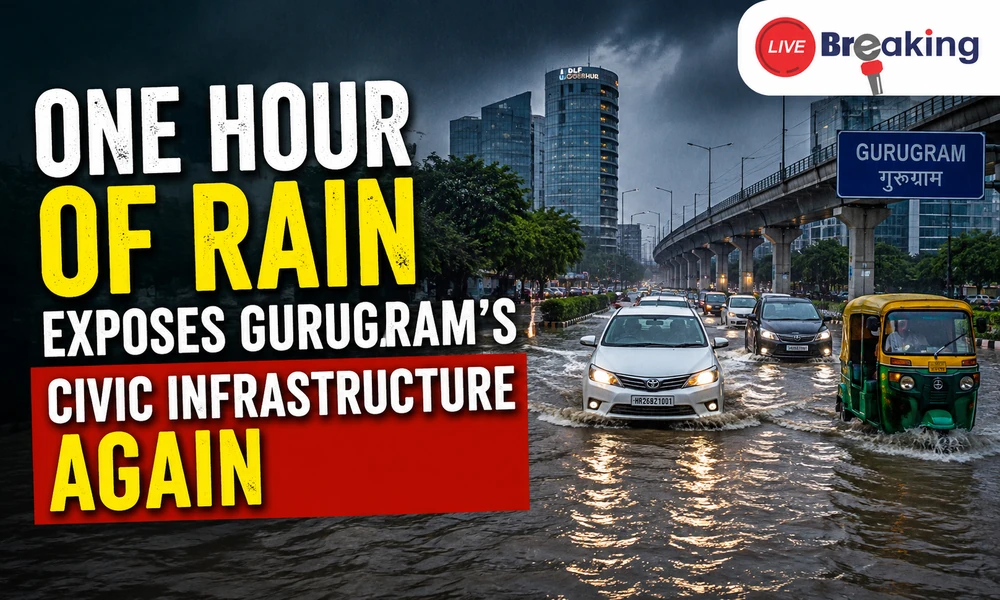
Gurugram Rain: One Hour of Rain Exposes Civic Infrastructure Again
Gurugram, one of India’s most prominent corporate and residential hubs, once again found itself struggling with a familiar monsoon problem: waterlogging. After around an hour of rain on Monday, August 24, several parts of the Millennium City were flooded, leaving commuters, students, pedestrians and motorists battling waterlogged roads and traffic congestion.
According to NDTV, Gurugram received around 70 mm of rainfall by 1:30 pm. Patel Nagar was among the worst-hit areas, while waterlogging was also reported across several major roads and intersections. The latest episode has renewed concerns over whether the city’s rapidly expanding infrastructure is capable of handling intense rainfall.
The incident is particularly striking because the disruption followed a relatively short spell of rain. For residents who have experienced similar conditions during previous monsoons, the latest flooding has become another reminder of the city’s recurring drainage and road-infrastructure problems.
Gurugram Rain Leaves Roads Underwater
The scenes reported from Gurugram were striking. An elderly man was seen struggling through knee-deep water with his scooter, while other commuters attempted to navigate roads where the actual condition of the surface was difficult to determine.
Students returning from school were also forced to negotiate flooded stretches, with some moving towards raised areas such as bus stops to avoid deeper water. Two-wheelers were particularly vulnerable because riders had limited options once engines stalled or roads became too uneven and submerged.
Waterlogging is not merely an inconvenience. When roads disappear beneath accumulated rainwater, commuters cannot easily identify potholes, broken surfaces, open drains or other hazards. This can increase the risk of accidents, vehicle damage and injuries.
Patel Nagar Among the Worst-Affected Areas
Patel Nagar reportedly experienced severe flooding following the rain. Several other parts of Gurugram also witnessed water accumulation, demonstrating that the problem was not limited to one isolated neighbourhood.
Areas identified as being significantly affected included Rajiv Chowk, IFFCO Chowk, Railway Road, Sector 5, Old Delhi Road, Mehrauli Road and Basai Road.
The spread of waterlogging across different parts of the city points towards a wider urban drainage challenge rather than a problem confined to one particular road.
Delhi-Jaipur Expressway Traffic Slows Down
The impact was also felt on one of Gurugram’s most important transportation corridors, the Delhi-Jaipur Expressway.
Flooded stretches caused traffic to slow considerably, with commuters reporting substantial delays. The journey between Signature Tower and Hero Honda Chowk, normally taking around 15 minutes, reportedly took at least 50 minutes during the disruption.
A section near Cyber Hub, opposite Gateway Tower Metro station, was also submerged. Such disruptions can have consequences far beyond individual commuters because Gurugram’s roads connect major residential districts, corporate offices, industrial areas and Delhi-NCR transport routes.
When one major corridor slows down, traffic frequently spills over into service roads and alternative routes, creating a domino effect across the wider city.
Even Gurugram’s Premium Areas Are Not Immune
One of the more striking aspects of the latest waterlogging was that even high-value residential areas were affected.
Outside The Magnolias, where some apartments reportedly command prices of more than ₹50 crore, roads were described as resembling rivers. The contrast highlights a broader urban reality: premium real estate and modern commercial development do not automatically guarantee resilient public infrastructure.
Gurugram has expanded dramatically over the past two decades. High-rise residential complexes, corporate campuses, shopping centres and expressways have transformed its skyline. However, the drainage network and supporting civic infrastructure have struggled to keep pace with that growth.
This creates a fundamental question for urban planners: Can a city continue expanding vertically and horizontally without proportionately upgrading the systems responsible for managing rainwater?
Why Does Waterlogging Keep Returning?
Gurugram’s waterlogging problem is not new. Similar episodes have occurred repeatedly during previous monsoons.
An NDTV report published in July noted that more than 50 areas of the city experienced waterlogging after heavy rain, with some roads seeing water levels of around one-and-a-half to two feet. Several homes and shops were also affected.
Another report from July highlighted how heavy rainfall contributed to massive traffic jams and even road cave-ins, including disruption along NH-48.
Read More: Trump ‘Superstar’ Karoline Leavitt Out, But Not Gone: Why The US President Still Wants Her Close
These repeated incidents suggest that the issue cannot simply be attributed to unusually heavy rainfall. Rainfall intensity is certainly important, but the ability of an urban area to absorb, channel and discharge stormwater is equally critical.
Drainage Capacity Is Central to the Problem
A functioning stormwater system should quickly move excess water away from roads and populated areas. When drains are blocked, undersized, poorly maintained or unable to handle peak rainfall, water begins accumulating on streets.
Gurugram’s rapid development has also increased the amount of built-up and paved surface. Concrete and asphalt prevent rainwater from naturally soaking into the ground, meaning more water can reach drainage systems in a shorter period.
If those systems lack sufficient capacity, flooding becomes increasingly likely.
The Human Cost of Waterlogged Roads
The consequences extend well beyond traffic delays.
For pedestrians, flooded roads can hide potholes, drains and damaged surfaces. For motorists, water can cause vehicles to stall and may damage engines and electrical systems. For two-wheeler riders, deep or fast-moving water can create an immediate safety risk.
Schoolchildren and elderly residents are particularly vulnerable because navigating submerged roads requires greater physical effort and caution.
Read More: 2 More Air India Pilots Fail To Clear 1st Drug Test After Phuket Flight Fiasco
There is also a potential public-health concern when rainwater mixes with sewage or waste from poorly maintained drainage channels. The resulting contaminated water can make streets more hazardous even after rainfall stops.
Gurugram Has Seen This Pattern Before
The latest episode is part of a larger pattern that has repeatedly triggered public criticism.
In July 2026, Gurugram experienced another major waterlogging episode in which traffic slowed dramatically and water entered residential and commercial areas.
Earlier in July, heavy rain was also linked to severe traffic disruption and road damage. NDTV reported that Gurugram received around 82 mm of rainfall during one such spell, while a road cave-in on NH-48 added to the chaos.
The recurrence raises an important question: Why do known flood-prone locations continue to struggle during successive rainfall events?
Identifying hotspots is only the first step. Permanent drainage improvements, regular desilting, maintenance of stormwater channels, road repairs and effective monitoring are necessary to prevent the same locations from becoming crisis points every monsoon.
What Needs to Change?
Gurugram’s recurring waterlogging problem requires a long-term infrastructure strategy rather than emergency pumping after roads have already flooded.
Read More: From Smriti Irani To Pasmanda Outreach: BJP UP 2027 Strategy In Nitin Nabin’s New Team
Authorities need to focus on several areas:
| Challenge | Required Action |
|---|---|
| Waterlogging | Upgrade stormwater drainage capacity |
| Blocked drains | Regular desilting and maintenance |
| Flood-prone roads | Permanent engineering solutions |
| Potholes and damaged roads | Pre-monsoon inspections and repairs |
| Traffic disruption | Real-time monitoring and traffic diversion |
| Rapid urbanisation | Integrate drainage planning with new development |
| Public safety | Clearly mark submerged and hazardous stretches |
| Emergency response | Deploy pumps and response teams before peak flooding |
Previous analysis has also highlighted the scale of Gurugram’s drainage challenge. An NDTV report noted that hundreds of crores had been spent on drainage infrastructure over the years, while questions continued over the effectiveness of the city’s flood-management measures.
That makes accountability and performance monitoring particularly important. The issue is not simply how much money is spent, but whether the resulting infrastructure actually performs when residents need it most.
From Millennium City to Monsoon Challenge
Gurugram is marketed as a modern business and technology destination, home to major corporations, premium housing projects and large commercial districts.
But the city’s image as a modern urban centre is repeatedly challenged whenever relatively short spells of rain transform important roads into waterlogged stretches.
The problem is therefore bigger than one day’s traffic jam.
It is about urban resilience.
Read More: Telangana Boy Stabbed Principal 27 Times. How His Lavish Lifestyle Busted Him
A city that experiences predictable monsoon rainfall should be able to plan for it. Extreme weather can certainly test infrastructure beyond its design limits, but recurring flooding in known hotspots suggests that maintenance, capacity and long-term planning deserve closer attention.
FAQs
1. Why was Gurugram waterlogged after the rain?
Gurugram experienced widespread waterlogging after around one hour of rain on August 24, 2026. The city’s drainage capacity and recurring flood-prone locations have been major concerns during previous monsoon spells as well. NDTV reported approximately 70 mm of rainfall by 1:30 pm.
2. Which areas of Gurugram were affected by waterlogging?
Patel Nagar was among the worst-affected areas. Waterlogging was also reported around Rajiv Chowk, IFFCO Chowk, Railway Road, Sector 5, Old Delhi Road, Mehrauli Road and Basai Road.
3. Did the rain affect traffic in Gurugram?
Yes. Waterlogging significantly slowed traffic, including on the Delhi-Jaipur Expressway. The Signature Tower-Hero Honda Chowk route reportedly took much longer than usual during the disruption.
4. Why does Gurugram face repeated waterlogging?
Repeated waterlogging can result from inadequate drainage capacity, blocked or poorly maintained drains, extensive paved surfaces and rapid urban development. Gurugram has experienced similar flooding and traffic disruption during several previous monsoon spells.
5. Is waterlogging in Gurugram a new problem?
No. Waterlogging has been a recurring monsoon problem in Gurugram for years. Previous incidents have affected dozens of locations and caused traffic jams, vehicle breakdowns and disruption to homes and businesses.
Read More: “Extreme Appeasement”: Amit Shah Blasts Congress Over Full Vande Mataram Snub
6. What can authorities do to reduce waterlogging?
Authorities can improve stormwater drainage capacity, regularly desilt drains, repair damaged roads, identify and permanently address flood hotspots, and strengthen real-time monsoon response systems.
Conclusion
Monday’s rain may have lasted only around an hour, but its impact once again exposed the vulnerability of Gurugram’s civic infrastructure.
For residents, waterlogging is no longer an unexpected monsoon event. It has become a recurring disruption that affects daily commutes, school journeys, businesses and public safety.
The challenge for Gurugram is now to move beyond temporary responses and address the underlying infrastructure weaknesses. A city known for its modern skyline needs an equally modern and resilient drainage network.
Until that happens, every major spell of rain risks producing the same familiar images: submerged roads, stalled vehicles, stranded commuters and another round of questions about Gurugram’s civic preparedness.
Like this post?