BJP UP 2027 Strategy: Smriti Irani, Pasmanda Outreach & Nitin Nabin’s New Team
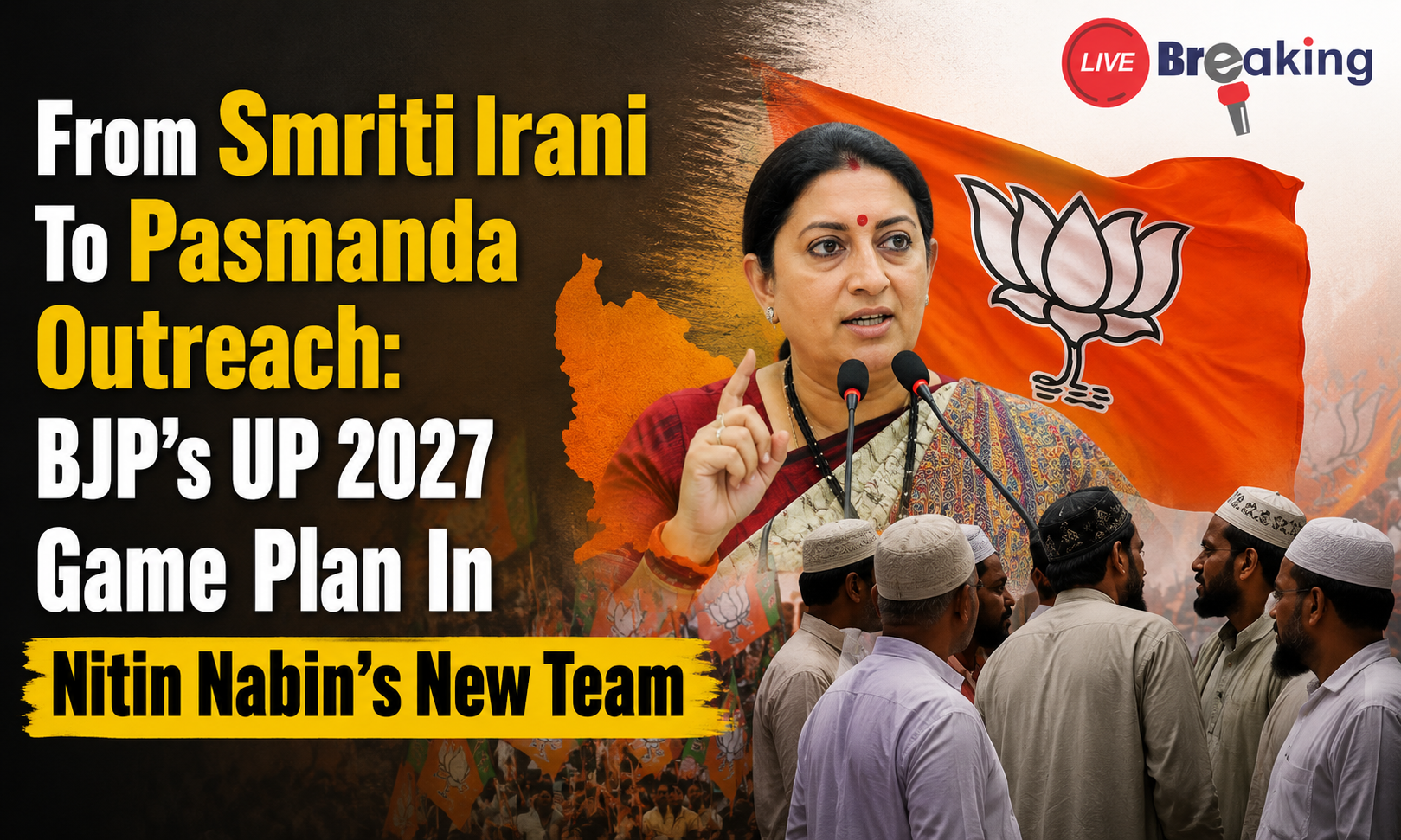
BJP UP 2027 Strategy: The Bharatiya Janata Party’s new national organisational team under president Nitin Nabin has sent a clear political signal: Uttar Pradesh will remain one of the party’s biggest priorities as it prepares for the 2027 Assembly election.
The new team includes eight leaders from Uttar Pradesh, among them former Union minister and former Amethi MP Smriti Irani, former Basti MP Harish Dwivedi and former Dhaurahra MP Rekha Verma. The composition also reflects a wider attempt to balance caste, region, gender and community representation inside the BJP organisation.
The timing is significant. The BJP is seeking to recover ground lost in the 2024 Lok Sabha election, when its Uttar Pradesh tally fell sharply from 62 seats in 2019 to 33. The party is therefore looking beyond its traditional social coalition and attempting to rebuild its connect with OBCs, Dalits, non-Yadav backward groups and sections of the Muslim community.
Smriti Irani’s Return: Why It Matters for Uttar Pradesh
Perhaps the most politically visible appointment is that of Smriti Irani as a national general secretary.
Irani has a strong political association with Uttar Pradesh, particularly because of her electoral battle in Amethi. Although she lost the 2024 Lok Sabha election to Congress leader Rahul Gandhi, her return to the BJP’s national organisational structure gives her a fresh role at a crucial political moment.
Her appointment can be read as more than an organisational promotion. Irani is one of the BJP’s most recognisable women leaders and has experience as a national campaigner, party functionary and Union minister. Her return provides the party with a prominent communicator who can be deployed across Uttar Pradesh and other politically important states.
For the BJP, the challenge in 2027 is not simply to repeat its previous campaign. It needs to rebuild confidence among sections of voters who moved towards the Samajwadi Party and other opposition parties in 2024.
That makes leaders with strong political visibility particularly valuable.
Eight UP Leaders in Nitin Nabin’s Team
The representation of Uttar Pradesh in the new national team is notable for both its size and social spread.
| Leader | New Role | Political Significance |
|---|---|---|
| Smriti Irani | National General Secretary | High-profile woman leader with strong UP political experience |
| Harish Dwivedi | National General Secretary | Strengthens the party’s Brahmin representation |
| Rekha Verma | National Vice-President | Represents the Kurmi/OBC community |
| Tariq Mansoor | National Vice-President | Important minority representation |
| Bhola Singh | National Secretary | Adds Dalit representation |
| Sangeeta Yadav | National Secretary | Strengthens OBC outreach, particularly in eastern UP |
| Amarpal Maurya | OBC Morcha President | Focus on backward-class mobilisation |
| Basit Ali | Minority Morcha President | Strengthens BJP’s minority outreach |
The composition is significant because the party has attempted to combine organisational experience with social representation. According to reporting on the new team, the eight UP members include three OBC leaders, a Brahmin, two Muslims and a Dalit, alongside other social and regional considerations.
OBC Outreach: BJP’s Answer to the PDA Challenge
The biggest political challenge for the BJP in Uttar Pradesh is arguably the opposition’s caste-based mobilisation.
The Samajwadi Party’s PDA — shorthand for Pichhda, Dalit, Alpsankhyak — became an important part of its political narrative during the 2024 Lok Sabha election. The BJP’s organisational changes suggest that it wants to counter that strategy through a broader social coalition.
The appointment of Amarpal Maurya as president of the BJP OBC Morcha is particularly important in this context. The OBC Morcha is one of the party’s key organisational mechanisms for reaching backward communities and building political networks below the level of senior leadership.
Rekha Verma’s continuation as national vice-president also carries significance because she belongs to the Kurmi community, an important OBC group in Uttar Pradesh. Political parties across the state have been competing to consolidate support among Kurmis and other non-Yadav OBC communities.
The BJP’s message appears to be straightforward: caste arithmetic cannot be ignored in the 2027 battle.
Why Yadav Outreach Is Also Important
Another notable appointment is that of Sangeeta Yadav as a national secretary.
The move assumes importance because the Yadav community has traditionally been closely associated with the Samajwadi Party in Uttar Pradesh. The BJP has previously attempted to make inroads among non-core sections of the Yadav electorate, but the appointment suggests that the party wants to give this effort additional organisational backing.
For the BJP, even a modest shift among Yadav voters could matter in closely contested constituencies.
The 2027 contest is likely to be fought constituency by constituency, making smaller changes in voting patterns potentially decisive.
Pasmanda Outreach and the Minority Question
The BJP’s minority outreach is another major element of the new organisational structure.
Tariq Mansoor has been retained as a national vice-president, while Basit Ali has been appointed president of the BJP Minority Morcha. The national team also includes representatives from several minority communities. The Economic Times reported that the new national team has six minority leaders and representation from major religious communities.
In Uttar Pradesh, this assumes added significance because of the size and diversity of the Muslim electorate.
The BJP has for several years spoken about outreach to Pasmanda Muslims — broadly referring to socially and economically backward sections among Indian Muslims. The political logic is to seek support from sections of the community on the basis of welfare, representation and development rather than relying solely on traditional religious or party alignments.
The inclusion of Muslim leaders in important organisational positions does not automatically translate into electoral support. However, it gives the BJP organisational faces who can potentially communicate with communities that have historically been distant from the party.
For the 2027 election, this could become one part of a larger strategy aimed at reducing the opposition’s advantage among Muslim voters.
Dalit Outreach Gets a Fresh Push
The BJP is also signalling renewed attention to Dalit voters.
The appointment of Bulandshahr MP Bhola Singh as a national secretary is significant in this respect. Reporting on the new team has linked his elevation to the BJP’s effort to strengthen its Dalit outreach.
This is particularly important after the BJP’s reduced performance in Uttar Pradesh in the 2024 Lok Sabha election.
Read More: Prashant Kishor Makes Stellar Electoral Debut From BJP’s Bihar Stronghold Bankipur
The party’s challenge is to prevent the opposition from converting caste-based mobilisation into a durable electoral coalition. Dalit voters are not politically uniform, and different communities have different local concerns. The BJP’s organisational approach therefore appears to focus on representation at multiple levels rather than depending on a single social bloc.
Yogi Adityanath Remains the Face of BJP in UP 2027
While the organisational structure is being changed, the BJP has already clarified the leadership question for Uttar Pradesh.
Nitin Nabin has said that Yogi Adityanath will be the party’s face for the 2027 Assembly election. The BJP leadership has also highlighted governance, infrastructure, development and law and order as key themes of the Yogi government.
That means the party’s strategy is taking shape on two parallel tracks.
The first is leadership continuity, with Yogi Adityanath positioned as the central face of the campaign.
The second is social coalition expansion, through OBC, Dalit, women and minority outreach.
Together, the two elements are intended to create a broader electoral platform.
Why the 2024 Lok Sabha Results Still Matter
The BJP’s 2027 strategy cannot be understood without looking at the 2024 Lok Sabha election.
The party’s Uttar Pradesh tally dropped from 62 seats in 2019 to 33 in 2024. That decline exposed weaknesses in the BJP’s social coalition and gave the Samajwadi Party greater political momentum.
Read More: Ramayana Designers React To Trolling Over Sai Pallavi’s Sita, Lara Dutta’s Kaikeyi Looks
The BJP therefore has to solve several problems simultaneously.
It must retain its core supporters, rebuild its OBC and Dalit support, prevent further erosion among communities that shifted to the opposition, strengthen women’s outreach and maintain organisational unity.
The party has already begun restructuring its Uttar Pradesh organisation. In June, its state unit announced a new team comprising 19 vice-presidents, eight general secretaries and 19 secretaries, along with changes among the six regional presidents. The restructuring was described as an effort to balance social groups and regions while bringing in fresh faces.
Nitin Nabin’s UP Focus: Organisation Before Election
Nitin Nabin’s recent Uttar Pradesh activity also suggests that the BJP is moving from organisational restructuring to election preparation.
During his July visit to Lucknow, Nabin held meetings with BJP leaders, MPs and MLAs and discussed the 2027 strategy. Party leaders were reportedly told to avoid factional disputes, spend more time in their constituencies and use social media more effectively.
Nabin also met senior state leaders and held discussions around the party’s social and regional equations.
Read More: What Happens To Indian Economy If Gen Z Never Buys A House?
This is important because elections in Uttar Pradesh are rarely won only through state-level messaging. Booth management, local leadership, caste networks, alliance coordination and constituency-level campaigning can all influence the outcome.
The Bigger Picture: BJP’s 2027 Strategy
Taken together, the appointments point towards a multi-layered BJP strategy for Uttar Pradesh.
First, Yogi Adityanath remains the central leadership face.
Second, Smriti Irani provides a high-profile national and women-focused political voice.
Third, OBC leaders are being given greater organisational responsibilities.
Fourth, the BJP is attempting to strengthen its Dalit outreach.
Fifth, Muslim leaders and the Minority Morcha are being given visible organisational roles, indicating that minority outreach remains part of the party’s broader strategy.
Sixth, the party is attempting to rebuild its grassroots machinery after the setbacks of 2024.
The real test, however, will come when these organisational decisions are converted into votes.
Appointments alone cannot guarantee a change in voter behaviour. The BJP will need to demonstrate that its new social outreach produces sustained grassroots engagement and that its leaders can address local concerns beyond election-time messaging.
What Does This Mean for the 2027 UP Election?
The 2027 Uttar Pradesh Assembly election is shaping up as a contest between competing social and political narratives.
The BJP is likely to emphasise the Modi-Yogi combination, governance, law and order, infrastructure and welfare delivery while simultaneously attempting to widen its social base.
Read More: Protesting Jharkhand Students Breach Barricades, Head Towards Assembly
The Samajwadi Party, meanwhile, is expected to continue emphasising PDA politics and social representation.
This makes the battle particularly important among OBCs, Dalits, women and marginalised communities.
The BJP’s new national team therefore appears to be less about individual appointments and more about building an electoral architecture for the next major political battle in Uttar Pradesh.
Smriti Irani’s return may attract the headlines, but the larger story lies in the combination of caste representation, minority outreach and organisational restructuring.
Conclusion
Nitin Nabin’s new BJP team has put Uttar Pradesh firmly in focus ahead of the 2027 Assembly election.
Smriti Irani’s elevation, the retention of Tariq Mansoor, the appointment of Basit Ali to the Minority Morcha, the prominence given to OBC leaders and the elevation of a Dalit leader together suggest an attempt to expand the BJP’s social coalition.
At the same time, Yogi Adityanath’s position as the party’s UP face provides continuity at the leadership level.
The BJP’s challenge now is implementation. It must turn organisational appointments into grassroots connections, convert outreach into trust and rebuild the social coalition that helped it dominate Uttar Pradesh in earlier elections.
With the opposition sharpening its caste-based strategy, the 2027 battle is unlikely to be decided by a single issue. It will be a contest of leadership, organisation, social arithmetic, welfare politics and voter outreach.
Read More: Trump ‘Superstar’ Karoline Leavitt Out, But Not Gone: Why The US President Still Wants Her Close
And in that contest, Nitin Nabin’s new team could become one of the BJP’s most important instruments for reclaiming lost ground in Uttar Pradesh.
Frequently Asked Questions
1. Who is Nitin Nabin?
Nitin Nabin is the national president of the Bharatiya Janata Party. His new national organisational team was announced in August 2026 and includes several leaders from Uttar Pradesh.
2. What role has Smriti Irani received in BJP’s new team?
Former Union minister Smriti Irani has been appointed a national general secretary in Nitin Nabin’s new team. Her appointment marks her return to the BJP’s national organisational structure.
3. Why is Uttar Pradesh important for BJP in 2027?
Uttar Pradesh is one of India’s most politically important states, and the BJP is seeking to strengthen its position ahead of the 2027 Assembly election after its reduced Lok Sabha performance in the state in 2024.
4. What is BJP’s Pasmanda outreach strategy?
Pasmanda outreach refers to attempts to engage socially and economically backward sections among Muslims. The BJP’s inclusion of Muslim leaders such as Tariq Mansoor and Basit Ali in organisational roles is part of a broader minority outreach strategy.
Read More: 2 More Air India Pilots Fail To Clear 1st Drug Test After Phuket Flight Fiasco
5. Who will be BJP’s face in the 2027 Uttar Pradesh election?
BJP president Nitin Nabin has indicated that Chief Minister Yogi Adityanath will be the party’s principal face for the 2027 Uttar Pradesh Assembly election.
6. Why is OBC outreach important for BJP in UP?
OBC voters form a major part of Uttar Pradesh’s electoral landscape. The BJP’s elevation of leaders such as Amarpal Maurya and Rekha Verma reflects an effort to strengthen its connection with backward communities.
7. What was BJP’s performance in Uttar Pradesh in the 2024 Lok Sabha election?
The BJP won 33 Lok Sabha seats in Uttar Pradesh in 2024, down from 62 seats in the 2019 election. The decline is one reason the party is focusing heavily on social and organisational outreach ahead of 2027.
Like this post?
Register at Live Breaking to never miss out on videos, celeb interviews, and best reads.