

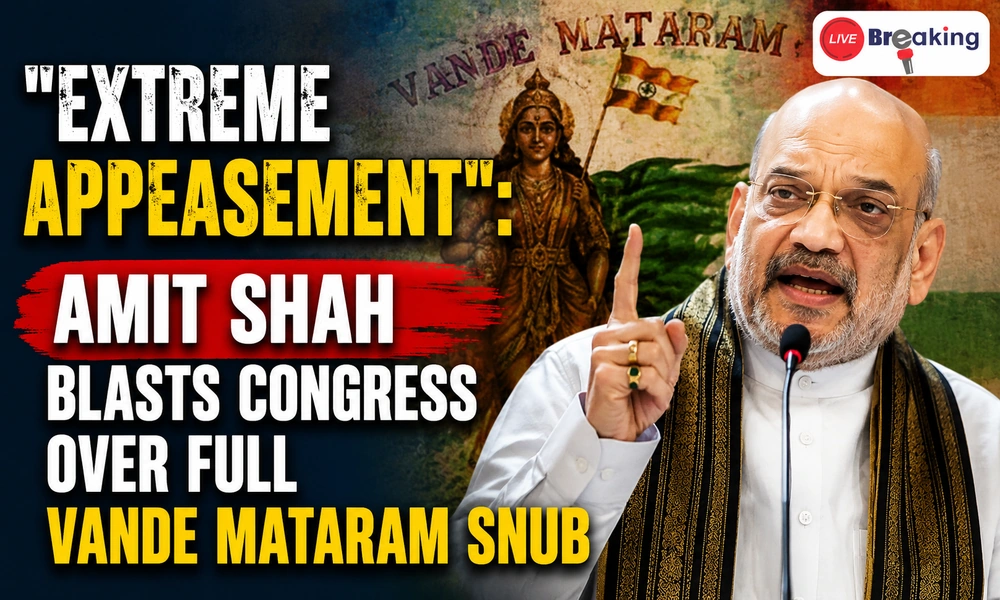
Amit Shah Slams Congress Over Vande Mataram Stand, Calls It “Extreme Appeasement”
The political controversy over Vande Mataram has intensified after Union Home Minister Amit Shah launched a sharp attack on the Congress over its decision to sing only the first two stanzas of the national song at party events.
Shah described the Congress Working Committee’s decision as an “anti-national” move and accused the party of returning to what he called its “extreme policy of appeasement.” The Congress, however, has defended its position by referring to its historical 1937 resolution on the national song.
The dispute has turned a long-standing question about the rendition of Vande Mataram into a fresh political flashpoint involving nationalism, history, religion, the freedom movement and competing interpretations of Congress’s historical position.
Why Is Amit Shah Criticising Congress Over Vande Mataram?
Amit Shah’s criticism followed the Congress Working Committee’s decision to continue with the party’s historical position of singing only two stanzas of Vande Mataram.
Shah argued that the decision was not simply about how much of a song should be performed. He linked the 1937 Congress resolution to what he described as a broader policy of appeasement and claimed that the historical decision contributed to circumstances that ultimately strengthened the two-nation theory and preceded Partition.
Shah also accused the Congress of ignoring what he described as the sacrifices of freedom fighters who used “Vande Mataram” as a rallying cry during India’s independence movement.
The Home Minister further said that the Narendra Modi government had attempted to correct what it considers a historical mistake by promoting the singing of the complete song.
Congress Defends Its Historical Position
The Congress has rejected the BJP’s interpretation of the controversy and maintained that its position is rooted in the decisions taken by its leaders during the freedom movement.
Congress MP K.C. Venugopal said after the Working Committee meeting that the party would follow the decisions associated with Mahatma Gandhi, Jawaharlal Nehru and Sardar Vallabhbhai Patel in 1937. The party’s current position therefore presents the two-stanza rendition as a continuation of its historical resolution rather than a rejection of Vande Mataram.
This distinction is central to the political dispute.
While the BJP frames the issue around national pride and what it calls appeasement, Congress frames it around its historical position and the circumstances surrounding the adoption and performance of the national song.
What Was the Congress Resolution of 1937?
The Congress’s 1937 position has become a major part of the latest political debate.
The controversy revolves around the decision to use the first two stanzas of Vande Mataram while avoiding later portions of the composition. The issue has historically involved concerns over the religious imagery contained in portions of the complete song and the need, according to Congress’s interpretation, to ensure that the national movement remained inclusive.
The present political dispute is therefore not entirely new. Instead, a historical question has been brought back into the centre of contemporary political debate.
Amit Shah, however, has presented the historical decision in very different terms. He argued that dividing the rendition of Vande Mataram represented a serious political mistake and connected it to the wider history of communal politics before Partition.
BJP Says Full Vande Mataram Strengthens National Integration
The BJP has made the complete rendition of Vande Mataram an important part of its current political messaging.
Shah said the Modi government had sought to reverse what he described as a decades-old mistake and strengthen national integration through the complete rendition of the song.
The Centre has also introduced measures concerning the singing of Vande Mataram at public gatherings, schools and official government functions. The report further stated that Parliament passed legislation concerning deliberate obstruction or disruption of its singing.
Read More: What Happens To Indian Economy If Gen Z Never Buys A House?
For the BJP, the controversy is consequently larger than a question of musical performance. It has become part of a broader argument about patriotism, India’s freedom struggle and the political legacy of the Congress.
Congress-BJP Political Clash Gets Sharper
The Vande Mataram controversy has also expanded into a wider political confrontation between the two parties.
Shah urged citizens to raise their voices against the Congress position and said the BJP would oppose it publicly and in legislative assemblies. He also criticised Congress leader Rahul Gandhi while arguing that the party was once again pursuing what he described as vote-bank politics.
Congress president Mallikarjun Kharge, meanwhile, responded by challenging the BJP and RSS to explain their contribution to India’s freedom struggle. Kharge also criticised Shah personally while defending Congress’s historical role in the independence movement.
The exchange shows how quickly the Vande Mataram issue has moved beyond the original question of how the song should be sung.
Why Vande Mataram Remains Politically Sensitive
Vande Mataram occupies a unique place in India’s national history.
Read More: Protesting Jharkhand Students Breach Barricades, Head Towards Assembly
Written by Bankim Chandra Chattopadhyay, the song became closely associated with the Indian freedom movement. It was used by nationalists as a symbol of resistance against British rule and subsequently became India’s national song, while Jana Gana Mana was adopted as the national anthem.
Its historical significance means that debates surrounding Vande Mataram often carry a strong emotional and political dimension.
The current controversy adds another layer because both the BJP and Congress are invoking India’s freedom struggle to support their respective arguments.
The BJP argues that the complete song represents national unity and respect for the sacrifices made during the freedom movement. Congress argues that its two-stanza position has historical precedent and reflects decisions taken during the independence era.
Is the Vande Mataram Controversy About History or Politics?
The answer is increasingly both.
At one level, the dispute concerns a historical decision made by Congress in the 1930s. At another, it has become part of the contemporary ideological competition between the BJP and Congress.
Read More: Trump ‘Superstar’ Karoline Leavitt Out, But Not Gone: Why The US President Still Wants Her Close
For the BJP, the issue provides an opportunity to highlight nationalism and criticise what it describes as Congress’s historical appeasement of minority communities.
For Congress, defending its 1937 position allows the party to argue that its understanding of India’s freedom movement was based on maintaining political and social inclusiveness.
The sharp disagreement demonstrates how historical events continue to influence present-day Indian politics.
Amit Shah’s Main Arguments at a Glance
| Issue | Amit Shah/BJP Position | Congress Position |
|---|---|---|
| Two-stanza rendition | Viewed as a historical mistake | Based on Congress’s 1937 resolution |
| Full Vande Mataram | Seen as strengthening national integration | Party maintains its established historical position |
| 1937 decision | Shah links it to appeasement politics | Congress cites historical leadership decisions |
| Nationalism | BJP presents full rendition as a patriotic issue | Congress says its position is rooted in the freedom movement |
| Political impact | BJP says appeasement politics should not continue | Congress rejects the BJP’s interpretation |
| Current controversy | BJP says Congress is ignoring the government’s position | Congress says it is following its historical resolution |
Read More: 2 More Air India Pilots Fail To Clear 1st Drug Test After Phuket Flight Fiasco
What Happens Next in the Vande Mataram Row?
The controversy is unlikely to disappear quickly because both parties have strong political incentives to continue debating it.
The BJP can use the issue to reinforce its broader narrative around nationalism, cultural identity and Congress’s historical record. Congress, meanwhile, can use the debate to challenge the BJP’s interpretation of the freedom struggle and defend the role played by its leaders.
The issue could therefore appear in political speeches, legislative debates and public campaigns in the days ahead.
For the public, the most important distinction is between historical fact, political interpretation and current policy. The 1937 Congress resolution is a historical matter, while the claims about its relationship to Partition and appeasement are political interpretations that remain central to the present dispute.
FAQ
1. Why did Amit Shah criticise Congress over Vande Mataram?
Amit Shah criticised Congress after its Working Committee decided to sing only the first two stanzas of Vande Mataram at party events. Shah called the decision “anti-national” and accused Congress of reviving what he described as its “extreme policy of appeasement.”
Read More: From Smriti Irani To Pasmanda Outreach: BJP UP 2027 Strategy In Nitin Nabin’s New Team
2. Why does Congress sing only two stanzas of Vande Mataram?
Congress says its position follows the party’s historical 1937 resolution. Congress leaders have argued that the first two stanzas should be used in the party’s rendition, referring to decisions made during the freedom movement.
3. What is Amit Shah’s argument about the 1937 Congress decision?
Shah argues that the 1937 decision to limit the rendition represented appeasement and claims it contributed to a historical political process that eventually strengthened the two-nation theory and preceded Partition.
4. What is Congress’s response to Amit Shah?
Congress has defended its position by referring to the decisions of its leaders during the freedom movement. K.C. Venugopal said the party would follow the approach associated with Gandhi, Nehru and Patel regarding the rendition of Vande Mataram.
5. Is Vande Mataram India’s national anthem?
No. Jana Gana Mana is India’s national anthem, while Vande Mataram is the country’s national song. Both hold important places in India’s national history.
6. Why is Vande Mataram important in Indian history?
Vande Mataram became strongly associated with India’s freedom movement and was used as a patriotic slogan and song during the struggle against British rule. Its historical association with the independence movement makes it particularly significant in contemporary political debates.
Read More: Telangana Boy Stabbed Principal 27 Times. How His Lavish Lifestyle Busted Him
7. What is the latest development in the Vande Mataram controversy?
The latest development is the Congress Working Committee’s decision to retain its two-stanza position, followed by Amit Shah’s strong criticism of the move and his call for people to oppose what he describes as Congress’s appeasement politics.
Conclusion
The latest Vande Mataram controversy has once again brought India’s freedom movement and its political legacy into the national spotlight. Amit Shah has framed the Congress Working Committee’s decision as evidence of what he calls “extreme appeasement,” while Congress has defended its position by pointing to its historical 1937 resolution.
The dispute is significant because it connects history with contemporary politics. The BJP sees the complete rendition of Vande Mataram as a symbol of national unity and a correction of a historical wrong. Congress, on the other hand, maintains that its two-stanza position has historical roots in the freedom movement.
As the political battle continues, Vande Mataram is likely to remain more than a song at the centre of the debate. It has become a symbol around which competing ideas of nationalism, history, secularism and political identity are being contested.
Like this post?