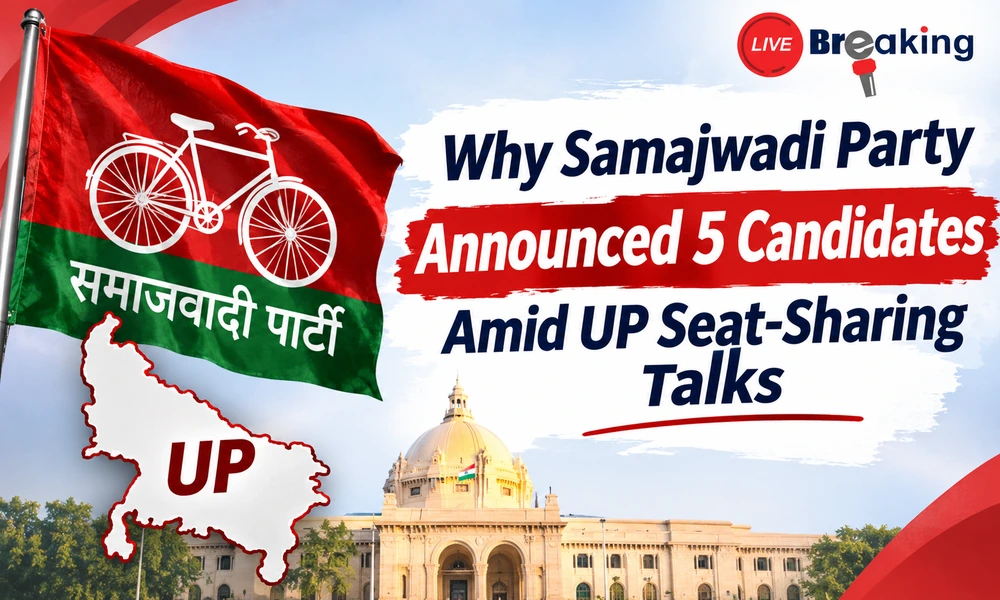
Why Samajwadi Party Announced 5 Candidates Amid UP Seat-Sharing Talks?
The political atmosphere in Uttar Pradesh has started heating up ahead of the 2027 Assembly elections. The Samajwadi Party (SP), led by Akhilesh Yadav, has announced its first list of five candidates even as discussions over seat-sharing with Congress continue.
The announcement has attracted considerable attention because it came at a time when both parties were negotiating a possible electoral arrangement as members of the opposition INDIA bloc. Instead of waiting for the conclusion of alliance discussions, the Samajwadi Party decided to reveal its candidates for five constituencies.
The decision is being viewed as an important political signal to Congress. It indicates that the SP wants to demonstrate its organisational readiness and maintain control over constituencies where it believes it has a strong electoral position.
The announcement has also raised questions about the future of the Congress-SP alliance in Uttar Pradesh. While negotiations are continuing, differences over seat allocation and political representation appear to be creating challenges for both parties.
Which Five Candidates Has Samajwadi Party Announced for the 2027 UP Elections?
The Samajwadi Party has announced five candidates for the upcoming Uttar Pradesh Assembly elections. Four of the selected candidates are sitting MLAs, while the fifth candidate represents the party’s broader social and electoral strategy.
The candidates and their constituencies are:
| Candidate Name | Assembly Constituency | District |
|---|---|---|
| Umar Ali Khan | Behat | Saharanpur |
| Ashu Malik | Saharanpur | Saharanpur |
| Nahid Hasan | Kairana | Shamli |
| Mehboob Ali | Amroha | Amroha |
| Jyoti Lodhi | Lalitpur | Lalitpur |
The selection of these candidates reflects the party’s confidence in several existing political representatives. By renominating four sitting MLAs, the SP appears interested in maintaining continuity and strengthening its existing electoral base.
The announcement is particularly significant in western Uttar Pradesh, where four of the five constituencies are located.
Why Did Akhilesh Yadav Announce Candidates Before Completing Alliance Talks?
One of the biggest questions surrounding the announcement is why the Samajwadi Party decided to declare candidates while negotiations with Congress were still underway.
The move appears to have several political objectives.
1. Sending a Strong Message to Congress
The announcement is widely being interpreted as a signal that the Samajwadi Party does not want to compromise easily on constituencies where it considers itself politically strong.
Seat-sharing negotiations between political parties often involve competing demands. Both parties want a larger share of constituencies to strengthen their electoral presence.
In this situation, announcing candidates for five seats demonstrates that the SP is prepared to move ahead with its election planning rather than wait indefinitely for an agreement.
The inclusion of Behat and Saharanpur is particularly important because these constituencies were reportedly part of Congress’s seat-sharing demands.
2. Demonstrating Electoral Preparedness
The second possible reason is organisational preparation.
Assembly elections require extensive planning, including booth-level management, voter outreach, local leadership coordination and campaign development.
By announcing candidates early, the Samajwadi Party can give its nominees additional time to connect with voters and strengthen their campaign networks.
Early candidate announcements can also help reduce uncertainty among party workers and supporters.
The SP may therefore be attempting to establish an advantage by beginning constituency-level preparations well before the election campaign officially intensifies.
3. Protecting Its Existing Strongholds
Four of the five candidates are sitting MLAs. This suggests that the party is prioritising constituencies where it already has an established political presence.
Replacing sitting legislators can sometimes create dissatisfaction among local party workers and supporters. Renominating existing representatives may help maintain organisational stability.
Read More: Global Outage Hits Microsoft, Outlook, Other 365 Services Down
The decision also indicates that the party is not necessarily willing to leave every constituency open for negotiations with its alliance partner.
Congress and Samajwadi Party Seat-Sharing Talks Face Challenges
The candidate announcement has come amid differences between the two opposition parties over the distribution of Assembly constituencies.
According to reports published on November 25, the Samajwadi Party had offered Congress 26 seats, while Congress was seeking a considerably larger share, reportedly more than 60 seats.
This difference highlights the difficulty of negotiating an alliance in a politically important state like Uttar Pradesh.
For Congress, contesting a reasonable number of seats is important to maintain its organisational presence and strengthen its political influence in the state.
For the Samajwadi Party, however, offering too many constituencies could affect its own electoral calculations, especially in areas where it believes it has a stronger support base.
The situation becomes more complicated when local leaders from both parties make public statements regarding seat-sharing arrangements.
Congress leader Imran Masood reportedly expressed dissatisfaction over the SP’s announcement, particularly because Saharanpur was among the constituencies included in the list.
However, Congress MP Ujjwal Raman Singh indicated that discussions between the senior leadership and designated negotiators could still send a positive message.
Read more: “PM Doesn’t Tap Phones”: Sam Pitroda Amid Rahul Gandhi Big Charge
This suggests that despite public disagreements, the possibility of an alliance has not necessarily disappeared.
What Is the Political Significance of Western Uttar Pradesh?
Western Uttar Pradesh is an important region in the state’s electoral politics.
The region has a diverse social composition and a complicated political landscape. Farmers, rural communities, traders, minority voters and different caste groups all influence electoral outcomes.
Four of the five constituencies announced by the SP are located in western Uttar Pradesh:
- Behat
- Saharanpur
- Kairana
- Amroha
The concentration of candidates in this region suggests that the Samajwadi Party wants to strengthen its position in an area where electoral competition can be particularly significant.
Saharanpur is especially important because Congress leader Imran Masood represents the constituency in Parliament. The announcement of an SP candidate for the Saharanpur Assembly seat has therefore added another dimension to the seat-sharing disagreement.
For both parties, the challenge will be to balance their local political ambitions with the broader objective of opposition unity.
How Does the PDA Strategy Influence Samajwadi Party’s Candidate Selection?
Another important aspect of the announcement is the Samajwadi Party’s PDA strategy.
PDA stands for Pichhda, Dalit and Alpsankhyak, referring to backward classes, Dalits and minorities.
Akhilesh Yadav has repeatedly highlighted this social coalition as an important part of the party’s electoral approach.
Read More: Eighth Price Hike In 11 Months, Mumbai CNG Price Rises By Rs 1.50
The five-candidate list includes four Muslim candidates and one candidate from the Lodh community.
This selection is being viewed as consistent with the party’s attempt to strengthen representation among different social groups.
The strategy aims to bring together communities that could collectively provide the party with a broader electoral base.
However, the effectiveness of this approach will ultimately depend on voter support, constituency-level political conditions, candidate popularity and the party’s ability to convert social representation into electoral results.
Can the Samajwadi Party-Congress Alliance Still Survive?
Despite the differences, it would be premature to conclude that the opposition alliance is heading towards a complete breakdown.
Political parties frequently adopt strong negotiating positions before reaching a final seat-sharing agreement.
The SP’s announcement may be intended to protect its political interests and communicate its expectations to Congress.
At the same time, Congress has reasons to continue discussions rather than immediately walk away from the negotiations.
A united opposition could help both parties consolidate their respective voter bases and avoid splitting votes in closely contested constituencies.
Read More: ‘Red Carpet vs Ban’ Claims As BJP And AAP Fight Over Yamuna On Chhath Puja
However, an alliance can work effectively only when both sides believe that the arrangement is fair and mutually beneficial.
The coming days will therefore be important in determining whether the two parties can resolve their differences.
What Does This Move Mean for the 2027 Uttar Pradesh Assembly Elections?
The 2027 Uttar Pradesh Assembly elections are expected to be an important political contest for all major parties.
The Samajwadi Party’s early candidate announcement suggests that the party wants to begin preparations well in advance.
It also indicates that Akhilesh Yadav is keen to maintain the party’s control over its preferred constituencies while negotiating with potential allies.
For Congress, the challenge is to secure a seat-sharing arrangement that provides enough political space to strengthen its position in Uttar Pradesh.
For the BJP and other political parties, disagreements between opposition partners could create an opportunity to target weaknesses in the proposed alliance.
Nevertheless, the final electoral picture will depend on candidate selection, campaign strategies, local political developments and the ability of parties to mobilise voters.
Read More: ‘Fine Without Jensen Huang’: Nvidia Message After 1st Earnings Since Scandal
The announcement of five candidates may be an early development, but its political implications could extend beyond these constituencies.
Conclusion
The Samajwadi Party’s decision to announce five candidates during ongoing seat-sharing discussions with Congress is more than a routine electoral announcement.
It reflects the party’s intention to protect its existing political strongholds, demonstrate organisational preparedness and maintain a firm position in alliance negotiations.
The selection of four sitting MLAs and the focus on western Uttar Pradesh also indicate that the party is prioritising constituencies where it sees an established electoral opportunity.
For Congress, the development presents a challenge in securing a mutually acceptable seat-sharing arrangement.
Whether both parties manage to overcome their differences remains to be seen. What is clear, however, is that political preparations for the 2027 Uttar Pradesh Assembly elections have already begun, and the Samajwadi Party’s first candidate list has added a new dimension to the state’s political debate.
Frequently Asked Questions (FAQs)
Q1. Why did the Samajwadi Party announce five candidates during seat-sharing talks with Congress?
The Samajwadi Party announced five candidates to demonstrate its electoral preparedness, protect its preferred constituencies and maintain a firm negotiating position during ongoing alliance discussions with Congress.
Q2. Who are the five candidates announced by Akhilesh Yadav?
The five candidates are Umar Ali Khan from Behat, Ashu Malik from Saharanpur, Nahid Hasan from Kairana, Mehboob Ali from Amroha and Jyoti Lodhi from Lalitpur.
Read More: “Paid To Defame India”: BJP On Rahul Gandhi’s “Compromised PM” Post
Q3. Which two constituencies reportedly created differences between SP and Congress?
Behat and Saharanpur reportedly figured in Congress’s seat-sharing demands. The SP’s decision to announce candidates for these constituencies created dissatisfaction among sections of the Congress leadership.
Q4. How many seats has the Samajwadi Party reportedly offered Congress?
According to reports dated November 25, 2026, the Samajwadi Party had offered Congress 26 Assembly seats during the ongoing negotiations.
Q5. What is the PDA strategy of the Samajwadi Party?
PDA stands for Pichhda, Dalit and Alpsankhyak, representing backward classes, Dalits and minorities. It is an important part of Akhilesh Yadav’s broader electoral strategy.
Q6. When will the next Uttar Pradesh Assembly elections take place?
The next Uttar Pradesh Assembly elections are scheduled for 2027. Political parties have already started preparing their organisational and electoral strategies.
Q7. Will Congress and Samajwadi Party contest the 2027 UP elections together?
The possibility of an alliance remains subject to ongoing negotiations. Differences over seat allocation and constituency selection will be important factors in determining the final arrangement.