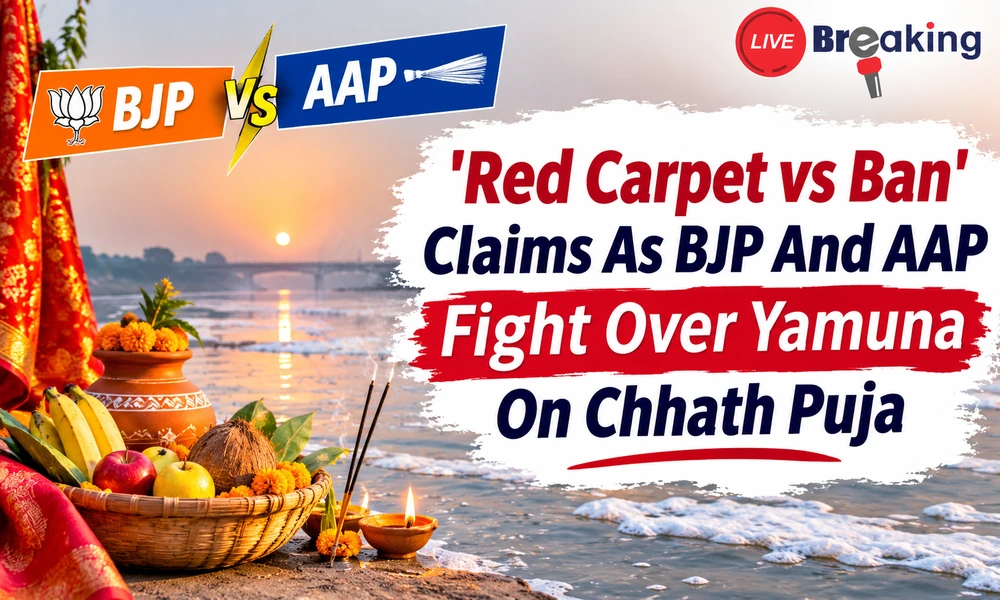
BJP vs AAP Over Yamuna Pollution During Chhath Puja in Delhi
The political battle between the Bharatiya Janata Party (BJP) and the Aam Aadmi Party (AAP) has intensified in Delhi during the Chhath Puja celebrations, with the condition of the Yamuna River becoming the centre of a fresh controversy. While the ruling BJP government has highlighted its arrangements for devotees across the national capital, the opposition AAP has questioned the cleanliness of the river and raised concerns about people performing religious rituals near water covered with thick white foam.
The controversy has brought two important issues into focus: the arrangements made for one of Delhi’s major religious festivals and the continuing challenge of Yamuna River pollution.
As political leaders exchanged accusations, videos showing devotees standing near the foam-covered river circulated on social media. The visuals triggered fresh questions about environmental conditions, public health and the responsibility of governments to ensure safe arrangements during religious celebrations.
BJP Defends Chhath Puja Arrangements, Targets Previous AAP Government
The BJP launched a strong response to the criticism raised by the opposition, accusing the AAP of politicising the issue of Yamuna pollution during an important religious festival.
Delhi BJP MP Manoj Tiwari defended the arrangements made by the current government and compared them with the situation during the previous administration.
According to Tiwari, devotees faced restrictions while celebrating Chhath Puja at certain Yamuna ghats under the previous AAP government. He claimed that the present administration had made significantly better arrangements, allowing people to celebrate the festival with greater convenience.
Tiwari also criticised the circulation of videos showing the condition of the river, alleging that the opposition was using the visuals to create a political controversy.
The BJP’s position is that the current administration has expanded access to religious facilities and provided better infrastructure for Chhath celebrations across Delhi.
AAP Shares Videos Showing White Foam in Yamuna
The AAP responded to the BJP’s statements by highlighting the condition of the Yamuna River.
The opposition party shared videos on social media showing devotees standing near or in water covered with layers of thick white foam, particularly around the Kalindi Kunj ghat.
The party questioned the government’s claims regarding river-cleaning efforts and alleged that the pollution problem remained unresolved despite promises and public announcements.
AAP also targeted Delhi Chief Minister Rekha Gupta, questioning how devotees could be expected to celebrate Chhath Puja safely when the river continued to show visible signs of pollution.
The videos quickly became a central part of the political debate, with both parties presenting different interpretations of the arrangements and the river’s condition.
However, the visual appearance of foam alone cannot establish the exact chemical composition or pollution levels of the water. Scientific testing is necessary to determine the presence of contaminants and the potential risks to people.
BJP Claims More Than 1,400 Ghats Prepared for Chhath Puja
Delhi Minister Kapil Mishra also joined the political exchange, highlighting the scale of the arrangements made for Chhath Puja across the capital.
Mishra claimed that the government had facilitated celebrations at more than 1,400 ghats in Delhi.
He contrasted these arrangements with what he described as restrictions during the previous administration, saying that the present government had welcomed devotees instead of imposing limitations.
The BJP has repeatedly presented the number of ghats and the availability of facilities as evidence of its efforts to support the festival.
For thousands of families, Chhath Puja is an important cultural and religious occasion. The availability of accessible locations, lighting, sanitation, security and other basic facilities plays a significant role in ensuring that devotees can complete their rituals comfortably.
However, the debate also highlights the difference between providing festival infrastructure and ensuring that the water bodies surrounding those facilities are environmentally safe.
Chief Minister Rekha Gupta Participates in Chhath Puja Rituals
Delhi Chief Minister Rekha Gupta participated in the concluding celebrations of Chhath Puja on November 16.
She offered prayers during the Usha Arghya ritual at the ITO ghat, where devotees gathered to offer prayers to the rising Sun.
The Chief Minister had also inspected Yamuna ghats by boat and participated in the evening Sandhya Arghya ritual at Sonia Vihar on November 15.
Addressing reporters, Gupta said her government had attempted to ensure that the festival was celebrated with devotion and grandeur.
She also acknowledged that there could have been shortcomings in the arrangements and expressed her intention to improve them in the future.
Read More: “Congress, Others Have Not Had A Level Playing Field”: Sonia Gandhi Jabs BJP
Her participation was significant amid the growing political controversy, as the government sought to demonstrate its involvement in the festival and its commitment to religious and cultural traditions.
Why Does White Foam Appear in the Yamuna River?
The white foam visible in sections of the Yamuna has remained a major environmental concern, particularly around the Delhi stretch of the river.
Such foam can develop due to the presence of surfactants, detergents, sewage and other pollutants in water. When water containing these substances experiences agitation, foam can form and accumulate on the surface.
The problem is particularly noticeable under certain seasonal and environmental conditions.
However, the exact cause of a particular foam formation event must be established through water-quality testing and scientific investigation.
The appearance of thick foam raises concerns because polluted river water can expose people to potentially harmful substances.
For devotees participating in religious rituals, contact with contaminated water may create health risks depending on the type and concentration of pollutants present.
The Yamuna’s pollution problem is not limited to one festival or one political administration. It involves wastewater treatment, sewage infrastructure, industrial discharge, solid waste management and effective enforcement of environmental regulations.
Chhath Puja and the Importance of the Yamuna for Devotees
Chhath Puja is one of the most significant festivals celebrated by communities from Bihar, Jharkhand, eastern Uttar Pradesh and other parts of northern India.
Read More: Bihar Gang Rape Survivor Thrown Off Rooftop Months After Assault, Suffers Serious Injuries
The festival is dedicated to the worship of Surya Dev, the Sun God, and Chhathi Maiya.
Devotees observe fasting and perform traditional rituals near rivers, ponds and other water bodies. Offering Arghya to the setting and rising Sun is among the most important parts of the celebration.
In Delhi, a large population from Purvanchal participates in Chhath Puja every year. Consequently, the availability of suitable ghats and safe water bodies becomes particularly important.
The political controversy surrounding the Yamuna has therefore attracted attention beyond the usual debate between ruling and opposition parties.
For devotees, the priority is not political messaging but the opportunity to perform religious rituals in a clean, safe and peaceful environment.
BJP vs AAP: What Is the Main Political Controversy?
The latest confrontation reflects a broader political disagreement over responsibility for the condition of the Yamuna and the arrangements made for Chhath Puja.
The BJP has focused on the facilities created for devotees, the number of available ghats and its criticism of restrictions allegedly imposed during the previous government.
The AAP, meanwhile, has focused on the visible pollution in the river and questioned whether the government’s claims about cleaning the Yamuna match the situation on the ground.
Both parties are attempting to establish their positions before the public, particularly among communities for whom Chhath Puja holds deep cultural importance.
Read More: Global Outage Hits Microsoft, Outlook, Other 365 Services Down
The disagreement also raises a larger question: should the success of festival arrangements be measured only by the number of ghats created, or should water quality and environmental safety receive equal attention?
Ultimately, both infrastructure and environmental protection are essential.
Yamuna Cleaning Remains a Major Challenge for Delhi
The political exchange during Chhath Puja has once again brought the Yamuna’s pollution problem into the spotlight.
Cleaning the river requires long-term planning and coordinated action rather than temporary measures around major festivals.
Authorities need to strengthen sewage treatment capacity, monitor industrial discharge, prevent untreated wastewater from entering the river and improve waste management along its banks.
Regular water-quality monitoring and transparent publication of test results can also help citizens understand the actual condition of the river.
Religious festivals should not become the only occasions when attention is directed towards river pollution. Maintaining clean water bodies throughout the year is important for public health, environmental sustainability and the protection of cultural traditions.
For Delhi, the challenge is to ensure that future Chhath celebrations are supported by both better public facilities and meaningful improvements in the Yamuna’s water quality.
Key Highlights of the BJP-AAP Yamuna Row
| Issue | BJP’s Position | AAP’s Position |
|---|---|---|
| Chhath Puja arrangements | Better facilities and arrangements across Delhi | Questions the government’s claims |
| Number of ghats | Claims arrangements at over 1,400 ghats | Focuses on conditions at the Yamuna |
| Yamuna pollution | Defends the government’s overall efforts | Highlights visible white foam |
| Previous government | Accuses AAP of restricting celebrations | Questions the current government’s performance |
| Public concerns | Emphasises facilities for devotees | Raises concerns about river cleanliness |
| Political focus | Festival arrangements and accessibility | Pollution and environmental accountability |
Conclusion
The BJP-AAP confrontation during Chhath Puja has once again placed the Yamuna River at the centre of Delhi’s political debate. While the BJP is highlighting the arrangements made at more than 1,400 ghats and defending its festival preparations, the AAP is questioning the river’s condition by sharing videos showing thick white foam near devotees.
Read more: “PM Doesn’t Tap Phones”: Sam Pitroda Amid Rahul Gandhi Big Charge
Beyond the political accusations, the controversy highlights an important issue that requires attention from every administration: the need to protect the Yamuna and ensure safe conditions for people performing religious rituals.
Chhath Puja represents faith, devotion and a deep connection with nature. Ensuring that devotees can celebrate the festival without concerns about polluted water should remain a shared responsibility.
Delhi’s long-term success will depend not only on grand festival arrangements but also on measurable progress towards a cleaner and healthier Yamuna.
Frequently Asked Questions (FAQs)
1. Why are BJP and AAP fighting over the Yamuna during Chhath Puja?
The BJP and AAP are exchanging accusations over the condition of the Yamuna River and the arrangements made for Chhath Puja. The BJP is highlighting facilities at more than 1,400 ghats, while the AAP has raised concerns about white foam and river pollution.
2. What did the BJP say about Chhath Puja arrangements in Delhi?
BJP leaders defended the current government’s preparations and claimed that devotees were receiving better facilities than during the previous administration. Delhi Minister Kapil Mishra also highlighted arrangements at more than 1,400 ghats.
3. Why did AAP share videos of the Yamuna River?
AAP shared videos showing devotees near sections of the Yamuna covered with thick white foam. The party used the visuals to question the government’s claims about cleaning the river and ensuring safe conditions.
Read More: Eighth Price Hike In 11 Months, Mumbai CNG Price Rises By Rs 1.50
4. Who is Manoj Tiwari?
Manoj Tiwari is a BJP Member of Parliament from Delhi. During the Chhath Puja controversy, he defended the government’s festival arrangements and criticised the opposition’s allegations.
5. What causes white foam in the Yamuna River?
White foam can form due to surfactants, detergents, sewage and other pollutants in water. Water-quality testing is required to identify the exact substances responsible for a particular incident.
6. What is Usha Arghya during Chhath Puja?
Usha Arghya is an important Chhath Puja ritual in which devotees offer prayers and water to the rising Sun. It marks the concluding morning worship of the festival.
7. Is Yamuna water safe for religious rituals?
The safety of river water depends on its actual quality and the presence of contaminants. Visible foam can indicate pollution concerns, but scientific water testing is necessary to determine whether the water is safe for human contact.
8. Why is Chhath Puja important in Delhi?
Chhath Puja is especially significant among Delhi’s Purvanchal communities. Devotees gather at rivers, ponds and designated ghats to worship the Sun God and Chhathi Maiya through traditional fasting and offering rituals.