BJP Slams Rahul Gandhi Over ‘Compromised PM’ Remark, Congress Row Escalates
The political confrontation between the Bharatiya Janata Party (BJP) and the Congress has intensified after Leader of the Opposition Rahul Gandhi launched a fresh attack on Prime Minister Narendra Modi over India’s position in international diplomacy. Gandhi’s remarks, referring to a meeting involving US President Donald Trump, Chinese President Xi Jinping and Russian President Vladimir Putin, triggered a strong reaction from BJP leaders.
The Congress leader suggested that India’s Prime Minister would have been present at the high-profile meeting if the Congress were in power. He further alleged that a compromised Prime Minister could not secure such a position on the global diplomatic stage.
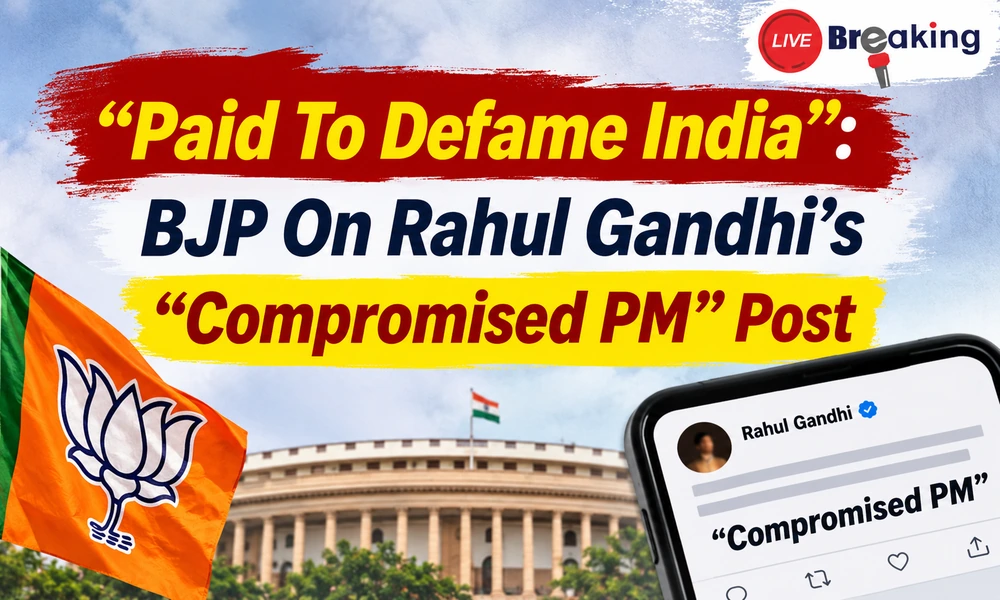
The BJP strongly rejected the criticism and accused Gandhi of presenting a negative picture of India internationally. One BJP leader even alleged that Gandhi was being paid to defame the country, escalating the political exchange between the ruling party and the opposition.
The controversy has once again brought India’s foreign policy, diplomatic relationships and international standing into the centre of national political debate.
Rahul Gandhi Targets PM Modi Over Trump-Xi-Putin Meeting
Rahul Gandhi sparked the latest political controversy after sharing a photograph featuring Donald Trump, Xi Jinping and Vladimir Putin during their rare trilateral meeting.
In his post on social media platform X, Gandhi wrote that if the Congress were in power, India’s Prime Minister would have been sitting at the same table with the three global leaders.
He added that a “compromised PM can never sit at this table”, a direct political attack on Prime Minister Narendra Modi.
The statement quickly attracted attention because it raised questions about India’s participation in important international discussions involving major global powers.
Gandhi’s criticism appears to be connected to a broader argument that India should have a more influential role in shaping international political and diplomatic decisions.
For the Congress leader, the photograph represented an opportunity to question the government’s diplomatic achievements and highlight what he described as India’s diminishing influence in certain global conversations.
However, the BJP interpreted the remarks differently, accusing the opposition leader of unnecessarily questioning India’s international reputation.
BJP Responds With Strong Allegations Against Rahul Gandhi
The BJP launched a sharp counterattack following Gandhi’s social media post.
Party spokesperson Tuhin Sinha criticised the Congress leader and questioned the foreign policy decisions taken during previous Congress-led governments.
Sinha referred to the Shimla Agreement and the release of Pakistani prisoners of war following the 1971 war, arguing that Congress governments had also taken decisions that could be questioned on national security grounds.
He additionally referred to the Sharm-el-Sheikh statement during former Prime Minister Manmohan Singh’s tenure.
In one of his strongest remarks, Sinha alleged that Rahul Gandhi appeared to be paid to defame India.
The BJP’s response was aimed at turning Gandhi’s criticism back towards the Congress party’s own diplomatic record.
Another BJP spokesperson, RP Singh, also criticised the Congress leader, arguing that Gandhi was promoting a negative narrative about India’s international position.
Singh maintained that India continued to enjoy relationships with major world leaders and that Prime Minister Modi had established connections across different international power blocs.
The BJP’s central argument is that India’s diplomatic strength should not be judged by its participation in a single meeting involving three powerful countries.
Why Did the Trump-Xi-Putin Meeting Become a Political Issue?
The meeting involving Donald Trump, Xi Jinping and Vladimir Putin has attracted considerable international attention because the three countries represent major centres of global economic, military and geopolitical influence.
The United States, China and Russia have significant roles in international security, global trade, energy markets and diplomatic negotiations.
Their discussions can influence important international developments, particularly at a time when geopolitical tensions and strategic competition remain major global concerns.
The meeting took place in Shenzhen, China, on November 19, on the sidelines of the Asia-Pacific Economic Cooperation (APEC) Summit, according to reports.
The gathering also became politically significant because it raised questions about India’s representation in important international conversations.
India maintains strategic relationships with all three countries, although its diplomatic priorities and relationships with each country are different.
The absence of India’s Prime Minister from this particular gathering became the foundation of Rahul Gandhi’s criticism.
However, participation in an individual meeting does not automatically establish the overall strength or weakness of a country’s foreign policy. Diplomatic influence is generally assessed through multiple factors, including bilateral agreements, international partnerships, economic cooperation and participation in multilateral institutions.
BJP Brings Up Congress’s Previous Foreign Policy Decisions
Rather than limiting its response to Gandhi’s comments about the present government, the BJP brought historical diplomatic decisions into the debate.
Tuhin Sinha referred to the Shimla Agreement of 1972, signed after the 1971 India-Pakistan war.
The agreement was signed by then Indian Prime Minister Indira Gandhi and Pakistani President Zulfikar Ali Bhutto. It established principles for resolving differences between the two countries through peaceful bilateral negotiations.
Read More: Global Outage Hits Microsoft, Outlook, Other 365 Services Down
The BJP spokesperson questioned the subsequent release of Pakistani prisoners of war and linked the decision to his criticism of Congress’s approach towards Pakistan.
The party also referred to the Sharm-el-Sheikh joint statement of 2009, issued during the tenure of former Prime Minister Manmohan Singh.
The statement became politically controversial because it discussed terrorism and bilateral relations between India and Pakistan. Critics questioned the language used in the document and its diplomatic implications.
By bringing up these historical developments, the BJP attempted to challenge Congress’s credibility on foreign policy and national security.
However, these historical agreements and decisions need to be examined in their respective political and diplomatic contexts rather than being reduced to competing political accusations.
Rahul Gandhi’s Earlier ‘Side Player’ Remark Adds to the Controversy
The latest exchange is also connected to Rahul Gandhi’s earlier comments about India’s position in international geopolitics.
During an interaction at the University of Chicago in the United States, Gandhi reportedly described India as becoming a “side player” in global affairs.
He argued that India traditionally maintained an independent approach to international relations and had the potential to play a much bigger role in global discussions.
Read more: “PM Doesn’t Tap Phones”: Sam Pitroda Amid Rahul Gandhi Big Charge
Gandhi also referred to Pakistan’s engagement with countries such as the United States and Iran, questioning why India was not taking a more active role in certain diplomatic conversations.
His comments attracted criticism from BJP leaders, who accused him of presenting Pakistan in a favourable light while overlooking India’s international relationships.
The BJP’s latest response is therefore part of a continuing political disagreement over how India’s global position should be assessed.
For the Congress, the government’s diplomatic performance deserves greater scrutiny. For the BJP, criticism of the Prime Minister should not be presented as criticism of India’s standing in the world.
India’s Foreign Policy and Global Standing: What Is at Stake?
The controversy highlights a larger question about India’s role in an increasingly complex international environment.
India has important relationships with the United States, Russia and China, but each relationship involves different strategic interests.
Its relationship with the United States includes cooperation in defence, technology, trade and the Indo-Pacific region. Relations with Russia remain important in areas such as defence cooperation, energy and long-standing strategic engagement.
Meanwhile, China remains a significant economic and geopolitical neighbour with which India has both economic interactions and unresolved strategic concerns.
Managing these relationships simultaneously requires diplomatic flexibility and careful decision-making.
India also participates in international platforms such as the G20, BRICS, the United Nations and APEC-related engagements.
These platforms provide opportunities to advance economic interests, strengthen partnerships and participate in discussions on international challenges.
Read More: Eighth Price Hike In 11 Months, Mumbai CNG Price Rises By Rs 1.50
Therefore, the debate surrounding the Trump-Xi-Putin meeting raises an important distinction: being invited to a particular gathering and maintaining meaningful diplomatic influence are not necessarily the same thing.
A country can exercise influence through bilateral negotiations, multilateral institutions and regional partnerships even when its leader is not present at a particular meeting.
At the same time, opposition parties have a legitimate role in questioning whether the government is making the most of India’s international position.
Political Battle Between BJP and Congress Likely to Continue
The latest exchange demonstrates how foreign policy has become an increasingly important subject in India’s domestic political debate.
Traditionally, issues such as employment, inflation, economic development and national security have dominated political discussions. However, India’s international relationships and diplomatic achievements are now also being used as important political arguments.
The BJP is presenting Prime Minister Modi’s international engagement as evidence of India’s growing global importance.
The Congress, meanwhile, is questioning whether India’s diplomatic relationships are translating into sufficient influence in major geopolitical decisions.
Both parties are attempting to establish their respective narratives before the public.
For voters, the more important question is whether political claims are supported by measurable diplomatic outcomes, strategic achievements and India’s long-term national interests.
Read More: ‘Red Carpet vs Ban’ Claims As BJP And AAP Fight Over Yamuna On Chhath Puja
The latest controversy may generate further political exchanges, particularly as both parties continue to defend their positions on India’s foreign policy.
Ultimately, India’s international reputation is shaped not by political statements alone but by its diplomatic decisions, economic strength, strategic independence and ability to protect its national interests.
Key Details of the BJP-Congress Political Controversy
| Topic | Key Details |
|---|---|
| Main political figures | Rahul Gandhi and Narendra Modi |
| BJP’s position | Strongly criticised Rahul Gandhi’s remarks |
| Congress’s position | Questioned India’s diplomatic influence |
| International leaders involved | Donald Trump, Xi Jinping and Vladimir Putin |
| Meeting location | Shenzhen, China |
| Meeting date | November 19, 2026 |
| Rahul Gandhi’s statement | A compromised PM cannot sit at the table |
| BJP’s response | Accused Gandhi of damaging India’s international image |
| BJP spokespersons | Tuhin Sinha and RP Singh |
| Historical references | Shimla Agreement and Sharm-el-Sheikh statement |
| Main issue | India’s foreign policy and global diplomatic standing |
Frequently Asked Questions (FAQs)
1. Why did Rahul Gandhi criticise Prime Minister Narendra Modi?
Rahul Gandhi criticised PM Modi after sharing a photograph of Donald Trump, Xi Jinping and Vladimir Putin at their trilateral meeting. He suggested that India’s Prime Minister would have been present if Congress were in power and described Modi as a compromised Prime Minister.
2. What did the BJP say about Rahul Gandhi?
The BJP strongly criticised Rahul Gandhi, accusing him of creating a negative image of India internationally. BJP spokesperson Tuhin Sinha alleged that Gandhi appeared to be paid to defame the country.
3. Who attended the Trump-Xi-Putin meeting?
The meeting involved US President Donald Trump, Chinese President Xi Jinping and Russian President Vladimir Putin. The leaders met in Shenzhen, China, on November 19, 2026.
Read More: ‘Fine Without Jensen Huang’: Nvidia Message After 1st Earnings Since Scandal
4. Why did the BJP mention the Shimla Agreement?
The BJP referred to the 1972 Shimla Agreement and the subsequent release of Pakistani prisoners of war to question Congress’s historical approach towards Pakistan and national security.
5. What was Rahul Gandhi’s ‘side player’ comment about?
Rahul Gandhi argued that India was not playing a sufficiently influential role in international geopolitics. He suggested that the country should participate more actively in major global diplomatic discussions.
6. What is the main issue behind the BJP-Congress political clash?
The central issue is India’s international diplomatic standing. While the BJP highlights the Modi government’s global relationships, Congress questions whether India has sufficient influence in important geopolitical decisions.
7. What is the significance of the Trump-Xi-Putin meeting?
The meeting is significant because the United States, China and Russia are major global powers. Their discussions can influence international security, economic cooperation, energy policies and geopolitical developments.