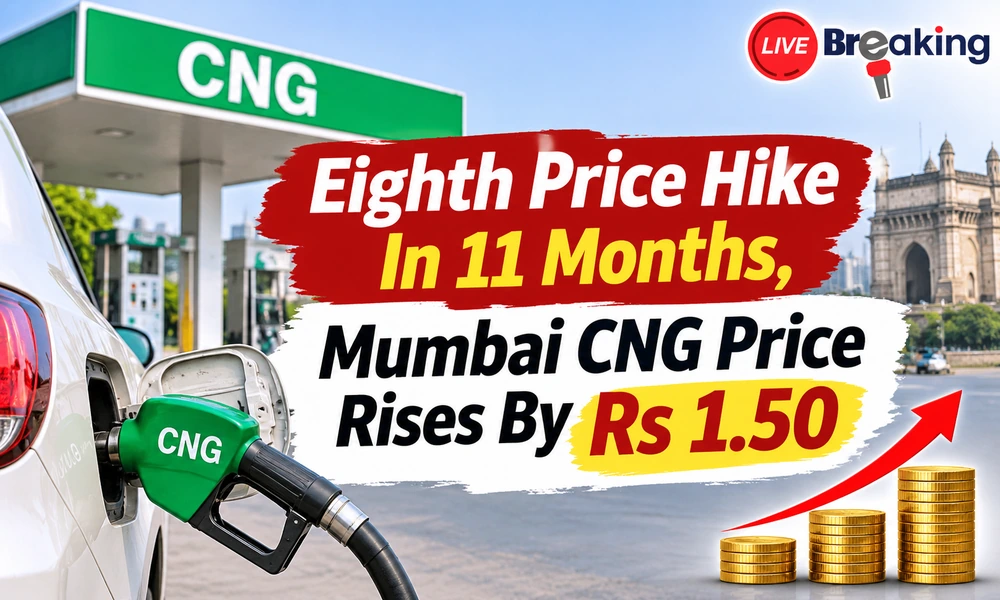
Mumbai CNG Price Hiked by ₹1.50: New Rate Reaches ₹91.50/kg
Mumbai motorists have another reason to worry about their monthly transportation expenses as compressed natural gas (CNG) prices have increased once again. Mahanagar Gas Limited (MGL) has raised the price of CNG by ₹1.50 per kg, taking the latest rate to ₹91.50 per kg across Mumbai and surrounding areas in the Mumbai Metropolitan Region (MMR).
The latest revision marks the eighth CNG price increase in approximately 11 months. With this development, motorists who depend on CNG-powered vehicles will have to spend more on fuel, adding further pressure to their monthly budgets.
The continuous increase is particularly significant for autorickshaw drivers, taxi operators, commercial vehicle owners and daily commuters who rely on CNG as their primary fuel. For people using their vehicles throughout the day, even a relatively small increase per kilogram can translate into a considerable additional expense over several weeks.
Mumbai CNG Price Reaches ₹91.50 Per Kg After Latest Hike
According to the latest announcement, MGL has increased CNG prices by ₹1.50 per kg. The revised price now stands at ₹91.50 per kg in Mumbai and the surrounding MMR areas.
The development comes after several price revisions during the year. At the beginning of January 2026, CNG was available at approximately ₹80.50 per kg. Following the latest increase, consumers are now paying ₹11 more per kilogram compared with the January rate.
This represents an overall increase of approximately 13.7%, or nearly 14%, in less than 11 months.
The latest price adjustment is another setback for consumers who had increasingly turned towards CNG-powered vehicles because of their comparatively economical running costs.
CNG Prices Have Increased Eight Times in 11 Months
The latest revision is particularly important because it is the eighth increase recorded during the period.
At the start of the year, CNG prices in Mumbai were around ₹80.50 per kg. Since then, repeated upward revisions have gradually pushed the cost to ₹91.50 per kg.
For regular consumers, the cumulative increase matters more than the latest ₹1.50 adjustment alone. Drivers who refuel their vehicles frequently are now facing a noticeably higher fuel bill compared with the beginning of the year.
The repeated increases may also influence the financial calculations of people considering purchasing a new CNG vehicle. Buyers generally compare the initial vehicle price, fuel efficiency, maintenance expenses and expected monthly running costs before choosing between petrol, diesel, electric and CNG-powered options.
When CNG becomes more expensive repeatedly, the potential savings associated with choosing this fuel may become smaller.
Why Have CNG Prices Increased in Mumbai?
The rising cost of gas procurement is the primary reason cited by MGL for the latest price revision.
Several factors have contributed to the pressure on the company’s procurement expenses.
1. Rising International Gas Prices
International developments, including the ongoing geopolitical situation in the Middle East, have created uncertainty in global energy markets.
Natural gas prices are influenced by international supply and demand conditions. Disruptions, geopolitical tensions and uncertainty surrounding energy transportation can affect procurement costs.
When imported gas becomes more expensive, city gas distribution companies may face higher expenses in maintaining supplies.
2. Reduction in Domestic Gas Allocation
Another important factor is the reduction in the allocation of domestically produced natural gas.
Domestic gas supplies are an important component of India’s energy requirements. When the availability of domestic gas decreases, companies may need to purchase additional quantities from alternative sources.
This can increase the overall cost of supplying CNG to consumers.
3. Greater Dependence on Imported Gas
MGL has also pointed towards an increased dependence on imported re-gasified liquefied natural gas (RLNG).
Imported RLNG is linked to international market prices and can therefore become more expensive when global gas prices rise.
Read More: “Congress, Others Have Not Had A Level Playing Field”: Sonia Gandhi Jabs BJP
A greater share of imported gas in the overall procurement mix can put additional pressure on the company’s operating costs.
4. Strong Demand for CNG
Demand for CNG remains another factor influencing the market.
CNG is widely used by public transport operators, commercial vehicle owners and private motorists. Strong demand, combined with changes in gas availability and procurement costs, can affect the economics of supplying the fuel.
MGL has indicated that the latest increase will help pass on part of the higher procurement expenses while maintaining a consistent and stable supply.
How Will the Latest CNG Price Hike Affect Auto and Taxi Drivers?
The increase is expected to have a direct impact on autorickshaw and taxi drivers across Mumbai.
Unlike private motorists, commercial drivers often consume larger quantities of fuel because they operate their vehicles for several hours every day.
An increase of ₹1.50 per kg may appear relatively small, but the additional expense can accumulate over time.
For example, a driver purchasing 10 kg of CNG will now pay ₹15 more for the same quantity compared with the previous price. A driver purchasing 20 kg will spend an additional ₹30.
Over a month, these additional costs can become significant, particularly for drivers operating on tight daily earnings.
Many commercial drivers already have to manage vehicle maintenance, permits, insurance, loan repayments and other operating expenses. Rising fuel prices can therefore put additional pressure on their take-home income.
Whether the increase will result in demands for higher autorickshaw or taxi fares remains to be seen. Any fare revision would depend on the applicable regulatory process and decisions by the relevant authorities.
Private Car Owners Will Also Feel the Impact
The latest CNG price increase is not limited to commercial vehicle operators.
Private car owners who use CNG-powered vehicles will also have to adjust their monthly fuel budgets.
Read More: Big Boost For Noida-Greater Noida Metro Connectivity, PM Shares “Good News”
For households that use CNG vehicles for daily office commutes, school transportation and regular travel, the higher rate means spending more money on the same amount of fuel.
The impact will depend on how frequently a vehicle is used and how much CNG it consumes.
For instance, someone purchasing 30 kg of CNG will pay ₹45 more at the new rate compared with the previous price. A household purchasing 60 kg will face an additional expense of ₹90.
Although these amounts may appear manageable individually, the cumulative impact of repeated price increases can become noticeable over several months.
Mumbai CNG Price Comparison: January vs November 2026
The following table highlights the change in CNG prices between the beginning of the year and the latest revision.
| Particulars | CNG Price |
|---|---|
| CNG price in January 2026 | ₹80.50/kg |
| Previous price before latest hike | ₹90.00/kg |
| Latest price increase | ₹1.50/kg |
| New CNG price | ₹91.50/kg |
| Total increase since January | ₹11.00/kg |
| Number of increases | 8 |
| Overall percentage increase | Approximately 13.7% |
Note: The previous price of ₹90 per kg is calculated by subtracting the latest ₹1.50 increase from the revised rate of ₹91.50. Prices are based on the reported revision and may vary by location or applicable supply conditions.
Will Mumbai Auto and Taxi Fares Increase After the CNG Price Hike?
One of the biggest concerns among commuters is whether the latest fuel price increase will eventually affect public transportation fares.
Read More: Bihar Gang Rape Survivor Thrown Off Rooftop Months After Assault, Suffers Serious Injuries
Autorickshaw and taxi operators depend heavily on fuel expenses to maintain their daily earnings. Repeated CNG price increases can make it difficult for drivers to manage their operating costs without affecting their income.
However, an increase in CNG prices does not automatically mean that passengers will have to pay higher fares.
Any change in regulated auto and taxi fares would require the appropriate approval or official notification from the relevant authorities.
Commuters should therefore wait for an official announcement rather than assume that the latest CNG price revision will immediately change existing fare rates.
MGL Exploring Ways to Control Rising Costs
Despite the latest increase, MGL has indicated that it is exploring different options to reduce procurement expenses.
The company has stated that it aims to identify opportunities to lower costs and pass on potential benefits to customers.
Maintaining a stable supply of natural gas is also an important priority, particularly because CNG plays a significant role in Mumbai’s transportation ecosystem.
However, the future direction of CNG prices will depend on several factors, including domestic gas availability, imported gas prices, international energy market conditions and overall demand.
If procurement costs continue to remain high, consumers may face further uncertainty regarding fuel expenses.
What Should Mumbai CNG Consumers Expect Next?
The latest increase highlights the challenges associated with maintaining affordable natural gas supplies amid changing domestic and international market conditions.
Read More: Global Outage Hits Microsoft, Outlook, Other 365 Services Down
For now, CNG consumers in Mumbai and the MMR will have to adjust to the revised price of ₹91.50 per kg.
Autorickshaw and taxi drivers may need to review their daily fuel budgets, while private vehicle owners could compare their monthly running costs with alternative fuel options.
Consumers should also keep track of official price announcements from MGL, as fuel rates can change depending on procurement costs and market conditions.
The bigger concern is the cumulative effect of repeated increases. With CNG becoming approximately 14% more expensive since January 2026, the latest development raises fresh questions about the affordability of this fuel for everyday commuters.
For thousands of commercial drivers and private motorists, the coming months will be important in determining whether CNG continues to offer the cost advantage that made it a popular alternative to conventional automotive fuels.
4. Frequently Asked Questions (FAQs)
Q1. What is the new CNG price in Mumbai?
The revised CNG price in Mumbai and the Mumbai Metropolitan Region is ₹91.50 per kg following the latest increase of ₹1.50 per kg announced by Mahanagar Gas Limited.
Q2. By how much has Mumbai CNG price increased?
CNG prices have increased by ₹1.50 per kg in the latest revision. Compared with the January 2026 price of ₹80.50 per kg, the cumulative increase has reached ₹11 per kg.
Q3. How many times has CNG become expensive in Mumbai in 2026?
CNG prices in Mumbai have been increased eight times in approximately 11 months. The repeated revisions have taken the price from ₹80.50 per kg in January to ₹91.50 per kg.
Q4. Why are CNG prices increasing in Mumbai?
The latest increase has been attributed to higher gas procurement costs, reduced domestic gas allocation, increased dependence on imported RLNG and international energy market uncertainty.
Read more: “PM Doesn’t Tap Phones”: Sam Pitroda Amid Rahul Gandhi Big Charge
Q5. Will auto and taxi fares increase after the CNG price hike?
Higher CNG prices could increase operating expenses for autorickshaw and taxi drivers. However, fuel price revisions do not automatically change passenger fares. Any fare adjustment would require the applicable official approval.
Q6. Who will be affected by the latest CNG price increase?
The increase will affect autorickshaw drivers, taxi operators, commercial vehicle owners and private motorists using CNG-powered vehicles across Mumbai and surrounding areas.
Q7. What was the CNG price in Mumbai in January 2026?
CNG was priced at approximately ₹80.50 per kg in January 2026. Following eight increases, the latest reported price has reached ₹91.50 per kg.
Q8. Will CNG prices increase further in Mumbai?
Future CNG price movements will depend on domestic gas allocation, international RLNG prices, procurement expenses and demand. No further increase should be assumed without an official announcement from the gas supplier.