

Delhi Building Collapse: How Basement Repair Work and an Unstable Structure Led to the Satya Niketan Tragedy
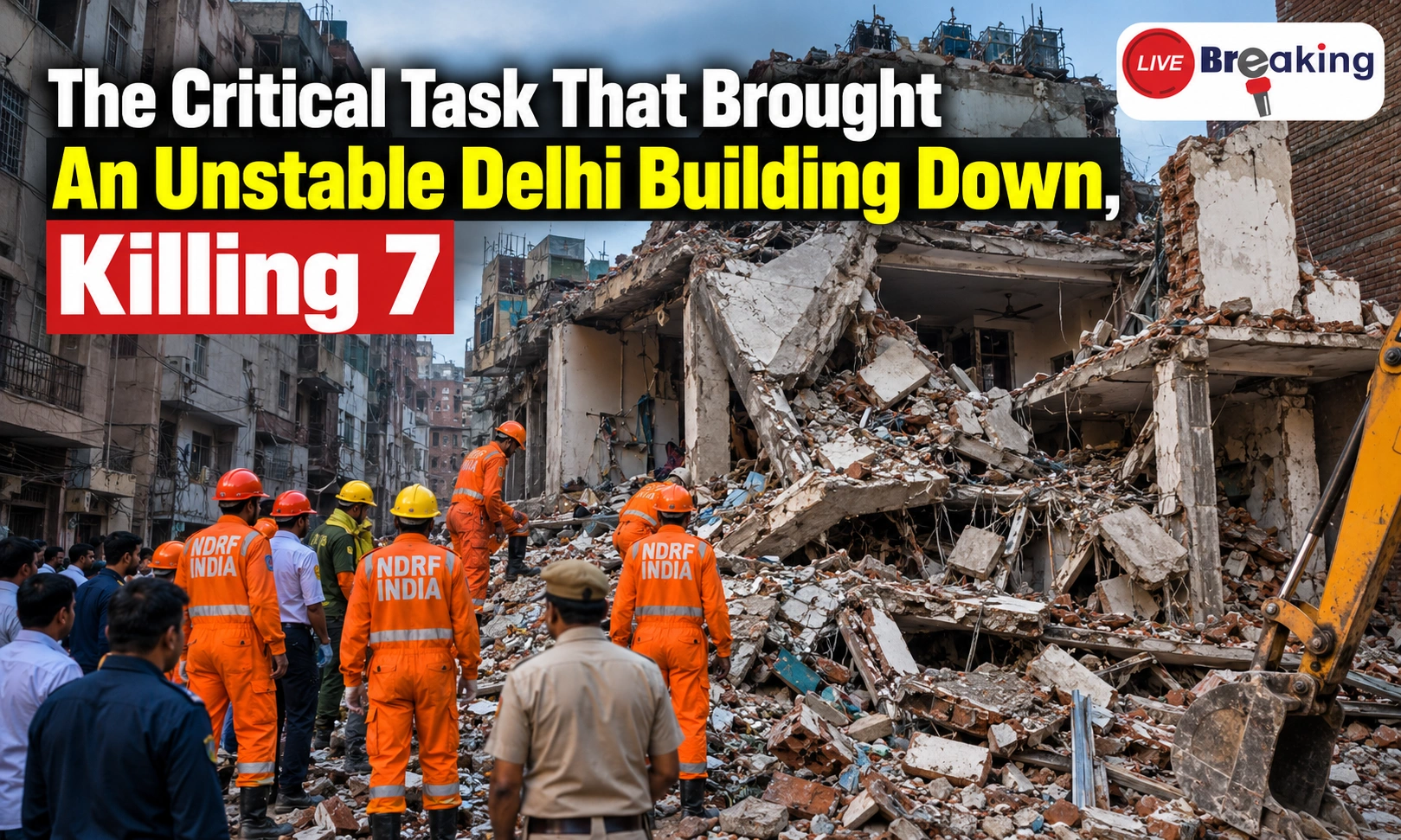
New Delhi: A deadly building collapse in Delhi’s Satya Niketan has raised fresh questions about the safety of ageing buildings, basement renovation work and structural oversight in densely populated parts of the capital. A nearly 50-year-old building in the area collapsed while repair work was reportedly being carried out in its basement, killing seven people and injuring several others.
The building, located near Delhi University’s South Campus, was being used as a boys’ paying guest accommodation. Preliminary information suggests that a critical structural failure occurred during renovation activity in the basement. According to the latest findings cited by NDTV, a pillar reportedly became unstable and lost support, weakening the structure and eventually causing the building to collapse.
Delhi Chief Minister Rekha Gupta has also said that water accumulation in the basement, combined with repair work on the ageing structure, contributed to the collapse. Authorities are continuing rescue, inspection and investigation operations at the site.
What Happened at Satya Niketan?
The incident took place on Sunday in Satya Niketan, a busy locality near Delhi University’s South Campus that has become a major residential and accommodation hub for students.
The collapsed property was an old multi-storey building with a basement and five upper floors. It was being used as a paying guest facility when the structure suddenly gave way.
The collapse happened rapidly, turning the building into a large pile of concrete, masonry and debris. Rescue teams, including the National Disaster Response Force and other emergency personnel, were deployed to search the rubble and assist those trapped inside.
The latest NDTV report says seven people lost their lives and six others were injured. Rescue operations and structural assessments continued as authorities dealt with the danger posed by nearby buildings.
The Critical Task: Basement Repair Work
The central question surrounding the tragedy is what happened beneath the building before it collapsed.
Preliminary information indicates that renovation or repair work was being undertaken in the basement. During the work, a pillar reportedly became unstable and lost structural support.
A building’s columns and pillars are critical components of its load-bearing system. If support is removed, weakened or disturbed without appropriate engineering measures, the loads carried by that part of the structure can shift unexpectedly to other elements.
In an ageing building, that risk can become even greater because the original structure may already have experienced deterioration, modifications or changes in loading conditions over several decades.
Delhi minister Manjinder Singh Sirsa said preliminary information indicated that work in the basement of the decades-old building may have triggered the accident.
Water Accumulation Added to the Risk
Water in the basement has emerged as another major factor in the preliminary explanation.
Chief Minister Rekha Gupta said that water had accumulated in the basement and that the combination of water accumulation and ongoing repair work on the old structure led to the collapse. She said a large portion of the debris had already been removed, while rubble from the basement remained particularly challenging for rescue teams.
Water accumulation can create serious problems for an ageing structure, particularly when construction or excavation work is taking place nearby. Depending on the circumstances, water can affect soil conditions, foundations and construction materials.
However, the exact technical chain of failure must be established through a detailed structural investigation. It would be premature to attribute the entire collapse to one factor before experts complete their assessment.
Why an Old Building Can Become Vulnerable
The Satya Niketan tragedy has once again highlighted the risks associated with ageing buildings in rapidly developing urban neighbourhoods.
Buildings that were originally designed for one purpose may later be converted into hostels, paying guest accommodation, offices or other high-occupancy uses. Additional floors or alterations may also change the load carried by the original structure.
The Indian Express has reported that investigators are examining issues including additional floors, repair work and the absence of adequate safety checks at the building.
Read More: One Hour Of Rain Exposes Gurugram Civic Infrastructure Again
Such changes do not automatically mean a building is unsafe. But structural modifications should be assessed and carried out under appropriate engineering supervision, particularly when work affects foundations, columns, beams or basements.
MCD Issues Demolition Order
Following the collapse, the Municipal Corporation of Delhi issued a demolition order for House No. 13 in Satya Niketan under Section 348 of the Delhi Municipal Corporation Act.
The civic body declared the property dangerous and ruinous and directed the owner or occupier to demolish it within three days of receiving the order. If the order is not complied with, the MCD said it can undertake the demolition and recover the associated expenses as arrears of property tax.
The action reflects the immediate safety concerns surrounding the property and the surrounding area.
Neighbouring Buildings Also Under Scrutiny
The collapse has created an additional challenge for rescue teams because nearby structures could themselves pose a risk.
According to the latest report, an adjacent building, also believed to be several decades old, was evacuated and is slated for demolition. Officials have been cautious because removing debris from the collapsed structure could affect the stability of nearby buildings.
Read More: Kriti Sanon’s Rakhi Ad Pulled Down Amid Feud With Kangana Ranaut Over ‘Bikini’ Remark
This is particularly important in densely packed neighbourhoods where buildings stand close together and emergency vehicles and rescue machinery have limited access.
Government Orders Wider Structural Checks
The Satya Niketan collapse has also prompted calls for stronger structural safety measures.
Chief Minister Rekha Gupta said dangerous buildings would not be spared and announced structural audits and inspections. She also directed action against officials if negligence or oversight is established.
Authorities have also been inspecting nearby paying guest accommodations and other buildings, with violations potentially leading to sealing or further action.
The incident has therefore moved beyond the question of one building. It has raised concerns about whether ageing properties being used as student accommodation and other high-occupancy premises are being adequately monitored.
Why Basement Construction Requires Special Care
Basement work is structurally sensitive because it can involve excavation, drainage, waterproofing, foundation modifications and changes to soil conditions.
If a building remains occupied while significant structural work is being undertaken, the risks can increase further. Engineers normally need to assess how temporary construction activity will affect the existing load-bearing system.
The Satya Niketan incident demonstrates why basement renovation in an old building cannot be treated as ordinary interior renovation.
Work involving structural members should be planned, supervised and monitored by qualified professionals, with appropriate safety measures in place.
What Happens Next?
The immediate priorities are rescue, medical treatment, debris removal and making neighbouring structures safe.
The longer-term questions will involve determining exactly how the building failed, whether repair work had the necessary approvals, whether structural modifications had been made over the years and whether there were regulatory or enforcement failures.
A proper investigation will be important because identifying the precise sequence of structural failure can help authorities prevent similar accidents elsewhere.
The tragedy also serves as a warning for residents, property owners and operators of paying guest accommodations: visible cracks, water accumulation, unauthorised construction, unusual movement or structural alterations should never be ignored.
Read More: “There’s Pressure”: Congress vs BJP As Penguin India Drops Sonia Gandhi’s Memoir
Satya Niketan Building Collapse: Key Facts
| Detail | Information |
|---|---|
| Location | Satya Niketan, New Delhi |
| Area | Near Delhi University’s South Campus |
| Building type | Multi-storey building used as boys’ PG accommodation |
| Age | Approximately 40–50 years |
| Structure | Basement plus five upper floors |
| Reported deaths | 7, according to the latest referenced NDTV version |
| Reported injuries | Several people injured |
| Preliminary factors | Basement repair work, water accumulation and structural instability |
| Critical structural issue | Pillar reportedly lost support |
| Rescue agencies | NDRF and other emergency teams |
| Civic action | MCD demolition order |
| Investigation status | Ongoing |
FAQs
What caused the Satya Niketan building to collapse?
Preliminary findings indicate that basement repair work and water accumulation contributed to the collapse of the ageing building. A pillar reportedly became unstable and lost structural support during the work. Authorities are continuing to investigate the precise sequence of events.
How many people died in the Delhi Satya Niketan building collapse?
The latest version of the referenced NDTV report states that seven people died in the Satya Niketan building collapse. Several others were injured and rescue operations continued at the site.
Was repair work taking place when the building collapsed?
Yes. Preliminary reports indicate that repair or renovation work was underway in the basement when the building collapsed. Officials are examining whether the work weakened critical structural components.
Did water in the basement contribute to the collapse?
Delhi Chief Minister Rekha Gupta said preliminary findings indicated that water accumulation in the basement, together with ongoing repair work, contributed to the building’s collapse. A detailed investigation is needed to establish the complete technical cause.
Read More: Nepal Floods Raise A Bigger Question: Could A Similar Disaster Hit Bengal?
What action has the MCD taken?
The Municipal Corporation of Delhi issued a demolition order for House No. 13 in Satya Niketan under Section 348 of the Delhi Municipal Corporation Act after declaring the property dangerous and ruinous.
Are nearby buildings also being inspected?
Yes. Authorities have evacuated and assessed nearby structures because the collapsed building created additional structural risks. An adjacent building has reportedly been slated for demolition after evacuation.
Why is basement repair dangerous in an old building?
Basement work can affect foundations, pillars, soil conditions and the distribution of structural loads. In an ageing building, these risks can be more significant, making proper structural assessment and engineering supervision essential.
Conclusion
The Satya Niketan building collapse is a devastating reminder of the dangers that can emerge when ageing structures undergo major alterations without adequate structural safeguards.
Read More: Vijay Steps On Formula 1 Gas, Announces Mega Olympic City In Chennai
The preliminary picture points toward a combination of basement repair work, water accumulation and the failure of structural support. But the final cause will depend on the findings of the authorities and structural experts investigating the incident.
With seven people dead and several others injured, the tragedy has placed renewed attention on the safety of Delhi’s ageing buildings, particularly properties converted into student PGs and other high-occupancy accommodations.
The most important lesson is that structural work is fundamentally different from cosmetic renovation. When foundations, basements, pillars or load-bearing elements are involved, even seemingly limited changes can have serious consequences if they are not properly assessed and executed.
The Satya Niketan collapse should therefore lead not only to accountability in this particular case, but also to stronger structural inspections, better enforcement and greater awareness of building safety across Delhi.
Like this post?