

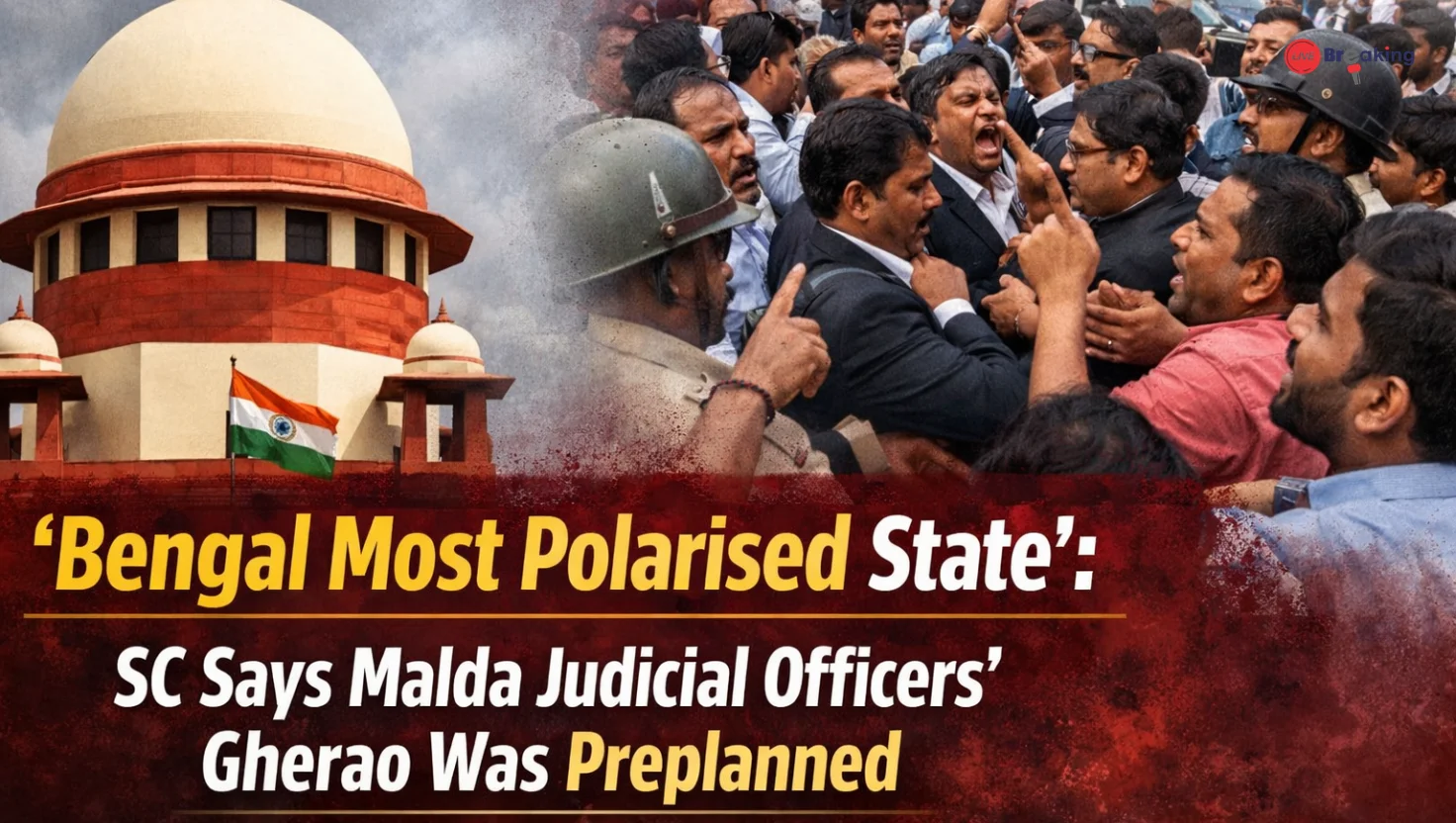
‘Bengal Most Polarised State’: SC Says Malda Judicial Officers’ Gherao Was Preplanned
Bengal Most Polarised State: In a significant observation that has sparked political and legal debate, the Supreme Court of India described West Bengal as the “most polarised state” while hearing a case involving the gherao of judicial officers in Malda. The court’s remarks came during proceedings examining whether the incident was spontaneous or a calculated act aimed at intimidating the judiciary.
The strong wording used by the apex court highlights growing concerns over law and order, political tensions, and the safety of judicial institutions in the state.
What Happened in Malda?
The controversy stems from an incident in Malda district where judicial officers were allegedly surrounded and obstructed—commonly referred to as a “gherao.” The incident raised serious concerns about judicial independence and security.
Key Details of the Incident
- Judicial officers were reportedly confined and prevented from carrying out their duties
- The gathering was not spontaneous but allegedly organized
- Local tensions escalated quickly, drawing national attention
- The matter reached the Supreme Court due to its constitutional implications
The judiciary viewed the situation as a direct challenge to its authority and functioning.
Supreme Court’s Observations
During the hearing, the Supreme Court made strong remarks regarding the nature of the incident.
“Preplanned and Calculated”
The bench noted that the gherao did not appear to be an impulsive protest but rather a “preplanned and calculated” act. This observation suggests a deeper level of coordination behind the incident.
“Most Polarised State” Remark
The court also described West Bengal as the “most polarised state,” pointing toward ongoing political and social divisions that may be influencing such incidents.
This statement has triggered sharp reactions across political circles and civil society.
Why This Case Matters
The Malda incident is not just a local law-and-order issue—it has broader implications for democracy and governance.
Threat to Judicial Independence
When judicial officers are obstructed or intimidated:
- It undermines the rule of law
- It creates fear within the judiciary
- It sets a dangerous precedent
Political Polarisation
The court’s remark highlights:
- Increasing political divisions
- Influence of local power groups
- Potential erosion of institutional neutrality
Legal Implications
The case raises several legal questions that could shape future rulings.
Contempt of Court
Obstructing judicial officers may fall under contempt:
- Interference with judicial proceedings
- Disrespect to court authority
Accountability
Authorities may be required to:
- Identify those responsible
- Ensure protection for judicial officers
- Prevent recurrence
Read More: Iran War Analysis 2026: How Conflict Could Strengthen Iran & Expose Gulf Vulnerabilities
Political Reactions
The Supreme Court’s observations have led to mixed reactions:
| Stakeholder | Reaction |
|---|---|
| Opposition Parties | Criticised state governance and law enforcement |
| State Government | Defended its position and questioned the remarks |
| Legal Experts | Supported judicial concern over safety |
| Public | Divided opinions reflecting broader polarisation |
Impact on Judiciary and Governance
The long-term consequences of such incidents can be significant.
For the Judiciary
- Increased demand for security
- Possible reluctance to serve in sensitive areas
- Institutional stress
Read more: Iran War May End in 2 Weeks: Global Oil Crisis, Economic Risks & What Happens Next
For Governance
- Pressure on administration to maintain law and order
- Scrutiny from higher courts
- Impact on state image
Broader Context: Rising Tensions in Bengal
West Bengal has witnessed multiple instances of political conflict in recent years. The Supreme Court’s remark reflects:
- Deep-rooted political rivalry
- Frequent clashes during elections
- Allegations of administrative bias
The Malda incident appears to be part of this larger pattern.
What Happens Next?
The case is expected to proceed with:
- Further investigation into the incident
- Possible directives from the Supreme Court
- Monitoring of law and order measures
Read more: Married Man in Live-In Relationship: Allahabad High Court Gives Contrasting Judgments in Two Cases
The outcome could set an important precedent regarding protection of judicial officers.
FAQs
Q1: What is the Malda judicial officers’ gherao case?
It refers to an incident where judicial officers in Malda were surrounded and allegedly prevented from performing their duties.
Q2: What did the Supreme Court say about the incident?
The court called it “preplanned and calculated” and described West Bengal as the “most polarised state.”
Q3: Why is this case important?
It raises concerns about judicial independence, law and order, and political influence on institutions.
Q4: What is a gherao?
A gherao is a form of protest where individuals surround a person or place, often restricting movement.
Q5: What legal action can be taken?
Those involved may face contempt of court charges and other legal consequences.
Read more: Plane and Truck Collision at LaGuardia Airport: Multiple Injuries Reported in New York
Conclusion
The Supreme Court’s strong remarks on the Malda judicial officers’ gherao case have brought national attention to issues of judicial safety and political polarisation in West Bengal. By calling the incident “preplanned and calculated,” the court has emphasized the seriousness of the matter and the need for accountability.
As the case unfolds, it will not only determine responsibility for the Malda incident but also shape the broader discourse around the independence of the judiciary and the role of governance in maintaining constitutional order.