

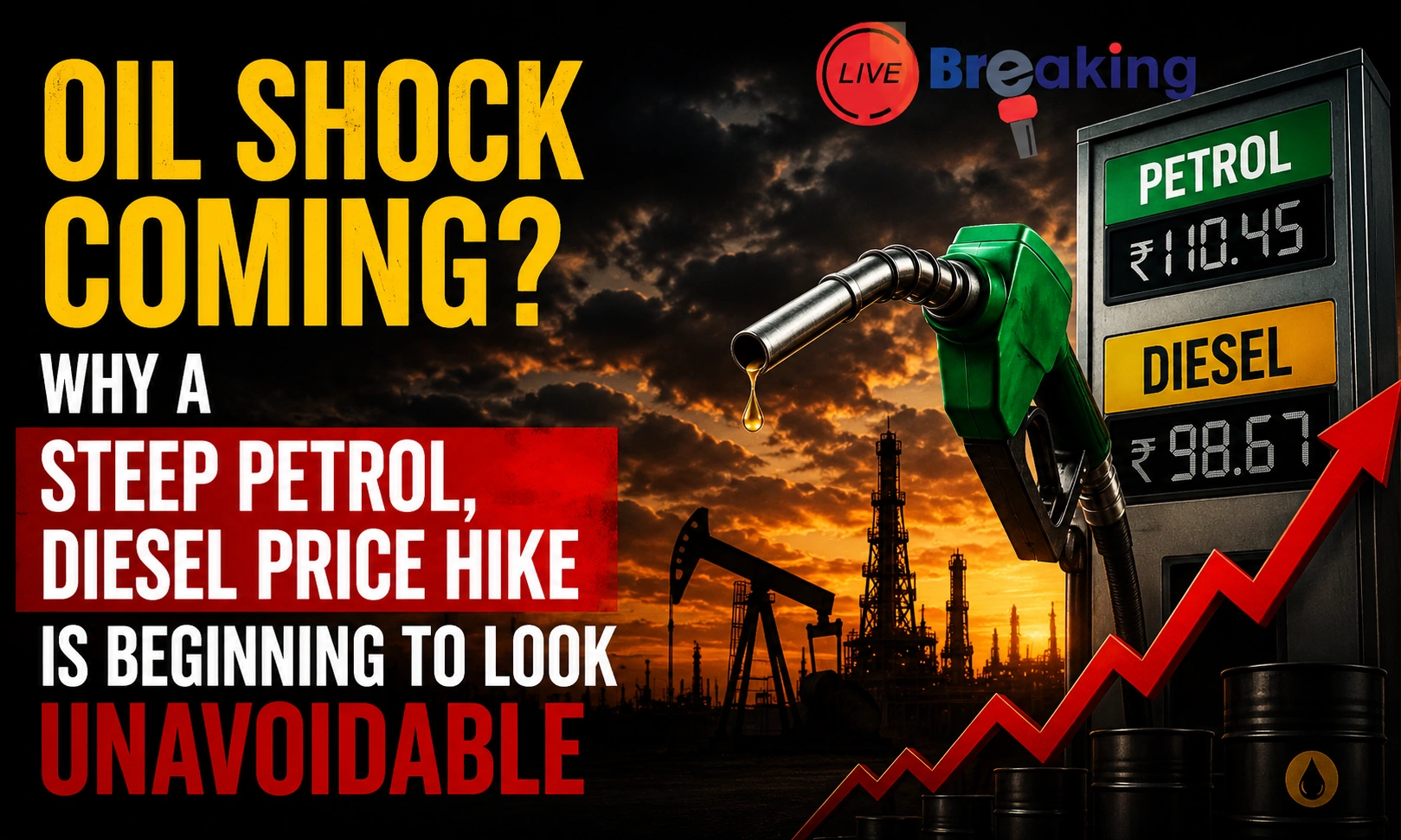
Oil Shock Coming? Why A Steep Petrol, Diesel Price Hike Is Beginning To Look Unavoidable
India may soon witness a major fuel price shock as rising global crude oil prices, geopolitical tensions in the Middle East, and mounting losses faced by oil marketing companies push petrol and diesel rates toward an unavoidable increase. While fuel prices have remained largely unchanged in recent years, experts and government officials are now openly acknowledging that sustaining the current pricing structure may no longer be financially possible.
The growing crisis has sparked concerns among consumers, transporters, businesses, and policymakers alike. If petrol and diesel prices rise sharply in the coming weeks, it could directly impact inflation, transportation costs, food prices, and household budgets across the country.
Why Is India Facing A Possible Fuel Price Hike?
The biggest reason behind the expected fuel price hike is the sharp increase in international crude oil prices. Global oil markets have become extremely volatile due to the ongoing geopolitical tensions in the Middle East and disruptions around the Strait of Hormuz, a key global oil supply route.
India imports more than 90% of its crude oil requirements, making the country highly vulnerable to international price fluctuations. When crude oil becomes expensive globally, Indian oil companies are forced to pay more for imports. However, retail petrol and diesel prices in India have remained largely frozen since April 2022, despite rising global costs.
As a result, oil marketing companies are reportedly absorbing massive financial losses every day.
Oil Companies Under Massive Financial Pressure
According to recent reports, public sector oil marketing companies are losing nearly ₹1,000 crore every day by selling petrol and diesel below market-linked prices.
Officials have reportedly indicated that these losses are becoming unsustainable. Some estimates suggest that state-run oil firms have already suffered losses exceeding ₹1 lakh crore in recent months due to the ongoing crude oil surge.
Petroleum Minister Hardeep Singh Puri recently hinted that oil companies may not be able to continue bearing these losses indefinitely. This statement has been interpreted as a strong indication that fuel prices may soon be revised upward.
How The Middle East Crisis Is Affecting Fuel Prices
The ongoing instability in the Middle East has created serious uncertainty in global energy markets. The Strait of Hormuz handles a significant portion of the world’s oil transportation, and any disruption there directly impacts oil supply and prices globally.
Several analysts believe that if tensions continue or worsen, crude oil prices could cross critical levels, making it nearly impossible for India to maintain current retail fuel rates.
Read More: Thalapathy Vijay Wins Again, TVK Crosses 118-Mark With VCK, Left Support
Reserve Bank of India Governor Sanjay Malhotra also recently warned that petrol and diesel price hikes could become inevitable if the Middle East conflict persists for a longer duration.
What Could Be The Impact On Common People?
A sharp increase in petrol and diesel prices could affect almost every sector of the economy. Fuel is directly linked to transportation, logistics, manufacturing, agriculture, and essential services.
Here are some likely consequences if fuel prices rise significantly:
| Sector | Possible Impact |
|---|---|
| Transportation | Higher cab, bus, and freight charges |
| Food Prices | Increase in vegetable and grocery prices |
| Household Budget | Rising monthly expenses |
| Inflation | Overall increase in cost of living |
| Businesses | Higher operational and logistics costs |
| Agriculture | Increased farming and transport expenses |
Since diesel powers a large part of India’s transportation and agricultural infrastructure, any increase in diesel prices could quickly lead to inflationary pressure across markets.
Will The Government Intervene?
The government faces a difficult balancing act. On one hand, keeping fuel prices low helps control inflation and protects consumers. On the other hand, continuously shielding consumers from global price increases creates enormous financial pressure on oil companies and public finances.
Experts believe the government may explore several options before implementing a steep hike, including:
- Reducing excise duties temporarily
- Offering limited support to oil companies
- Introducing gradual instead of sudden price hikes
- Encouraging fuel conservation measures
However, reports suggest that compensating oil companies indefinitely may not be fiscally sustainable anymore.
Read More: $72 Billion: The Forex Logic Behind PM Modi Appeal To Avoid Buying Gold
Could Petrol And Diesel Prices Rise Soon?
While there has been no official announcement yet, several recent statements from policymakers and industry experts indicate that fuel price hikes may happen sooner rather than later.
Market experts believe the timing and scale of any hike will depend on:
- Global crude oil trends
- Stability in the Middle East
- Government policy decisions
- Inflation concerns
- Oil company financial health
If crude prices remain elevated for an extended period, analysts believe a retail fuel price revision may become unavoidable.
Can India Reduce Dependence On Imported Oil?
The current crisis has once again highlighted India’s dependence on imported crude oil. Experts say the long-term solution lies in reducing reliance on fossil fuel imports through:
- Expansion of electric vehicles
- Greater use of renewable energy
- Increased ethanol blending
- Domestic oil exploration
- Public transport modernization
India has already been investing heavily in renewable energy and EV infrastructure, but the transition will take time.
Read More: Employee Email To HR Seeking 1-Year WFH After PM Modi Fuel-Saving Appeal Goes Viral
What Are Experts Saying?
Industry leaders and economists have increasingly warned that the current fuel pricing situation cannot continue forever.
Former HPCL Chairman MK Surana recently said fuel price hikes may become inevitable amid rising crude stress and widening under-recoveries faced by oil companies.
Banker Uday Kotak also warned about a “major shock” coming through rising oil prices and stressed the need for stronger economic resilience.
These statements reflect growing concern across sectors that India may soon face difficult economic choices if the global oil crisis intensifies further.
Conclusion
India’s fuel pricing system is under increasing pressure as global crude oil prices surge and geopolitical tensions continue to disrupt energy markets. While petrol and diesel prices have remained stable for consumers so far, the financial burden on oil companies is mounting rapidly.
Read more: NEET UG 2026 Paper Leak: How a Nashik Student Allegedly Leaked Exam 45 Hours Before Test
With policymakers, economists, and industry leaders all warning about the unsustainable nature of current pricing, a fuel price hike now appears increasingly likely. For millions of Indians, the coming weeks could determine whether the country manages to absorb the global oil shock—or passes the impact directly to consumers at petrol pumps.
FAQ
Q1. Why are petrol and diesel prices expected to rise in India?
Petrol and diesel prices may rise due to increasing global crude oil prices, Middle East tensions, and heavy losses faced by Indian oil marketing companies.
Q2. How much are oil companies losing currently?
Reports suggest public sector oil companies are losing nearly ₹1,000 crore per day by selling fuel below market-linked prices.
Read More: NEET UG 2026 Exam Cancelled After Paper Leaks, Protests Erupt In Delhi
Q3. What is causing global oil prices to increase?
Geopolitical tensions in the Middle East and disruptions around the Strait of Hormuz are major reasons behind rising global crude prices.
Q4. Will fuel price hikes increase inflation?
Yes, higher petrol and diesel prices can increase transportation costs, food prices, and overall inflation.
Q5. Can the government stop fuel price hikes?
The government may provide temporary relief through tax cuts or subsidies, but experts believe long-term price control may not be sustainable.