India-US Trade: Exports Rise 11.1%, China Deficit Widens
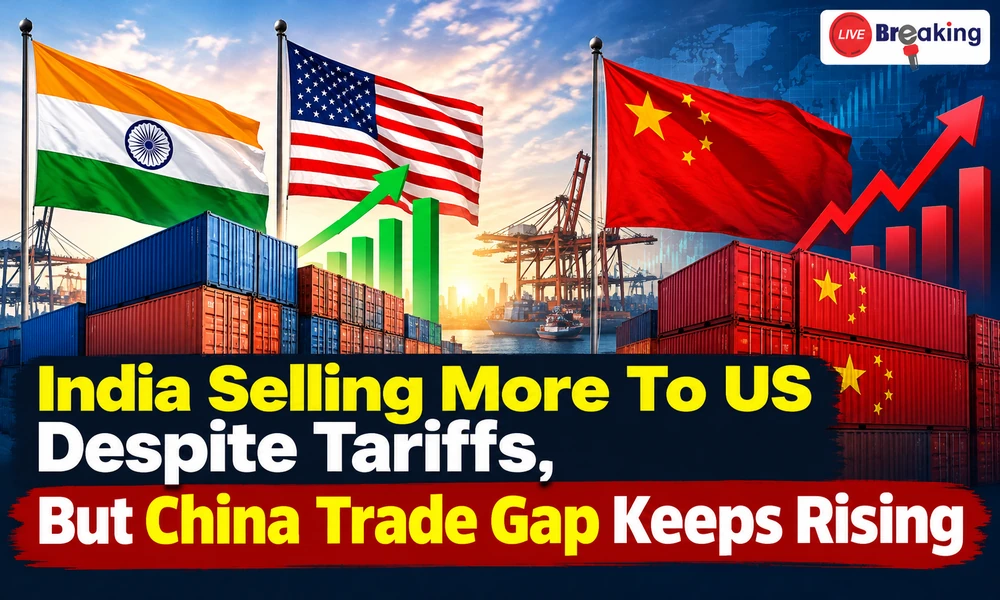
India’s international trade is presenting two contrasting trends. On one side, Indian exporters are increasing shipments to the United States despite tariff-related uncertainty. On the other, India’s trade deficit with China remains a major economic challenge as imports continue to exceed exports by a substantial margin.
India’s merchandise exports to the United States reached $50.81 billion during April–September 2026, representing an increase of 11.1% compared with $45.73 billion in the corresponding period a year earlier.
Meanwhile, India’s exports to China increased by 40.7% to $19.26 billion during January–September 2026. However, imports from China rose to $125.19 billion, resulting in a trade deficit of $105.93 billion over the same period.
These figures highlight an important difference between the two trading relationships. India is continuing to find buyers for its products in the American market, while its growing commercial engagement with China has not yet translated into a comparable balance between exports and imports.
The developments also raise questions about India’s export competitiveness, domestic manufacturing capabilities, dependence on imported industrial components and the potential impact of international trade policies on businesses.
India’s Exports to the US Increase Despite Tariff Uncertainty
The United States remains an important destination for Indian goods, making the latest export growth significant for businesses across several sectors.
India’s exports to the US increased from $45.73 billion to $50.81 billion during April–September 2026. The 11.1% rise suggests that American demand for Indian products has remained resilient despite uncertainty surrounding tariffs and trade negotiations.
However, export growth alone does not establish that tariffs have had no effect. Indian companies could have experienced higher costs, reduced profit margins or greater pressure to offer competitive prices to overseas buyers.
For exporters, the challenge is to maintain their market share while managing changing trade conditions. Businesses must consider not only the price of their products but also shipping expenses, production costs, delivery schedules and the tariff treatment of competing goods.
The performance of Indian exporters will therefore depend on their ability to remain competitive while adapting to changing international trade rules.
India-US Trade Deal Could Influence Future Export Opportunities
Trade negotiations between India and the United States remain an important factor for businesses planning their export strategies.
The first phase of an India-US trade deal was nearing completion. It also cited a Reuters report concerning a proposed reduction in the announced tariff burden, while noting that finalisation was still pending at the time of publication.
Any eventual agreement could influence the relative competitiveness of Indian products in the American market. More predictable tariff arrangements could help businesses make investment decisions, negotiate supply contracts and plan production over longer periods.
Nevertheless, the actual impact will depend on the final terms of the agreement, the products covered and the treatment of Indian goods compared with competing exports from countries such as Vietnam, Bangladesh and Indonesia.
For now, the latest export figures indicate continued growth, but the longer-term outlook will depend on both market demand and trade policy.
India’s Overall Merchandise Exports Show Strong Growth
India’s export performance extends beyond the American market.
According to the figures cited in the report, India’s overall merchandise exports rose 18.51% to $259.89 billion during April–September 2026–27, compared with $219.30 billion in the corresponding period a year earlier.
This growth rate was higher than the 11.1% increase recorded for exports to the United States. The comparison suggests that Indian exports are expanding across a broader range of international markets, although individual sectors and destinations may be experiencing different conditions.
Electronics, petroleum products, chemicals and engineering goods have contributed to the wider export expansion.
Electronics exports, in particular, recorded a notable increase. The report cited a 70.44% year-on-year rise to $5.31 billion in September 2026.
The performance of electronics is important because the sector offers opportunities to expand manufacturing, attract investment, develop supplier networks and create skilled employment. However, the long-term benefits will depend partly on how much value is added within India.
Read More: ‘Head, Hands Almost Severed’: Dentist Treats Indian Pilot On flydubai Plane
If production relies heavily on imported components, higher exports may not translate into an equally large increase in domestic value creation. Strengthening component manufacturing and developing local suppliers could help India capture a greater share of the value generated by export industries.
Why Is India’s Trade Deficit With China Increasing?
India’s trade relationship with China presents a different picture.
India’s exports to China increased 40.7% to $19.26 billion during January–September 2026. Despite this strong percentage increase, imports from China reached $125.19 billion, producing a trade deficit of $105.93 billion.
The key issue is the substantial difference between the value of goods India sells to China and the value of goods it purchases from the country.
Even rapid export growth may have a limited effect on the overall trade balance when imports begin from a much higher base and continue to rise.
China supplies a wide range of goods required by Indian manufacturers, infrastructure projects and consumers. These include electronics, machinery, chemicals, industrial components and other production inputs.
Indian businesses depend on some of these imports to manufacture finished products, expand industrial capacity and serve domestic and international markets.
India, meanwhile, exports a smaller range of goods to China, including certain ores, fuels, seafood and agricultural products.
This difference in trade composition contributes to the imbalance. Increasing exports is important, but reducing the deficit also requires Indian businesses to become more competitive in product categories where imports currently dominate.
Higher Imports Can Offset Strong Export Growth
The latest figures demonstrate why export growth rates must be considered alongside absolute trade values.
A 40.7% increase in exports to China appears substantial. However, exports totalled $19.26 billion during the reported nine-month period, compared with imports of $125.19 billion.
The difference between these figures is too large to be eliminated through export growth alone in the short term.
India’s trade deficit with China stood at $112.6 billion in the 2025–26 financial year, according to the report. The report also cited imports of $131.63 billion and exports of $19.47 billion for that financial year.
The persistence of the deficit highlights the need for a long-term strategy that combines export diversification, domestic manufacturing investment and improvements in industrial productivity.
At the same time, policymakers must recognise that some imported products are essential for domestic production. Reducing dependence on foreign suppliers should not disrupt industries that rely on imported machinery, components or raw materials.
India-US Trade Surplus Versus India-China Trade Deficit
The latest reported figures show a clear difference between India’s trade balances with its two major trading partners.
| Trade Indicator | United States | China |
|---|---|---|
| Reporting period | April–September 2026 | January–September 2026 |
| India’s exports | $50.81 billion | $19.26 billion |
| Export growth | 11.1% | 40.7% |
| India’s imports | $32.33 billion | $125.19 billion |
| Trade balance | $18.48 billion surplus | $105.93 billion deficit |
| Main concern | Tariff uncertainty and competitiveness | High import dependence |
The comparison shows that India exported considerably more goods to the United States than to China during the respective reported periods. More importantly, India recorded a merchandise trade surplus with the US while maintaining a substantial deficit with China.
Read More: ‘Create Fear In The Minds Of Culprits’: SC’s 5 Big Observations On Women Safety In Delhi
These figures should not be interpreted as a direct comparison of performance over identical periods. Nevertheless, they illustrate how different trade structures can produce very different economic outcomes.
A trade surplus with one country does not automatically offset a deficit with another, and the overall effect depends on India’s complete trade account.
What the Latest Trade Figures Mean for Indian Businesses
For Indian exporters, the growth in US-bound shipments offers opportunities to expand overseas sales and strengthen relationships with international buyers.
Businesses operating in electronics, engineering goods, chemicals and other export-oriented industries may benefit from stronger market access, improved production efficiency and diversification of their customer base.
However, rising export revenue does not automatically mean that companies are earning higher profits.
Exporters may face additional costs related to tariffs, logistics, financing, compliance and competitive pricing. Some businesses may absorb these costs to retain customers, reducing the margins they earn from each shipment.
This makes the quality of export growth just as important as the headline numbers. Policymakers and businesses need to assess domestic value addition, employment creation, productivity and profitability alongside export revenue.
India can strengthen its export position by improving access to affordable export credit, ensuring timely tax refunds, upgrading transport and port infrastructure, and helping companies meet international quality and regulatory standards.
Small and medium-sized businesses may particularly benefit from easier access to finance, market information and export support services.
At the same time, expanding the domestic manufacturing ecosystem could reduce reliance on imported components and improve the competitiveness of Indian-made products.
Can India Reduce Its Dependence on Chinese Imports?
Reducing the trade deficit with China is likely to require a combination of measures rather than a single policy intervention.
First, India needs to expand the domestic production of goods that can be manufactured competitively within the country. This includes selected electronics components, industrial machinery, chemicals and other products for which viable local production can be developed.
Second, Indian exporters need to identify opportunities in the Chinese market and other international destinations. Expanding the range of products exported can reduce dependence on a narrow set of commodities and help businesses respond to changing global demand.
Third, investment in technology, workforce skills, research and development and industrial infrastructure can improve productivity. More competitive domestic suppliers would give manufacturers additional sourcing options and could gradually reduce dependence on imported inputs.
Fourth, trade policy must balance domestic industrial development with the needs of existing businesses. Abrupt restrictions on imported machinery or components could increase production costs and affect companies that depend on these goods.
The objective should therefore be to build a stronger and more competitive manufacturing base, not simply to reduce imports regardless of their economic purpose.
Read More: RBI Hikes Repo Rate By 25 Basis Points To 5.5% Amid Rising Inflation
India’s ability to narrow the trade deficit will depend on whether domestic suppliers can deliver products at competitive prices, maintain quality and meet the requirements of Indian manufacturers.
Outlook: What to Watch in India’s Trade Performance
The latest trade figures point to both opportunities and challenges for the Indian economy.
The increase in exports to the United States suggests that Indian products continue to find demand in a market affected by trade-policy uncertainty. Progress in bilateral negotiations could provide greater clarity for exporters, although the final outcome and its sector-specific implications remain important.
The rise in overall merchandise exports also indicates that India is expanding its presence in global markets. Continued growth in electronics, engineering goods, chemicals and other manufacturing sectors could support this trend if it is accompanied by stronger domestic value addition.
However, the trade deficit with China remains a major concern. Rising exports are encouraging, but the much larger import bill means that the imbalance is unlikely to disappear without sustained improvements in domestic industrial capacity and export competitiveness.
Investors, businesses and policymakers will need to monitor future trade data, tariff developments, manufacturing investment and changes in the composition of imports and exports.
Ultimately, the objective is not merely to increase the total value of goods sold abroad. India also needs to strengthen the domestic economic benefits of trade through higher productivity, better-paying jobs, resilient supply chains and a more diversified manufacturing base.
Read More: Pregnant Journalist Alleges Rahul Gandhi Pushed Her. Lies, Says Congress
The contrast between the US and China trade figures underscores a central point: export growth is important, but the composition of trade and the value India creates domestically are equally significant.
Frequently Asked Questions (FAQs)
1. How much did India export to the US in April–September 2026?
India’s merchandise exports to the United States reached $50.81 billion during April–September 2026, up 11.1% from $45.73 billion in the corresponding period a year earlier.
2. Why are India’s exports to the US increasing despite tariffs?
Export growth suggests that demand for Indian products has remained resilient. However, the figures do not prove that tariffs have had no impact. Higher trade costs may affect exporters’ profit margins, pricing decisions and competitiveness.
3. What is India’s trade deficit with China in 2026?
India recorded a trade deficit of $105.93 billion with China during January–September 2026. The deficit reflects imports of $125.19 billion compared with exports of $19.26 billion.
4. Why does India import more from China than it exports?
China supplies a broad range of electronics, machinery, chemicals and industrial components used by Indian manufacturers and consumers. India’s exports to China cover a comparatively smaller range of products, contributing to the trade imbalance.
5. Which sectors are contributing to India’s export growth?
Electronics, petroleum products, chemicals and engineering goods are among the sectors supporting India’s wider merchandise export expansion. The reported increase in electronics exports has been particularly notable.
Read More: In First Show Of Support, Rahul Gandhi Backs CJP Leaders Jailed For Protest
6. Can India reduce its trade deficit with China?
India can work towards reducing the deficit by strengthening domestic manufacturing, developing competitive local suppliers, diversifying exports and improving productivity. However, reducing imports too abruptly could disrupt businesses that depend on essential industrial inputs.
7. How could an India-US trade deal affect Indian exporters?
A trade agreement could provide greater clarity on tariffs and market access, depending on its final terms. Its impact would vary by sector and would depend on how Indian products are treated relative to goods from competing countries.
Conclusion
India’s latest trade performance highlights two different economic realities. Exports to the United States are rising despite tariff uncertainty, while the trade deficit with China remains substantial because imports continue to far exceed exports.
The next stage of India’s trade strategy will depend on sustaining export growth while improving domestic manufacturing, expanding the range of export products and increasing value addition within the country.
For India, the long-term objective is to convert stronger international trade into more competitive industries, sustainable employment and a more balanced economic relationship with global markets.