NCERT Adds Emergency Chapter to Class 9 Textbook, Calls It a ‘Challenge to Democracy’
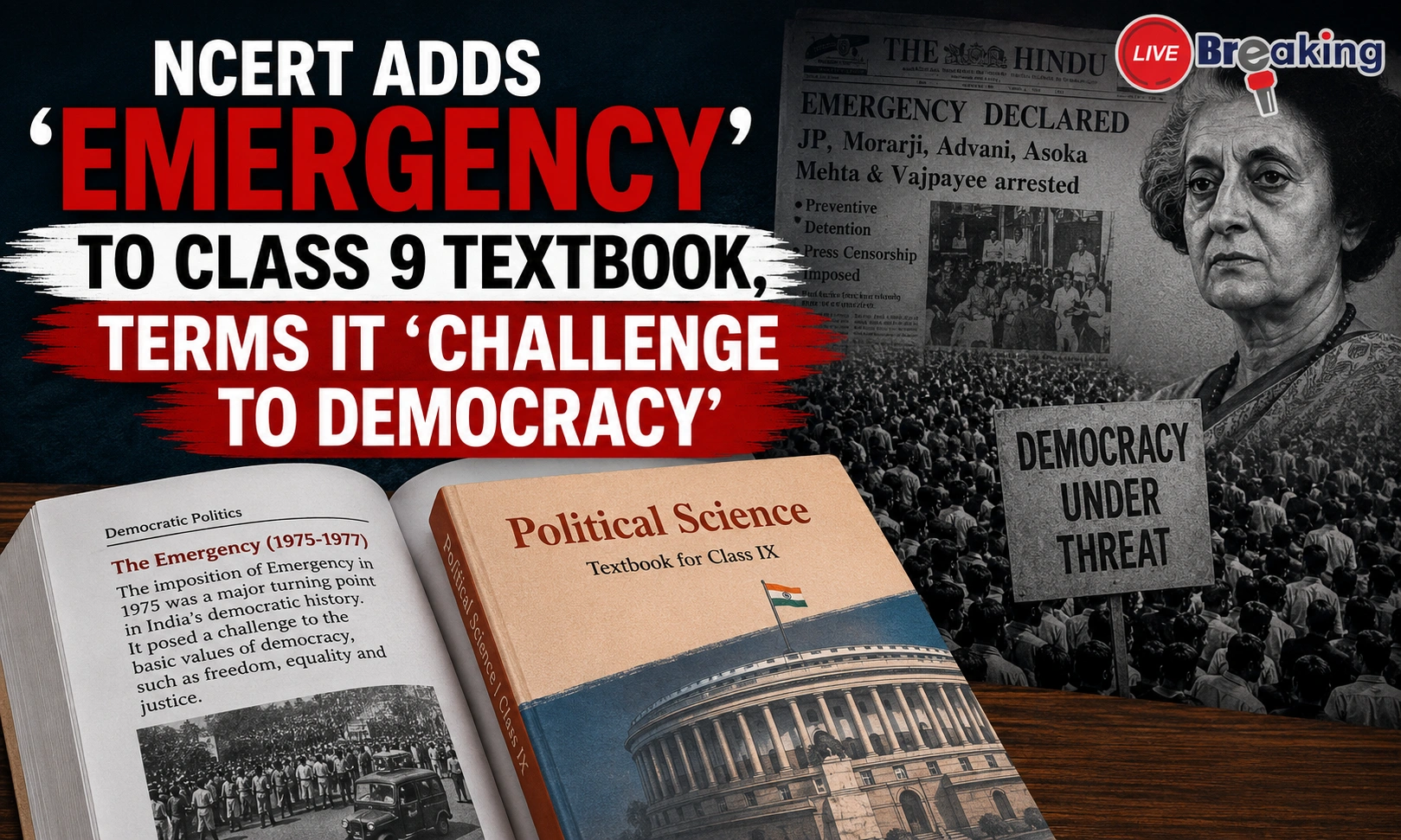
In a significant revision to India’s school curriculum, the National Council of Educational Research and Training (NCERT) has introduced a dedicated section on the 1975-77 Emergency in its Class 9 Social Science textbook for the first time. The chapter describes the Emergency as one of the most serious challenges faced by Indian democracy and explains its impact on citizens’ rights, democratic institutions, and press freedom.
The topic has been included in the newly developed Social Science textbook titled “Understanding Society: India and Beyond”. According to NCERT, the chapter aims to help students understand both the strengths and challenges of democracy in India. The move comes nearly five decades after the Emergency was imposed in the country and marks a major addition to the curriculum.
What Does the New NCERT Chapter Say?
The chapter discusses the political and social circumstances that led to the declaration of the Emergency in June 1975. It explains that during the early 1970s, India witnessed growing public dissatisfaction due to unemployment, inflation, and allegations of poor governance. These issues led to widespread protests across various parts of the country.
According to the textbook, the government imposed a National Emergency citing “internal disturbance” as the reason. The chapter states that during this period, many fundamental rights were suspended, press censorship was imposed, and several opposition leaders and activists were arrested. It further notes that democratic institutions came under severe strain and citizens experienced restrictions on their freedoms.
NCERT describes the Emergency as “one of the major challenges to democracy in India,” emphasizing the importance of safeguarding democratic values and constitutional rights.
Why Is This Addition Significant?
The inclusion of the Emergency chapter is significant because it introduces students to one of the most debated periods in India’s political history. Until now, the topic had not been included in Class 9 NCERT textbooks.
Education experts believe that understanding historical events such as the Emergency can help students gain a deeper appreciation of democratic institutions and constitutional safeguards. By learning about both achievements and challenges, students can better understand the functioning of democracy and the importance of civic participation.
The chapter also encourages learners to think critically about governance, citizens’ rights, and the role of democratic institutions during times of crisis.
Read More: Meta Layoffs 2026: Employee Survives Job Cuts But Loses Entire Team and Leadership Role
Key Features of the New Chapter
The chapter covers several important aspects of the Emergency period:
- Political developments leading to the Emergency.
- Suspension of fundamental rights.
- Press censorship and restrictions on media.
- Arrest of political leaders and activists.
- Impact on democratic institutions.
- Restoration of democracy through elections.
- The importance of constitutional safeguards.
It also includes sections that connect historical events with present-day democratic values, encouraging students to reflect on their role as responsible citizens.
Understanding the Emergency of 1975-77
The Emergency was declared on June 25, 1975, and remained in effect until March 1977. During this period, extraordinary powers were exercised by the government. Civil liberties were restricted, political opposition was curtailed, and media organizations faced censorship.
The Emergency remains one of the most discussed chapters in Indian political history because it raised important questions about the balance between state authority and individual freedoms. Historians and political analysts often describe the period as a crucial test for India’s democratic framework.
Read More: Sushmita Dev Quits Trinamool, Meets Himanta Biswa Sarma For “Guidance”
Table: Key Facts About the Emergency Chapter in NCERT Class 9 Textbook
| Feature | Details |
|---|---|
| Textbook Name | Understanding Society: India and Beyond |
| Class | Class 9 |
| Subject | Social Science |
| New Addition | Chapter on Emergency (1975-77) |
| NCERT’s Description | Major challenge to democracy |
| Key Topics Covered | Rights suspension, censorship, political arrests |
| Focus Area | Democratic values and constitutional rights |
| Educational Objective | Understanding strengths and challenges of democracy |
Educational Impact on Students
The inclusion of the Emergency chapter is expected to broaden students’ understanding of Indian democracy. By studying real historical events, students can learn how democratic systems respond to crises and why constitutional protections are important.
The chapter also aligns with the broader educational goal of developing informed and responsible citizens who understand the significance of democratic participation and civic responsibility.
Experts say that exposing students to different phases of India’s democratic journey can help create greater awareness about governance, accountability, and constitutional values.
Political and Academic Reactions
The inclusion of the Emergency chapter is likely to generate discussions in academic and political circles. While some view it as a necessary addition to understanding modern Indian history, others may debate the interpretation and presentation of historical events.
Read More: Indian Air Force AN-32 Transport Aircraft Crashes In Assam’s Jorhat, Five Killed
However, NCERT has maintained that the chapter is part of a broader effort to present students with important developments that shaped Indian democracy and constitutional governance.
Conclusion
NCERT’s decision to introduce a chapter on the Emergency in the Class 9 Social Science curriculum marks an important shift in how modern Indian history is taught in schools. By describing the 1975-77 Emergency as a major challenge to democracy, the textbook seeks to educate students about the importance of constitutional rights, democratic institutions, and civic responsibility.
As India continues to strengthen its democratic foundations, understanding historical events such as the Emergency can help young learners appreciate the value of freedom, accountability, and active citizenship.
FAQ
Q1. What is the new addition in the NCERT Class 9 Social Science textbook?
NCERT has introduced a chapter on the 1975-77 Emergency for the first time in a Class 9 Social Science textbook.
Q2. How does the textbook describe the Emergency?
The textbook describes the Emergency as one of the major challenges faced by Indian democracy.
Read More: ‘NEET Paper Leaked Again?’ PIB Fact Check Debunks Viral Claim, Calls It Fake
Q3. Which textbook contains the new Emergency chapter?
The chapter appears in the Social Science textbook titled Understanding Society: India and Beyond.
Q4. What topics are covered in the chapter?
The chapter discusses suspension of fundamental rights, press censorship, political arrests, democratic institutions, and the restoration of democracy.
Q5. Why is the inclusion of the Emergency chapter significant?
It helps students understand an important period in Indian history and highlights the importance of democratic values and constitutional safeguards.