Supreme Court Backs Election Commission’s SIR Exercise, Calls It Vital For Democracy
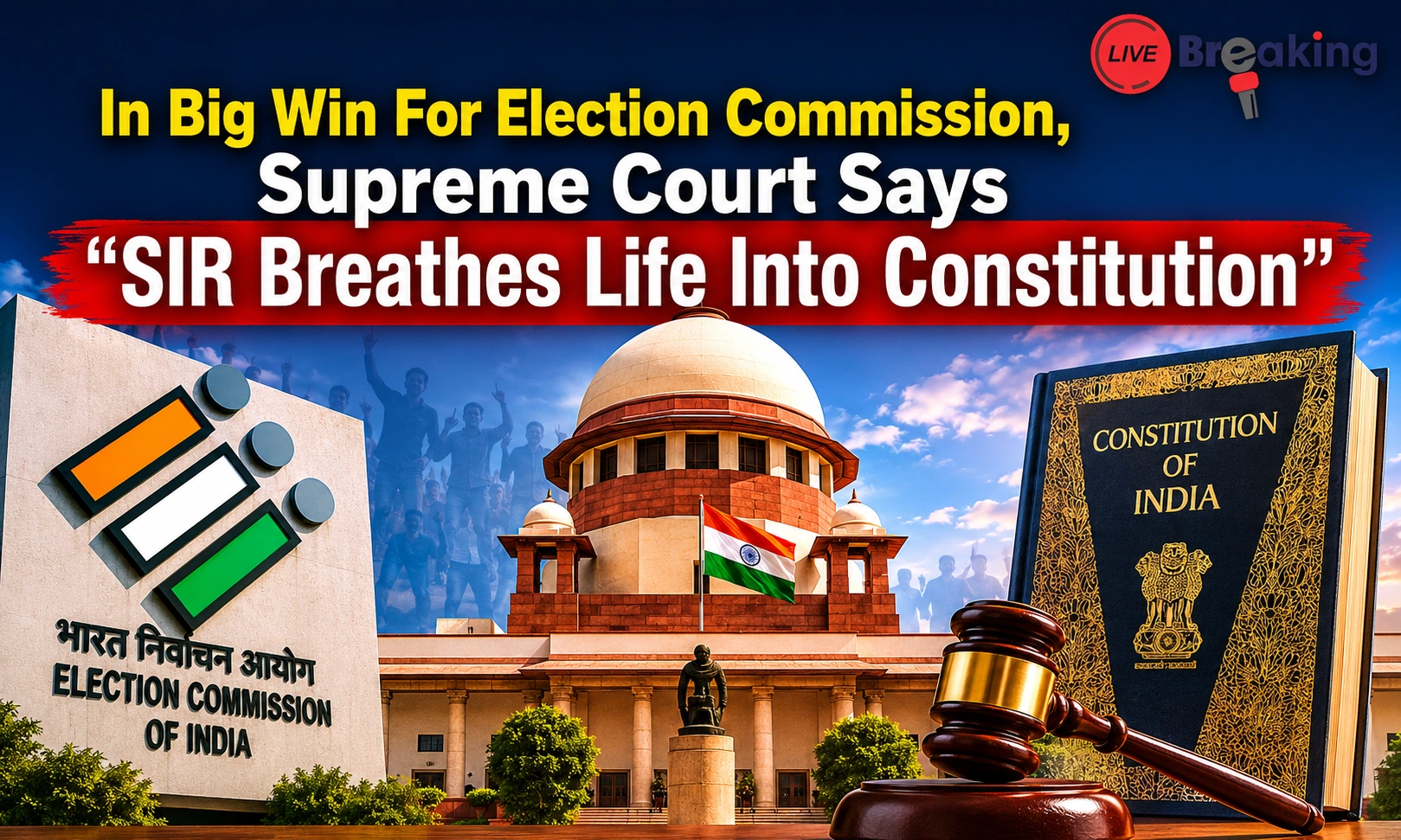
In a major development with far-reaching political and constitutional implications, the Supreme Court of India has backed the Election Commission’s Special Intensive Revision (SIR) exercise, describing it as an initiative that “breathes life into the Constitution.” The observation came during hearings related to the revision of electoral rolls and the powers of the Election Commission in ensuring free and fair elections.
The court’s remarks are being viewed as a significant endorsement of the authority and constitutional role of the Election Commission of India in maintaining the integrity of India’s democratic process. The SIR process, which has triggered political debates in several states, aims to clean up electoral rolls, remove duplicate or ineligible voters, and ensure transparency in voter registration.
The ruling is expected to strengthen the Election Commission’s ongoing electoral verification drives while also setting an important precedent regarding constitutional institutions and democratic accountability.
What Is The SIR Exercise?
Understanding The Special Intensive Revision Process
The Special Intensive Revision (SIR) is a detailed verification exercise conducted by the Election Commission to revise electoral rolls. Unlike regular updates, the SIR process involves door-to-door verification, document checks, corrections in voter data, and deletion of duplicate or invalid entries.
The primary objective of this exercise is to ensure that only eligible citizens remain registered as voters. Election officials verify addresses, citizenship details, age eligibility, and other essential information to maintain an accurate voter database.
Read More: In Big Order, Supreme Court Allows Killing Of Rabid, Aggressive Stray Dogs
The Election Commission argues that maintaining clean electoral rolls is critical for preserving electoral fairness and preventing fraudulent voting practices.
Key Features Of SIR Exercise
| Feature | Purpose |
|---|---|
| Door-to-door verification | Confirm voter identity and address |
| Removal of duplicate names | Prevent multiple voting |
| Verification of documents | Ensure voter eligibility |
| Addition of new voters | Include eligible citizens |
| Correction of voter details | Improve database accuracy |
Supreme Court’s Strong Observation On Constitution And Democracy
During the hearing, the Supreme Court observed that the SIR exercise “breathes life into the Constitution,” emphasizing that free and fair elections form the backbone of Indian democracy.
The bench highlighted that electoral roll purification is not merely an administrative exercise but a constitutional responsibility tied directly to democratic legitimacy. The judges underlined that accurate voter lists strengthen public confidence in elections and democratic governance.
Read More: Video: PM Modi Cashes In On Internet Memes With Melody Gift For Meloni
The court also indicated that constitutional bodies like the Election Commission must have adequate powers to discharge their duties effectively while adhering to principles of fairness and transparency.
Why Opposition Parties Have Raised Concerns
Political Debate Around Electoral Roll Verification
Several opposition parties and civil rights groups have raised concerns over the SIR exercise in different states. Critics argue that large-scale verification drives may unintentionally exclude genuine voters, particularly those from marginalized or migrant communities.
Some petitions filed before the Supreme Court questioned whether the Election Commission was following proper legal procedures and safeguards during the revision process. Concerns were also expressed about documentation requirements and possible voter disenfranchisement.
However, the Election Commission defended the exercise by stating that the process follows constitutional mandates and existing electoral laws. It clarified that voters are given opportunities to submit documents, file objections, and correct records if discrepancies are found.
Supreme Court Emphasizes Fairness And Transparency
While supporting the Election Commission’s powers, the Supreme Court also stressed the importance of transparency and natural justice during the SIR process.
Read More: Tamil Nadu Congress MLA Mentions Rahul Gandhi During Oath, Governor Objects
The court observed that any revision affecting voting rights must be conducted in a fair, just, and non-arbitrary manner. It indicated that citizens whose names are removed or questioned must receive proper notice and an opportunity to respond.
This balanced approach by the judiciary aims to protect both electoral integrity and voter rights simultaneously.
Why This Verdict Matters For Indian Democracy
Major Constitutional Significance
The Supreme Court’s observations carry significant constitutional weight because they reinforce the independent functioning of democratic institutions.
India’s electoral process depends heavily on public trust in voter lists and election management. By backing the Election Commission’s authority, the court has reaffirmed the constitutional importance of clean electoral rolls and institutional accountability.
Read More: Shashi Tharoor Advice To Opposition Amid ‘Cockroach Janata Party’ Rage
Experts believe the ruling may also influence future electoral reforms and strengthen administrative mechanisms aimed at improving election transparency.
Impact Of Supreme Court’s Observation
| Area | Expected Impact |
|---|---|
| Electoral transparency | Improved voter list accuracy |
| Democratic credibility | Greater public confidence |
| Election Commission authority | Stronger constitutional backing |
| Political accountability | Better monitoring of electoral processes |
| Voter protection | Need for fair verification procedures |
States Where SIR Became Politically Sensitive
The SIR exercise has become a politically sensitive issue in states where elections are approaching or where voter demographics are highly contested.
Read More: How Urban India Weekend Obsession Became A $50 Million Market
In states like Bihar, West Bengal, Tamil Nadu, and Kerala, opposition leaders have accused the Election Commission of targeting specific voter groups. Meanwhile, the poll body maintains that the process is purely administrative and aimed at maintaining clean voter records.
The Supreme Court has repeatedly stated that no constitutional authority can act arbitrarily, but at the same time, it acknowledged the necessity of voter list revision exercises.
Election Commission’s Stand On The Matter
The Election Commission argued before the court that electoral roll revision is legislative in nature and falls squarely within its constitutional mandate.
Senior advocates representing the Commission informed the court that the exercise is guided by established rules and procedures. They also emphasized that voters who can establish valid identity and residence details are not unfairly excluded.
The poll body further stated that maintaining updated electoral rolls is essential to preventing electoral fraud and ensuring the credibility of democratic elections.
Legal Experts React To Supreme Court’s Observation
Constitutional experts believe the court’s remarks provide a strong institutional endorsement of the Election Commission’s powers while also placing checks on arbitrary implementation.
Read More: In Twisha Sharma Case, Supreme Court’s Big ‘Narrative As Accused Ex-Judge’ Remark
Some legal scholars say the ruling could shape future debates on voter verification, electoral reforms, and institutional independence. Others note that the judgment reflects the judiciary’s attempt to strike a balance between administrative efficiency and protection of citizens’ voting rights.
Conclusion
The Supreme Court’s statement that the SIR exercise “breathes life into the Constitution” marks a major moment in India’s electoral and constitutional discourse. The verdict reinforces the Election Commission’s role in protecting democratic integrity while reminding authorities that fairness and transparency must remain central to every electoral process.
As India continues to witness intense political competition and rising scrutiny over elections, the ruling may serve as an important benchmark for how constitutional institutions balance power, accountability, and democratic rights in the years ahead.
FAQs
What is the SIR exercise conducted by the Election Commission?
The SIR or Special Intensive Revision is a detailed voter verification process aimed at updating and cleaning electoral rolls.
Why did the Supreme Court support the SIR exercise?
The court said the exercise strengthens democracy and “breathes life into the Constitution” by ensuring accurate voter lists.
Read More: ‘Twisha Sharma Bipolar, Relationship Troubled’: CBI To Decode Husband’s Claims
Why are opposition parties opposing the SIR process?
Some opposition leaders fear that genuine voters could be excluded during large-scale verification drives.
What did the Supreme Court say about voter rights?
The court stressed that the process must follow fairness, transparency, and principles of natural justice.
Which states witnessed controversy over the SIR exercise?
States including Bihar, West Bengal, Tamil Nadu, and Kerala saw political debates over the revision process.