China Export Curbs Threaten India $120 Billion Electronics Manufacturing Ambition
India electronics manufacturing industry has emerged as one of the country’s biggest economic success stories over the past five years. From assembling smartphones to becoming a global production hub for major brands like Apple and Samsung, India has aggressively pushed its “Make in India” strategy to reduce imports and strengthen domestic manufacturing.
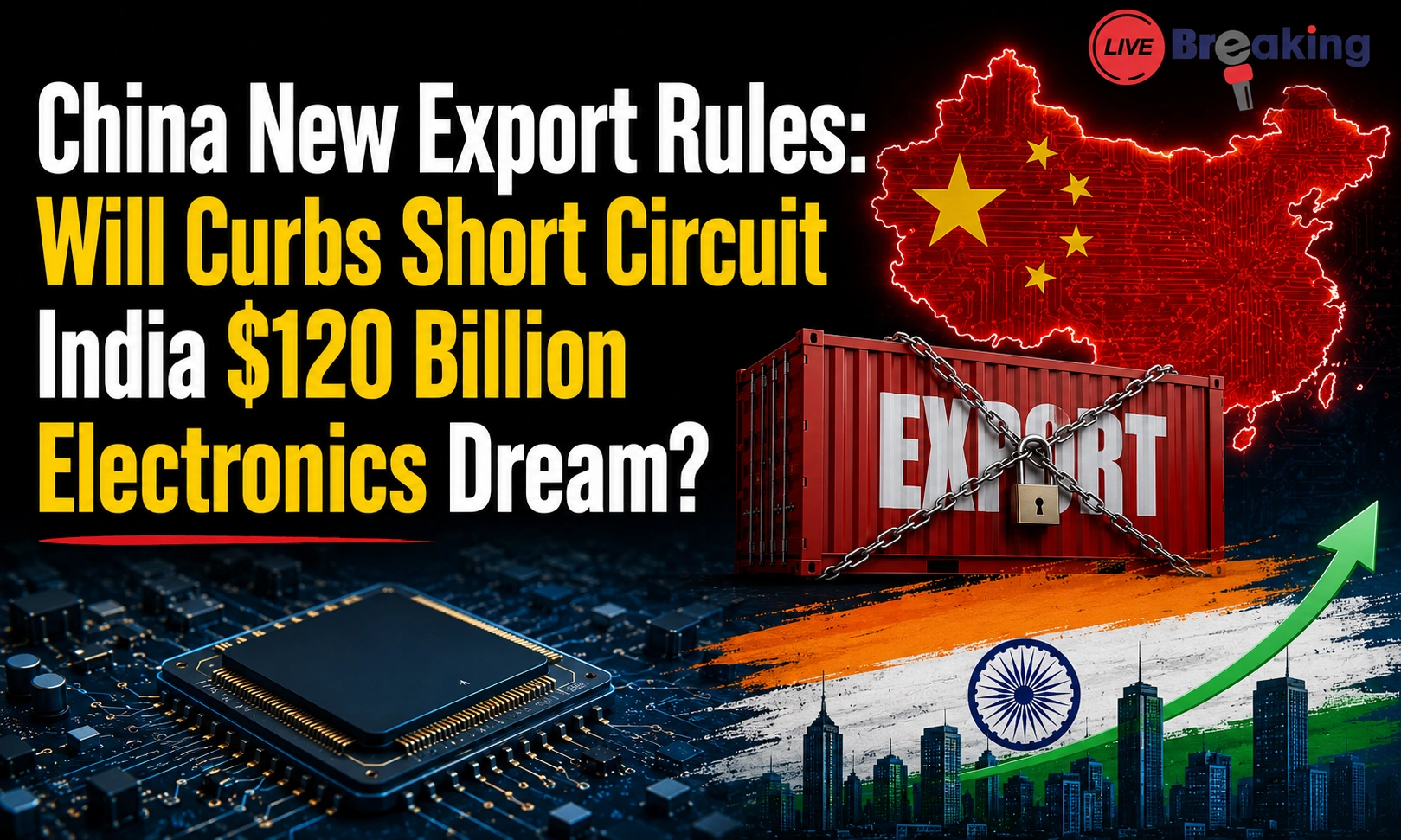
However, a fresh challenge has surfaced from China — India’s largest supplier of electronics components and machinery. Beijing’s latest export restrictions on critical technologies, manufacturing equipment, and rare materials are raising serious concerns across India’s electronics ecosystem.
Industry experts fear that these curbs could slow production, increase costs, delay expansion plans, and potentially impact India’s ambitious target of achieving a $120 billion electronics manufacturing industry by the coming years.
Why China’s Export Curbs Matter to India
China dominates the global electronics supply chain. From semiconductor machinery and lithium battery materials to smartphone components and rare earth minerals, Chinese companies control a massive share of the market.
India’s electronics manufacturing growth still heavily depends on imports from China. Even though smartphone assembly in India has expanded rapidly, a large percentage of high-value components continue to come from Chinese suppliers.
The new export restrictions introduced by China reportedly focus on:
| Sector | Potential Restriction Impact |
|---|---|
| Semiconductor equipment | Delays in chip manufacturing setup |
| Rare earth materials | Higher prices for electronics production |
| Battery technology | EV and smartphone battery disruptions |
| Precision manufacturing tools | Slower factory expansion |
| Electronics components | Supply chain bottlenecks |
The restrictions are seen as part of China’s broader strategy to protect strategic technologies amid growing global geopolitical tensions.
India’s Electronics Manufacturing Boom
India’s electronics manufacturing industry has grown dramatically in recent years.
According to government estimates, the sector is expected to cross $120 billion in value, driven by:
- Smartphone manufacturing
- Semiconductor investments
- Consumer electronics production
- Export growth
- Production Linked Incentive (PLI) schemes
Global companies including Apple, Foxconn, Pegatron, and Dixon Technologies have expanded operations in India due to favorable policies and rising global demand for supply chain diversification away from China.
Apple, in particular, has significantly increased iPhone production in India. Reports suggest that India may soon account for a major share of global iPhone manufacturing.
But despite these gains, India still imports a substantial portion of:
- Display panels
- Printed circuit boards
- Semiconductor parts
- Battery cells
- Industrial machinery
This dependency makes India vulnerable to any disruption originating from China.
Supply Chain Risks Could Slow Momentum
The biggest concern for Indian manufacturers is supply chain disruption.
Many factories operate on tight production schedules. Even minor delays in obtaining components can impact exports, product launches, and delivery timelines.
If Chinese approvals for exports become slower or more restrictive, Indian companies may face:
1. Increased Production Costs
Alternative suppliers outside China are often more expensive. This could reduce profit margins and increase product prices.
2. Delayed Manufacturing Expansion
Several electronics firms are currently setting up new production lines in India. Restrictions on machinery or technology transfer could delay these projects.
3. Pressure on Smartphone Exports
India has become a major smartphone export hub. Any slowdown in component availability could impact export targets and global competitiveness.
4. Impact on Semiconductor Ambitions
India is trying to establish a semiconductor ecosystem with global partners. However, semiconductor manufacturing requires highly specialized equipment — much of which still comes from Chinese-linked supply chains.
Apple Suppliers May Feel the Heat
India’s electronics ambitions are closely tied to Apple’s expanding manufacturing footprint.
Suppliers such as Foxconn, Wistron, and Pegatron have invested billions in Indian facilities. But these companies still rely on integrated supply chains connected to China.
Potential disruptions may affect:
- iPhone assembly timelines
- Component sourcing
- Factory automation
- Logistics operations
While Apple has diversified manufacturing to India and Vietnam, China remains deeply embedded in the ecosystem.
This means India’s manufacturing rise cannot yet completely escape Chinese influence.
Read More: In Big Order, Supreme Court Allows Killing Of Rabid, Aggressive Stray Dogs
Can India Reduce Dependence on China?
The current situation has renewed calls for India to accelerate domestic component manufacturing.
Experts believe India must now focus on:
| Priority Area | Required Action |
|---|---|
| Semiconductor ecosystem | Faster policy execution |
| Electronics components | Local supplier development |
| Rare earth processing | Strategic investments |
| Battery manufacturing | Domestic gigafactories |
| Supply chain diversification | Partnerships with Taiwan, Japan, Korea |
India has already taken steps through:
- PLI schemes
- Semiconductor incentives
- Import substitution policies
- Strategic trade partnerships
However, building a self-reliant electronics supply chain will take years, not months.
Read More: Video: PM Modi Cashes In On Internet Memes With Melody Gift For Meloni
Global Geopolitics Is Reshaping Manufacturing
China’s export controls are not happening in isolation.
The global technology industry is witnessing increasing geopolitical fragmentation. The US-China trade war, restrictions on semiconductor exports, and competition over critical minerals are reshaping manufacturing strategies worldwide.
Countries are now prioritizing:
- Supply chain security
- Domestic manufacturing
- Strategic technology independence
- Diversified sourcing
India is benefiting from the “China Plus One” strategy, where companies expand beyond China to reduce risks.
Read More: Tamil Nadu Congress MLA Mentions Rahul Gandhi During Oath, Governor Objects
But this transition also highlights how interconnected the global electronics industry still remains.
Will India’s $120 Billion Dream Survive?
Despite the concerns, analysts believe India’s long-term electronics growth story remains strong.
Several factors continue to support the sector:
- Massive domestic market
- Government incentives
- Rising exports
- Global diversification trends
- Competitive labor costs
- Strong demand for smartphones and electronics
However, China’s export restrictions serve as a reminder that India’s manufacturing ecosystem is still evolving.
Read More: Shashi Tharoor Advice To Opposition Amid ‘Cockroach Janata Party’ Rage
To truly become a global electronics powerhouse, India will need to move beyond assembly and build deeper capabilities in:
- Semiconductor fabrication
- Component manufacturing
- Advanced materials
- Research and development
- Industrial automation
The next phase of growth will depend not only on attracting foreign companies but also on creating resilient domestic supply chains.
Key Impact Snapshot
| Factor | Positive for India | Negative Risk |
|---|---|---|
| Apple manufacturing shift | More global attention | Supply chain dependence remains |
| PLI schemes | Boost local manufacturing | Component shortages possible |
| Export growth | Higher global competitiveness | Rising production costs |
| China Plus One strategy | New investments | Technology restrictions |
| Domestic demand | Strong long-term growth | Import dependency continues |
FAQs
What are China’s new export restrictions?
China has reportedly tightened controls on critical electronics-related technologies, manufacturing equipment, and rare materials that are essential for global supply chains.
Read More: How Urban India Weekend Obsession Became A $50 Million Market
Why is India worried about these curbs?
India’s electronics manufacturing sector still depends heavily on Chinese imports for components, machinery, and raw materials. Restrictions could disrupt production and raise costs.
Will Apple manufacturing in India be affected?
Apple suppliers operating in India may face delays or sourcing challenges if Chinese component exports become slower or more restricted.
Can India become self-reliant in electronics manufacturing?
India is investing heavily in semiconductor and electronics manufacturing, but achieving full self-reliance will require long-term infrastructure, technology, and supplier development.
What is the “China Plus One” strategy?
It refers to global companies diversifying manufacturing beyond China by expanding operations in countries like India and Vietnam to reduce supply chain risks.
Read More: In Twisha Sharma Case, Supreme Court’s Big ‘Narrative As Accused Ex-Judge’ Remark
Conclusion
China’s new export curbs have added uncertainty to the global electronics industry at a crucial time for India. While India’s manufacturing momentum remains strong, the latest developments expose a key weakness — heavy dependence on Chinese supply chains.
The road to becoming a $120 billion electronics manufacturing giant is still achievable, but India now faces a critical test. The country must accelerate domestic capability building, diversify sourcing networks, and strengthen strategic partnerships to reduce future vulnerabilities.
The coming years could determine whether India simply becomes an assembly hub — or evolves into a truly self-reliant global electronics powerhouse.