

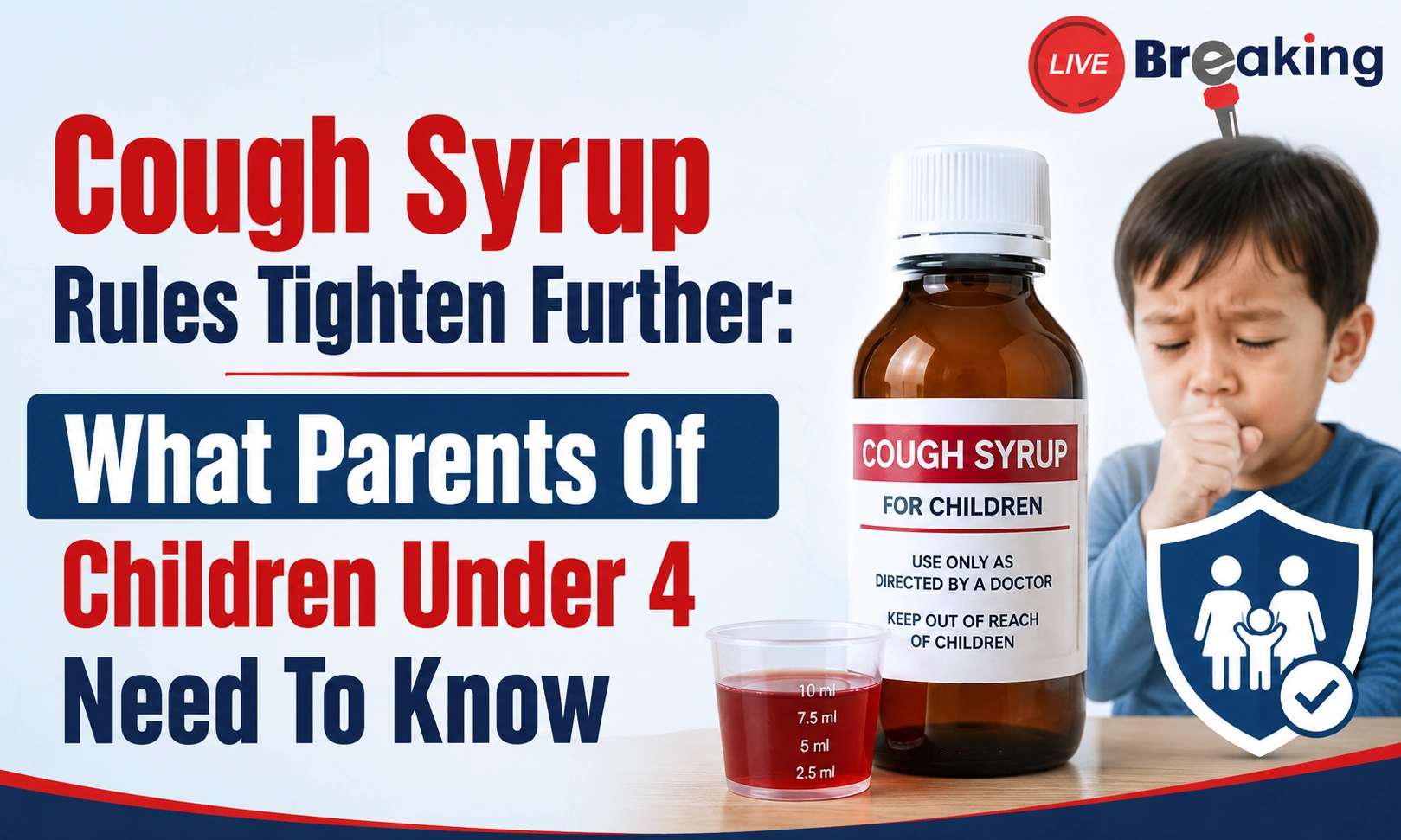
Cough Syrup Rules Tighten in India: What Parents Under 4 Need to Know
India has tightened restrictions on certain cough and cold medicines for young children, adding another layer of caution for parents. The latest regulatory action specifically concerns fixed-dose combination (FDC) medicines containing chlorpheniramine maleate and phenylephrine hydrochloride and their use in children below four years of age.
The government has directed that these formulations carry a prominent warning that they should not be used in children below four years. The move follows recommendations from an expert committee and the Drugs Technical Advisory Board (DTAB), which raised safety concerns and noted that safer alternatives are available.
The latest decision comes after a series of regulatory actions involving cough and cold medicines in India. It is important, however, to understand that the new rule does not mean every cough syrup has been banned for children under four. The restriction specifically targets formulations containing the chlorpheniramine-phenylephrine combination.
What Has the Government Restricted?
The latest notification restricts the manufacture, sale and distribution of FDC medicines containing chlorpheniramine maleate and phenylephrine hydrochloride for use in children below four.
Chlorpheniramine is an antihistamine, while phenylephrine is a decongestant. Such medicines may be used for symptoms including a blocked or runny nose, sneezing and other cold or allergy-related symptoms.
According to the reported regulatory decision, manufacturers are required to display the age-specific warning on the medicine label, package insert and promotional material.
This is also an expansion of an earlier action. In April 2025, the government had already restricted certain FDC formulations containing the same two ingredients and required warnings against their use in children below four. The August 2026 move extends the restriction to all formulations containing the combination.
Why Are Cough and Cold Medicines Facing Greater Scrutiny?
The latest decision follows a series of safety concerns surrounding cough and cold medicines in India.
In 2025, contaminated cough syrups were linked to the deaths of children in Madhya Pradesh. The incident drew attention not only to manufacturing and quality-control issues but also to the appropriateness of certain cough and cold formulations for very young children.
The World Health Organization subsequently issued a medical product alert concerning specific contaminated oral liquid medicines in India after diethylene glycol (DEG) was detected. DEG is a toxic substance that can cause severe kidney injury and death.
These incidents triggered broader discussions around medicine manufacturing standards, quality testing, prescribing practices and the risks of giving children medicines without appropriate medical supervision.
A Timeline of Cough Syrup Restrictions in India
| Period | Regulatory/Safety Development | What Parents Should Know |
|---|---|---|
| April 2025 | Restrictions on certain chlorpheniramine-phenylephrine FDCs | Warning introduced for children below 4 |
| October 2025 | Advisory concerning cough and cold medicines in very young children | States and UTs were advised not to prescribe or dispense such medicines to children below 2 |
| January 2026 | Almond Kit cough syrup action in Tamil Nadu | Manufacturing, sale, distribution and consumption were banned after testing detected ethylene glycol |
| June 2026 | Syrup medicines lost an earlier OTC exemption | Syrup-based medicines moved toward regulated dispensing through prescriptions |
| August 2026 | Broader restriction on chlorpheniramine-phenylephrine FDCs | These formulations must not be used in children below 4 |
The timeline illustrates why parents are being advised to exercise greater caution rather than treating cough syrups as routine medicines.
Does This Mean All Cough Syrups Are Banned for Children Under 4?
No.
This distinction is particularly important.
The latest restriction specifically concerns FDC medicines containing chlorpheniramine maleate and phenylephrine hydrochloride. It does not amount to a blanket ban on every cough syrup or every medicine used for respiratory symptoms in children below four.
Parents should therefore avoid assuming that one medicine is interchangeable with another simply because both are marketed for cough, cold or congestion.
The ingredients, concentration, age of the child, weight, symptoms and medical history can all influence whether a medicine is appropriate.
Read More: World Lung Cancer Day 2026: Raising Awareness for Early Detection and Better Lung Health
Do Children Need Cough Syrup for Every Cough?
Not necessarily.
A cough is often a symptom of a viral respiratory infection and may improve as the illness resolves. Cough medicines generally provide symptom relief rather than treating the underlying cause of an infection.
The World Health Organization has previously highlighted limited measurable benefit from medicines used for acute cough and cold symptoms in young children, while also noting safety concerns associated with combination cough-and-cold products.
For this reason, parents should not automatically reach for a cough syrup every time a young child develops a cough.
A previous prescription should also not be reused without medical advice. A medicine that was prescribed for one child, or for the same child during an earlier illness, may not necessarily be appropriate during a new episode.
What Should Parents Check Before Giving a Medicine?
Parents can take several practical precautions.
1. Check the Active Ingredients
Do not rely only on the brand name printed on a bottle. Look at the active ingredients and check whether the medicine contains chlorpheniramine maleate and phenylephrine hydrochloride.
For children below four, formulations containing this combination are specifically covered by the latest restriction.
2. Check the Child’s Age and Weight
Children are not simply small adults. Medicines can have different safety considerations depending on age and, where relevant, weight.
Parents should follow advice from a qualified healthcare professional rather than estimating a dose themselves.
3. Avoid Sharing Medicines
A cough syrup prescribed for one child should not automatically be given to another child.
Similarly, parents should be cautious about using an old prescription for a new illness. Symptoms that appear similar can have different causes.
Read More: Caffeine In Evening May Affect Quality Of Night-Time Sleep, Study Finds
4. Do Not Depend Only on Brand Names
Different products can contain similar or multiple active ingredients. Checking the composition helps parents avoid accidentally giving a child a medicine containing an ingredient that may not be suitable for their age.
5. Seek Medical Advice When Symptoms Worsen
A cough accompanied by breathing difficulty, persistent high fever, poor feeding, unusual drowsiness, dehydration or worsening symptoms should be medically evaluated rather than simply treated with a cough suppressant.
Why the New Rule Matters for Parents
For parents, the biggest takeaway is that cough and cold medicines for young children are receiving increased regulatory and medical scrutiny.
The recent changes also reinforce a broader principle: more medicine does not necessarily mean faster recovery.
When a young child develops a cough, parents may understandably want immediate relief. However, choosing a medicine based on a television advertisement, an earlier prescription, another child’s medicine or informal pharmacy advice can create unnecessary risks.
The safest approach is to understand what the medicine contains and seek appropriate medical guidance before administering it.
Read More: H1N1 Cases Rise In Delhi: 5 Signs Your Cold May Not Be ‘Normal Viral’ Infection
What Parents Should Remember About Cough Syrups
The latest rules can be summarised in a few important points:
| Key Point | What It Means |
| Under-four restriction | Chlorpheniramine-phenylephrine FDCs should not be used in children below 4 |
| Not a blanket ban | The latest action does not prohibit every cough syrup for under-fours |
| Check ingredients | Parents should examine active ingredients rather than relying only on brand names |
| Avoid self-medication | A previous prescription should not automatically be reused |
| Watch for warning signs | Breathing problems, dehydration, persistent fever or worsening symptoms require medical attention |
| Medical advice matters | A child’s age, weight, symptoms and medical history should be considered |
Frequently Asked Questions
Is cough syrup banned for children under 4 in India?
No. The latest restriction does not ban every cough syrup for children below four. It specifically targets fixed-dose combination medicines containing chlorpheniramine maleate and phenylephrine hydrochloride, which must not be used in children below four under the latest restriction.
Which cough syrup ingredients are restricted for children under 4?
The latest restriction concerns the combination of chlorpheniramine maleate and phenylephrine hydrochloride in FDC medicines. Parents should check the active ingredients on the product packaging and consult a healthcare professional before giving medicines to young children.
Can parents give children cough medicine without a prescription?
Parents should not self-select cough and cold medicines for young children based on previous prescriptions, another child’s medicine or informal recommendations. The appropriate treatment depends on the child’s age, symptoms, weight and medical circumstances.
Does every cough need medicine?
No. Many coughs, particularly those associated with viral respiratory infections, may improve as the illness resolves. Cough medicines may provide temporary symptom relief but do not necessarily treat the underlying cause.
What should parents do if a child has a cough?
Parents should consider the child’s overall condition rather than focusing only on suppressing the cough. If symptoms are severe, persistent or worsening, or if the child develops breathing difficulty, dehydration, poor feeding, unusual drowsiness or persistent high fever, medical evaluation is important.
Read More: “The ‘Chai-Biscuit’ Bloat: Why Your Evening Routine Is Destroying Your Gut Barrier During The Rains
Why have cough syrup regulations become stricter in India?
The tightening follows a series of safety and regulatory developments, including concerns over inappropriate medicines for young children and incidents involving contaminated cough syrups. The latest restriction is part of a wider move toward more cautious and supervised use of cough and cold medicines in children.
Final Takeaway
India’s latest cough syrup regulation sends a clear message to parents: do not assume that every cough or cold requires medication, and do not treat all cough syrups as interchangeable.
For children below four, particular attention is now required for medicines containing the chlorpheniramine maleate and phenylephrine hydrochloride combination. Parents should check active ingredients, avoid giving medicines based solely on previous prescriptions and seek professional medical advice when symptoms are concerning.
The new restriction is another step in the country’s broader effort to improve the safety and supervision of medicines used by young children.
Medical disclaimer: This article is for general informational purposes only and should not replace advice from a qualified doctor or other healthcare professional. Parents should consult a healthcare professional before giving medicines to young children.
Like this post?