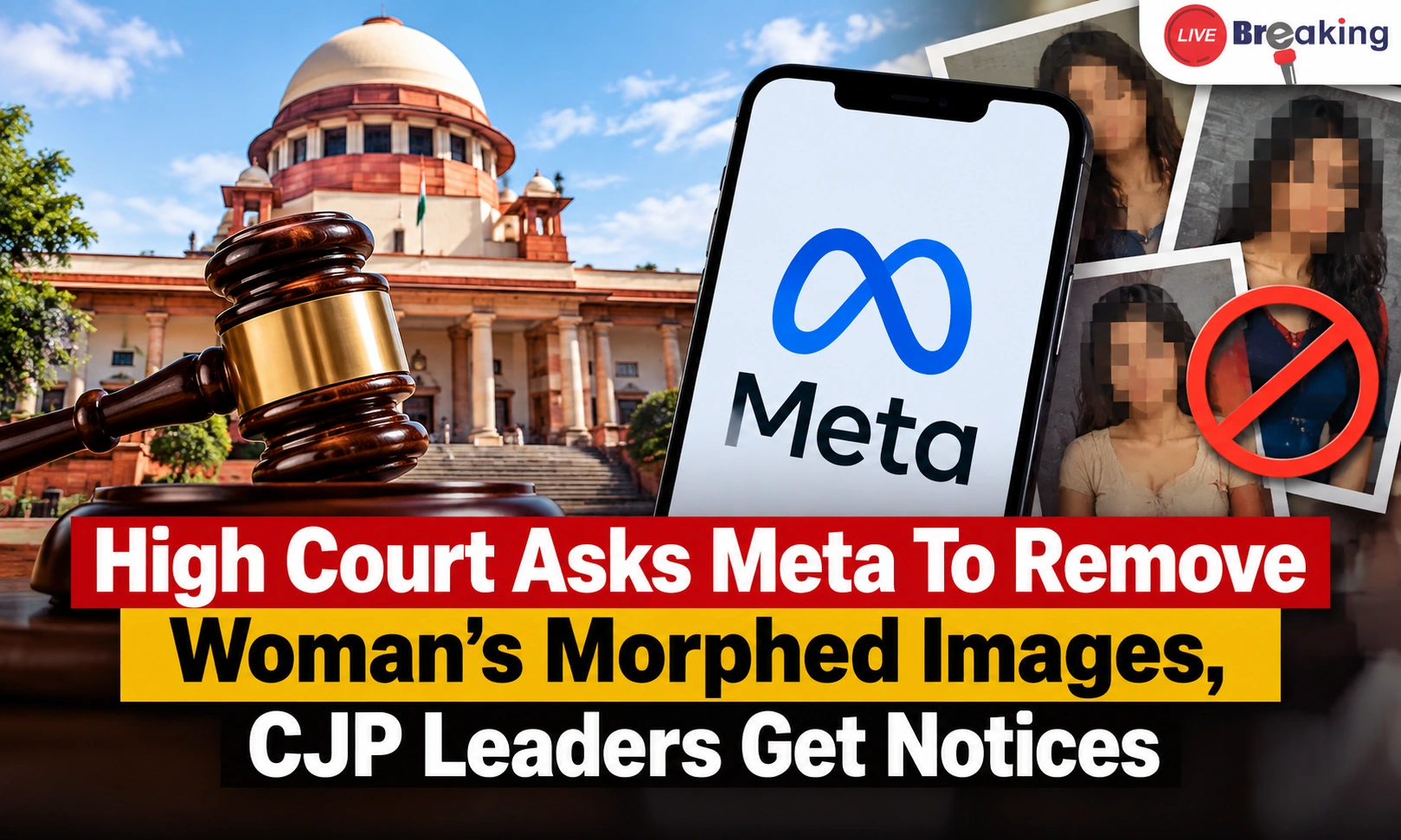
Delhi High Court Orders Meta to Remove Woman’s Morphed Images, Issues Notices to CJP Leaders
The Delhi High Court has directed social media giant Meta to remove objectionable images and links allegedly involving a woman whose photograph was purportedly manipulated using artificial intelligence (AI) and face-swapping technology. The court also issued notices to four leaders of the Cockroach Janta Party (CJP) in connection with the allegations.
The matter came before the court after the woman approached the Delhi High Court alleging that her photograph had been morphed and circulated without her consent during protests organised by the CJP at Jantar Mantar in New Delhi.
According to the reported details, the court has directed Meta to remove the allegedly objectionable pictures and related links from its platforms within 24 hours. The court also ordered police protection for the woman and sought a status report from the Delhi Police within two weeks.
Delhi High Court Takes Up Woman’s Plea Over Alleged AI-Morphed Images
The case concerns allegations that a personal photograph of the woman was manipulated using AI-based face-swapping technology.
According to the petition, the woman’s photograph was allegedly obtained during recent CJP-led protests at Jantar Mantar. The petitioner alleged that her face was subsequently superimposed onto an objectionable image involving Prime Minister Narendra Modi.
The alleged manipulated image was then reportedly used in protest-related material, including banners and posters, and was also circulated through social media platforms.
The allegations have not been established as facts against the individuals named in the petition. The High Court’s notices provide the concerned parties an opportunity to respond to the allegations.
Court Issues Notices to Four CJP Leaders
The Delhi High Court issued notices to CJP leaders Saurav Das, Abhijeet Dipke, Ashutosh Ranka and Ratna Singh.
The development came shortly after a case was registered by the Delhi Police against unknown persons in relation to the alleged image manipulation. The woman had complained to the police, but the FIR reportedly did not name the CJP leaders mentioned in her complaint as accused.
The court’s decision to issue notices means that the respondents will have an opportunity to present their position before the court. A notice itself is not a finding of guilt or a final determination of responsibility.
Meta Asked to Remove Objectionable Images Within 24 Hours
One of the key directions from the court concerns the social media content allegedly linked to the woman.
The Delhi High Court ordered Meta to remove all objectionable pictures and links related to the woman from its platforms within 24 hours.
The direction is significant because digitally manipulated images can be copied and redistributed rapidly across multiple accounts and platforms. Removing identified links can therefore become an important part of limiting further circulation while the underlying dispute is being examined.
The court’s order, as reported by NDTV, also includes directions concerning the woman’s safety and the role of Delhi Police in investigating the matter.
Police Protection Ordered for the Woman
Apart from the online takedown direction, the court ordered police protection for the woman.
The court also issued a notice to the Delhi Police and directed the police to submit a status report within two weeks.
An FIR had already been registered against unknown persons in connection with the allegations. The petitioner had reportedly argued that concrete action was needed both to identify those responsible and to prevent continued circulation of the alleged deepfake material.
What Happened During the Jantar Mantar Protests?
The allegations relate to protests organised by the CJP at Jantar Mantar in New Delhi.
According to the reports, the CJP-led agitation began on June 20 and continued for more than a month before being called off on July 25.
The protest movement reportedly included a march towards Parliament, during which clashes occurred between protesters and security personnel. Security forces used lathis and tear gas to disperse the protesters, according to NDTV’s report.
Read More: Bihar Teacher’s Unique Teaching Method Earns Her State Teacher Award
The alleged image-morphing incident is connected to this broader protest period.
Why AI-Generated Deepfake Images Are a Growing Legal Concern
The case highlights a broader problem created by increasingly accessible AI image-generation and face-swapping tools.
AI technology can be used to alter photographs, replace faces and create realistic-looking images that may be difficult for an ordinary viewer to distinguish from genuine photographs.
When such manipulated content involves a real person without their consent, it can raise serious questions concerning privacy, reputation, dignity and the unlawful use of a person’s image.
The legal issues can become particularly complicated when the manipulated material is circulated publicly or presented in a manner that falsely suggests that the person actually appeared in the depicted situation.
Recent Indian court proceedings involving AI-generated or manipulated material have also focused on protecting individuals from unauthorised use of their image, likeness and other personal attributes.
The Difference Between an Allegation and a Court Finding
An important aspect of the present case is the distinction between allegations and findings.
The woman has alleged that her photograph was manipulated and circulated without her consent. The petition reportedly attributes the alleged activity to CJP leaders and others.
The Delhi High Court has issued notices to the named individuals and ordered Meta to remove the identified material. However, these procedural and interim directions should not be interpreted as a final finding that the named individuals created or circulated the alleged images.
Read More: Eiffel Tower Shuts After Women Staff “Sidelined” For Hindu Group’s Visit
The investigation and court proceedings will determine the facts and the responsibility of the parties involved.
Why the Case Matters for Social Media Platforms
The dispute also raises questions about the responsibilities of social media companies when users report allegedly unlawful or harmful manipulated content.
Platforms such as Facebook and Instagram can allow content to spread rapidly, making timely reporting and removal mechanisms important when an individual alleges that fabricated material is being circulated using their identity.
The High Court’s reported 24-hour direction to Meta demonstrates the court’s focus on preventing continued availability of the allegedly objectionable material while the legal proceedings move forward.
Deepfakes and Personal Privacy in India
Deepfake technology has created new challenges for privacy and online safety because it can be used to create realistic but fabricated representations of individuals.
A photograph that appears authentic may, in reality, have been digitally altered. When such material is used without permission, the affected person may face reputational, emotional and social consequences.
The present Delhi High Court matter is therefore relevant beyond the individuals involved. It illustrates how courts may be asked to respond when AI-generated or manipulated content is allegedly used to target an individual’s identity.
At the same time, each case depends on its specific facts, evidence and applicable law.
What Happens Next in the Case?
The Delhi High Court has sought a status report from Delhi Police within two weeks.
The CJP leaders who received notices will also have an opportunity to respond to the allegations made in the petition.
Meanwhile, Meta has been directed to remove the identified objectionable images and links within 24 hours.
Further proceedings are expected to clarify the circumstances surrounding the alleged manipulation, the circulation of the material and the involvement, if any, of the individuals named in the petition.
Key Details at a Glance
| Issue | Details |
|---|---|
| Court | Delhi High Court |
| Matter | Alleged AI-morphed/deepfake image |
| Petitioner | Woman who alleged her photograph was manipulated |
| Platform mentioned | Meta platforms |
| CJP leaders named in notices | Saurav Das, Abhijeet Dipke, Ashutosh Ranka and Ratna Singh |
| Allegation | Photograph allegedly manipulated using AI/face-swapping technology |
| Alleged location connected to incident | Jantar Mantar, New Delhi |
| Meta direction | Remove objectionable pictures and links within 24 hours |
| Police direction | Provide protection to the woman |
| Status report | Delhi Police directed to file it within two weeks |
| FIR | Registered against unknown persons, according to reports |
Read More: Gurugram Hit-And-Run Accused Kalyan Bainsla Detained, ‘Attempt To Murder’ Invoked
FAQ
What did the Delhi High Court order Meta to do?
The Delhi High Court directed Meta to remove objectionable pictures and links related to the woman from its platforms within 24 hours, according to the reported court proceedings.
Why did the woman approach the Delhi High Court?
The woman alleged that her photograph was obtained and manipulated using AI and face-swapping technology and that the resulting image was circulated without her consent.
Which CJP leaders received notices?
The court issued notices to Saurav Das, Abhijeet Dipke, Ashutosh Ranka and Ratna Singh, according to NDTV’s report.
Has the court found the CJP leaders guilty?
No. The reported proceedings involve notices and directions concerning the allegations. The issuance of a notice is not, by itself, a final finding of guilt or responsibility.
Was an FIR registered in the case?
Yes. Reports state that an FIR was registered against unknown persons in connection with the alleged image manipulation.
What has the Delhi High Court directed the police to do?
The court ordered police protection for the woman and directed the Delhi Police to file a status report within two weeks.
Read More: Huge Row After Report Flags 2 Election Commissioners Objected To Poll Panel Steps
What are deepfake images?
Deepfake images are digitally manipulated or AI-generated media that can make it appear that a person is present in a situation or has an appearance that is not genuine. Such technology can have legitimate uses, but its unauthorised use can raise legal and privacy concerns.
Conclusion
The Delhi High Court’s intervention in the alleged AI-morphed image case has brought renewed attention to the legal challenges posed by deepfakes and digitally manipulated photographs.
The court has directed Meta to remove the reported objectionable material within 24 hours, ordered police protection for the woman and sought a status report from Delhi Police. Notices have also been issued to four CJP leaders named in the petition.
The next stage of the proceedings will be important in establishing the facts surrounding the alleged manipulation and circulation of the images. Until those proceedings are completed, the allegations against the named individuals should be treated as allegations rather than established findings.