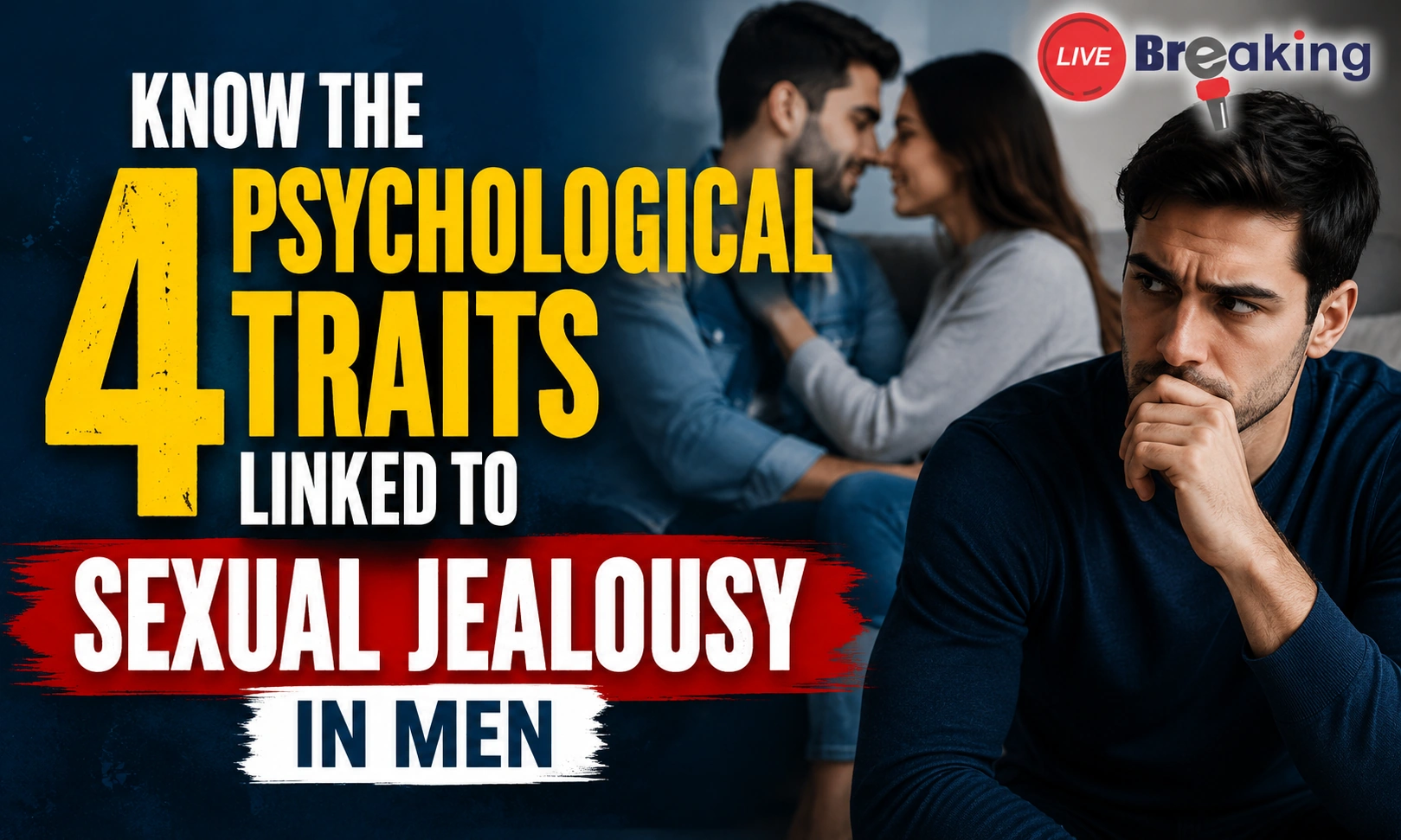
4 Psychological Traits Linked to Sexual Jealousy in Men, Relationship Psychology
Relationship Psychology: Jealousy is a complicated emotion that can appear in many relationships. While occasional jealousy may be a normal emotional response, intense or persistent jealousy can create tension, mistrust, and emotional distance between partners. One form that can be particularly challenging is sexual jealousy, which involves anxiety or fear that a romantic partner may be sexually interested in, attracted to, or intimate with someone else.
Psychologists and relationship researchers have explored several factors that may contribute to jealousy. These factors do not mean that every man who experiences jealousy has the same personality or psychological profile. Instead, certain traits and relationship patterns may make some people more vulnerable to jealousy than others.
Here are four psychological traits commonly associated with sexual jealousy in men.
1. Low Self-Esteem and Feelings of Insecurity
One of the most important psychological factors associated with jealousy is insecurity.
A person who has doubts about their own attractiveness, value, or ability to maintain a relationship may be more likely to worry about losing their partner. In romantic relationships, these doubts can sometimes become focused on potential rivals.
For example, a man who frequently compares himself with other men may interpret ordinary social interactions as signs of romantic or sexual interest. If his partner talks to someone who appears confident or attractive, his insecurity may cause him to imagine a threat even when there is no evidence of one.
Low self-esteem can therefore turn uncertainty into suspicion.
However, insecurity is not always obvious. Someone may appear confident in professional or social situations while privately worrying that they are not “good enough” for their partner.
Building self-confidence and maintaining open communication can help reduce this pattern.
2. Anxious Attachment and Fear of Abandonment
Attachment style can also influence how people respond to romantic uncertainty.
People with an anxious attachment pattern may have a strong fear of rejection, abandonment, or losing emotional closeness with their partner. Because of this fear, they may pay close attention to changes in their partner’s behaviour.
In the context of sexual jealousy, this can lead to questions such as:
- “Does my partner still find me attractive?”
- “Why are they spending so much time with that person?”
- “Could they be interested in someone else?”
- “What if they leave me?”
These concerns can become repetitive and emotionally exhausting if they are not addressed.
An anxious attachment style does not automatically mean someone will become controlling or excessively jealous. Healthy relationships, emotional awareness, and communication can help people manage attachment-related fears.
The important distinction is between expressing vulnerability and attempting to control a partner’s behaviour.
3. Possessiveness and a Strong Need for Control
Another trait that may be connected with intense jealousy is possessiveness.
In a healthy relationship, partners understand that they remain individuals with their own friendships, interests, boundaries, and social lives. Possessive behaviour, on the other hand, may involve treating a partner as though they are a possession whose interactions need to be monitored or restricted.
Sexual jealousy can become problematic when it leads to behaviours such as repeatedly checking a partner’s phone, demanding constant updates about their whereabouts, questioning friendships, or attempting to dictate who they can interact with.
Such behaviour is different from simply feeling jealous.
An emotion is not the same as an action. A person may experience jealousy without acting in a controlling manner. Learning to recognise and regulate the emotion can prevent it from becoming harmful behaviour.
If jealousy consistently results in monitoring, intimidation, isolation, or accusations, it may indicate a deeper relationship problem that should not be dismissed as “normal male behaviour.”
4. Suspiciousness and Difficulty Trusting
Trust is one of the foundations of a healthy romantic relationship. When a person has difficulty trusting their partner, ordinary situations can become sources of suspicion.
A suspicious mindset may cause someone to search for hidden meanings in harmless behaviour. A delayed response to a message, a friendly conversation, or a change in routine could be interpreted as evidence of infidelity despite the absence of reliable evidence.
This pattern can create a cycle:
Doubt → suspicion → questioning → conflict → emotional distance → greater doubt.
Once this cycle develops, reassurance may provide only temporary relief. The underlying issue may be the person’s difficulty tolerating uncertainty.
Developing healthier communication skills can help. Instead of making accusations, partners can discuss specific concerns using calm and direct language.
For example, saying, “I felt insecure when I noticed this situation and I’d like to talk about it,” is generally more constructive than making an immediate accusation.
What Causes Sexual Jealousy?
Sexual jealousy rarely has one single cause. It can be influenced by a combination of personality, past experiences, relationship dynamics, cultural expectations, and individual beliefs about love and commitment.
Previous betrayal can also affect trust. Someone who has experienced infidelity in an earlier relationship may become more alert to possible signs of betrayal in a new relationship.
Past experiences, however, do not necessarily predict future behaviour. People can learn to recognise emotional triggers and develop healthier responses.
Read More: What Is Divorce Dust? The Viral Glitter Trend Women Are Using to Catch Cheaters
Sexual Jealousy vs Healthy Concern
It is important to distinguish between normal relationship concern and unhealthy jealousy.
| Healthy Relationship Concern | Unhealthy Sexual Jealousy |
|---|---|
| Communicating feelings openly | Constant accusations |
| Respecting personal boundaries | Monitoring a partner |
| Asking questions calmly | Interrogating a partner |
| Trusting without ignoring concerns | Assuming guilt without evidence |
| Maintaining individual friendships | Trying to isolate a partner |
| Managing insecurity personally | Making the partner responsible for constant reassurance |
Jealousy itself is not automatically a sign of a bad relationship. What matters is how a person understands and manages the emotion.
How Can Men Manage Sexual Jealousy?
Recognising the emotion is an important first step.
Instead of immediately reacting to jealousy, a person can ask themselves what is actually causing the feeling. Is it based on something their partner has done, or is it connected to an internal fear of rejection or inadequacy?
Other useful approaches include:
Read More: Why Rage-Baiting Is the Toxic Love Language You Need to Avoid
Communicate Without Accusations
Talk about emotions rather than assigning blame. Honest conversations can make it easier for partners to understand each other’s concerns.
Challenge Negative Assumptions
Ask whether there is concrete evidence supporting a suspicion. Anxiety can sometimes make imagined possibilities feel like facts.
Strengthen Self-Confidence
Personal confidence should not depend entirely on a partner’s attention. Maintaining friendships, hobbies, career goals, and personal interests can support emotional independence.
Respect Boundaries
A partner has the right to privacy and healthy social relationships. Trust does not require constant surveillance.
Seek Professional Support When Necessary
If jealousy becomes overwhelming or repeatedly damages relationships, speaking with a qualified mental-health professional or relationship counsellor can be helpful.
Why Understanding Jealousy Matters
Sexual jealousy is ultimately about more than competition with another person. In many situations, it can reveal deeper emotions involving self-worth, attachment, trust, fear, and insecurity.
Understanding these underlying factors can make it easier to respond thoughtfully rather than impulsively.
It is also important to avoid generalising jealousy as something that all men experience in the same way. Personality, relationship history, circumstances, and individual emotional development all matter.
Read more: Dating Red Flags You Shouldn’t Ignore, Warning Signs in Modern Relationships
A healthy relationship does not require the complete absence of jealousy. Instead, it requires the ability to recognise difficult emotions without allowing them to undermine trust, autonomy, and respect.
Frequently Asked Questions
1. What is sexual jealousy in men?
Sexual jealousy refers to feelings of insecurity, fear, anger, or anxiety related to the possibility that a romantic partner may be sexually attracted to or intimate with another person. Its intensity can vary significantly from one individual to another.
2. Is jealousy normal in a relationship?
Occasional jealousy can be a normal emotional response, particularly when someone feels uncertain or threatened. However, persistent accusations, controlling behaviour, monitoring, or attempts to isolate a partner can become unhealthy.
3. What psychological traits are linked to sexual jealousy?
Four commonly discussed traits include low self-esteem, anxious attachment, possessiveness or a strong need for control, and suspiciousness or difficulty trusting. These traits do not mean that every person experiencing jealousy has a psychological disorder.
4. Does low self-esteem cause jealousy?
Low self-esteem can contribute to jealousy because a person may fear that their partner could find someone else more attractive or desirable. However, jealousy usually has multiple potential influences rather than one single cause.
5. Can sexual jealousy be controlled?
People can learn to manage jealousy by identifying emotional triggers, challenging assumptions, communicating openly, developing self-confidence, and respecting relationship boundaries. Professional support may also help when jealousy becomes severe.
Read More: Why Compatibility Matters Before Starting a Relationship
6. When does jealousy become unhealthy?
Jealousy becomes concerning when it repeatedly leads to controlling, threatening, monitoring, intimidating, or isolating behaviour. Feeling an emotion is different from acting on it in a way that harms a partner or relationship.
Conclusion
Sexual jealousy can be a powerful emotional experience, but understanding its psychological roots can help people respond to it more constructively. Low self-esteem, anxious attachment, possessiveness, and difficulty trusting may all contribute to stronger jealous reactions in some men.
Rather than treating jealousy as an unavoidable part of relationships, couples can work toward greater trust, communication, emotional awareness, and mutual independence. The goal is not to eliminate every uncomfortable emotion but to ensure that those emotions do not replace respect and healthy boundaries.