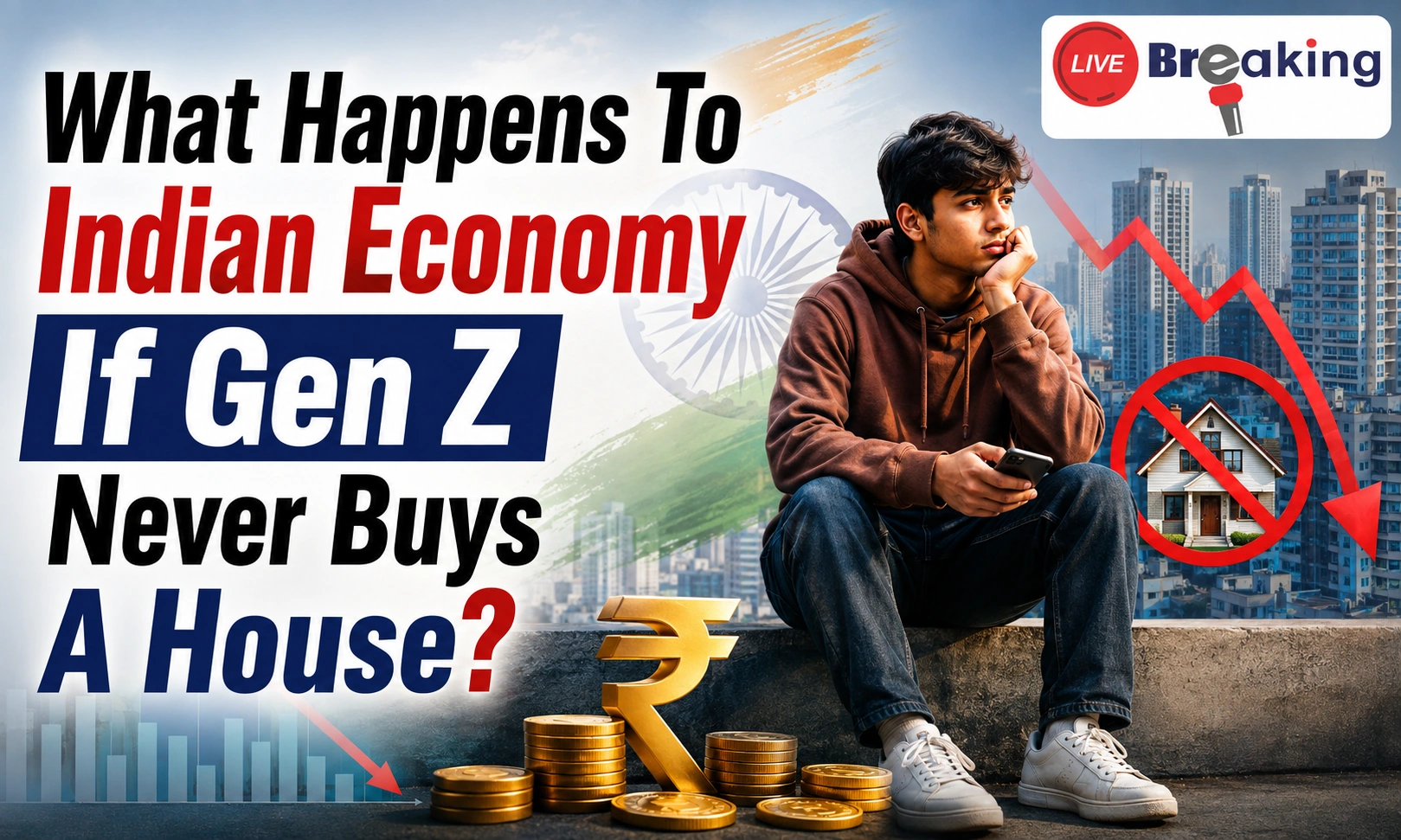
What Happens To Indian Economy If Gen Z Never Buys A House? The Big Shift That Could Reshape India’s Real Estate Market
For generations, buying a house has been considered one of the biggest financial milestones in India. A stable job, a home loan and eventually owning a property have traditionally formed part of the middle-class financial journey.
But Generation Z may be changing that equation.
Young Indians are entering adulthood at a time when property prices in major cities have risen sharply, jobs can be less predictable and financial products such as mutual funds, equities and REITs are easier to access than ever. As a result, some members of Gen Z may choose to rent for longer and invest their money elsewhere instead of rushing into homeownership.
The question is bigger than whether young Indians will own houses. If Gen Z significantly delays buying property, what happens to the Indian economy?
The answer is complicated because people will always need somewhere to live. The major change could be in who owns the housing, when they buy it and where young people’s savings go instead.
Will Gen Z Really Stop Buying Houses?
It is unlikely that an entire generation will completely abandon homeownership.
Housing is a basic requirement, and population growth will continue to create demand for homes. Some young Indians will eventually purchase properties, while others may inherit homes from their parents. Many will continue renting, particularly in expensive urban markets.
The bigger possibility is that Gen Z will buy homes later in life.
Instead of purchasing a property in their 20s, young professionals may choose to rent while building financial assets. They could invest in stocks, mutual funds, retirement products or REITs before considering a property purchase.
This represents a change in the timing of homeownership rather than the disappearance of housing demand.
Economists quoted in the NDTV report similarly argue that housing demand itself is unlikely to vanish because people still require accommodation. The key uncertainty is how much of that demand translates into ownership instead of renting or inherited housing.
Why Is Gen Z Rethinking Homeownership?
One of the biggest factors is affordability.
For many young Indians, buying a home in cities such as Mumbai, Delhi-NCR, Bengaluru, Hyderabad or Pune can require a substantial down payment followed by a large monthly EMI.
At the same time, younger consumers have become more comfortable with financial investments that do not require locking a large portion of their wealth into one physical asset.
There is also a lifestyle component.
Gen Z has grown up with greater exposure to global travel, digital entertainment, social media and flexible careers. A traditional financial path built around one job, one city and one house may not appeal to everyone.
Renting can provide mobility. If a professional changes jobs or cities, renting makes relocation easier than selling a property.
This does not necessarily mean young Indians dislike houses. It may simply mean they want financial flexibility before financial permanence.
What Happens To India’s Real Estate Market?
A prolonged delay in first-time home buying could affect developers.
First-time buyers form an important part of the housing ecosystem. When purchases are delayed, developers may experience slower sales and could become more cautious about launching new projects.
That can eventually influence the wider construction industry.
A slowdown in housing activity does not affect only builders. Real estate is connected to a large network of industries, including:
- Cement
- Steel
- Paint
- Tiles
- Furniture
- Electrical equipment
- Home appliances
- Construction labour
- Architecture and design
- Banking and housing finance
- Property brokerage
The NDTV report notes that real estate contributes an estimated 7% to 13% of India’s GDP, depending on the methodology used, and is a major source of employment.
Therefore, even a gradual change in home-buying behaviour could have effects far beyond property developers.
What Happens To Home Loans And Banks?
Home purchases are closely connected to India’s banking and housing-finance system.
A typical property purchase involves a large mortgage that can remain active for decades. If younger households postpone buying, demand for new home loans could grow more slowly.
That does not necessarily mean banks lose all the money.
Young Indians may borrow for other purposes or invest more of their disposable income in financial markets. However, the nature of credit demand could change.
Instead of a large secured home loan, some consumers may use smaller loans for education, travel, consumer goods, vehicles or other expenses.
This matters because secured housing loans and unsecured consumer credit carry very different risk profiles.
A major generational shift from property ownership toward consumption and financial investments could therefore change the way household credit is distributed across the economy.
Could Renting Become More Important?
Yes.
If Gen Z postpones buying homes, India’s rental market could become increasingly important.
A larger renter population would create opportunities for landlords, rental platforms, property-management companies and businesses providing services to tenants.
Developers could also respond by building housing specifically for rental demand rather than focusing exclusively on individual ownership.
This could encourage the growth of professionally managed rental housing, co-living spaces and flexible accommodation in India’s major employment centres.
In other words, fewer young people buying houses does not mean fewer houses are required.
It could mean a different housing business model.
What Happens To Government Revenue?
Property transactions generate revenue for state governments through mechanisms such as stamp duty and registration charges.
Read More: Panchayat Season 5 OTT Release Date: When And Where To Watch Jitendra Kumar’s Hit Series Online
If younger buyers postpone transactions for several years, governments could see slower growth in these revenues.
The impact would not necessarily be dramatic overnight. Instead, it could emerge gradually as fewer first-time purchases take place each year.
Lower transaction activity could also affect related professional services, including property registration, brokerage, legal services and home-related businesses.
The NDTV analysis identifies stamp-duty collections as one of the areas that could be affected if property transactions slow.
But Could Gen Z’s Money Help Other Parts Of The Economy?
This is where the story becomes more interesting.
Money that does not go into a home down payment does not necessarily disappear.
Suppose a young professional decides not to spend a large amount on a property. That person may instead allocate savings toward mutual funds, equities, REITs, retirement investments or even business ventures.
That could increase the flow of household savings into financial markets.
The reference article highlights this possibility, arguing that a greater allocation toward liquid financial assets could provide companies with capital while reducing the concentration of household wealth in property.
This could be beneficial for the economy over the long term if savings are channelled productively.
Could This Change The Traditional Indian Dream?
Possibly.
For decades, owning a house has represented security, social status and financial success in India.
Gen Z could redefine that definition.
For some young Indians, financial success may mean having a diversified investment portfolio, emergency savings and the freedom to move cities rather than owning a large apartment at a young age.
The house may become something purchased when financially comfortable rather than something purchased as quickly as possible.
That would represent a major cultural as well as economic change.
Read More: ‘Never Saw Madhuri Dixit Throw Tantrums’: Ravi Kishan Praises Maa Behen Co-Star
Gen Z May Not Reject Homeownership — It May Simply Delay It
The most realistic scenario is not that Gen Z never buys houses.
Instead, many young Indians may rent first, invest first and buy later.
This distinction is important.
If homeownership is delayed by five or ten years, the immediate consequences could include slower growth in some segments of residential construction, mortgages and property transactions.
But the money could simultaneously move into India’s capital markets, consumption economy and rental sector.
The long-term outcome would depend on how effectively that capital is used.
If young Indians invest productively and build financial wealth before buying property, the economy could eventually benefit from a more diversified household balance sheet.
If the money instead moves primarily into excessive consumption and high-cost unsecured borrowing, the outcome could be very different.
What Could India’s Housing Market Look Like In The Future?
India’s future housing market may become more diverse.
There could be more renters, later-stage homebuyers and investors who treat property as one part of their portfolio rather than the centre of their financial lives.
Read More: Anirudh Ravichander and Kavya Maran Wedding Rumours: Here’s Everything We Know So Far
Developers may need to respond by offering smaller, more affordable homes, better rental-oriented properties and projects closer to employment hubs.
Banks and housing-finance companies may also have to understand a younger customer who is less willing to commit to a 20- or 30-year financial obligation early in their career.
The Indian housing story, therefore, may not be about Gen Z abandoning houses.
It may be about Gen Z changing the order in which financial milestones are achieved.
Final Takeaway
If Gen Z never bought houses, India’s economy would certainly feel the impact because real estate connects construction, employment, banking, manufacturing and government revenues.
But a complete rejection of homeownership is unlikely.
The more realistic scenario is that Gen Z delays buying property and puts more money into financial assets, experiences and flexible lifestyles.
Read More: Connor Murphy Death Rumors Explained: What Happened to the YouTube Fitness Influencer in Thailand?
That would create winners and losers.
Traditional residential developers, mortgage lenders and property-related businesses could face slower growth if first-time buyers stay away for longer. At the same time, rental businesses, financial markets and investment products could benefit from the shift.
Ultimately, the important question is not “Will Gen Z buy houses?”
It is:
“When Gen Z’s money does not go into a home, where does it go instead?”
That answer could shape India’s housing market — and parts of its economy — for decades to come.
Key Points At A Glance
| Area | Possible Impact If Gen Z Delays Home Buying |
|---|---|
| Real Estate | Slower first-time buyer demand |
| Construction | Potentially slower new project launches |
| Home Loans | Slower growth in mortgage demand |
| Banks | Possible shift toward other forms of credit |
| Rental Market | Potential increase in long-term renters |
| Stamp Duty | Slower growth in property transaction revenue |
| Financial Markets | More money could flow into equities, mutual funds and REITs |
| Consumer Spending | More disposable income could go toward experiences and goods |
| Household Wealth | Potentially greater diversification beyond property |
| Economy | Short-term pressure on property-linked sectors but possible long-term diversification |
Frequently Asked Questions
1. What happens to the Indian economy if Gen Z never buys a house?
If Gen Z permanently avoided homeownership, the impact could extend beyond real estate. Construction, home loans, cement, steel, furnishings and state stamp-duty revenues could be affected. However, money saved from property purchases could move into equities, mutual funds, REITs, consumption and other investments.
2. Will Gen Z stop buying houses in India?
A complete rejection of homeownership appears unlikely. Young Indians will still need housing, and some will buy properties, inherit homes or purchase later. The more likely change is that Gen Z may postpone homeownership compared with previous generations.
3. Why is Gen Z choosing renting over buying?
High property prices, large down payments, long-term EMIs, job mobility and a preference for financial flexibility can make renting attractive. Younger consumers may also prefer investing their savings in liquid financial assets before committing to property.
4. Will delayed home buying hurt India’s real estate sector?
It could create pressure if a large number of first-time buyers postpone purchases for many years. Developers could face slower sales, while connected industries such as construction materials, home furnishings and housing finance could also experience weaker demand.
5. Can renting instead of buying help the Indian economy?
It can redirect household money toward other parts of the economy. Rent supports landlords and rental businesses, while money that would have gone toward a property down payment could potentially enter financial markets or consumer spending.
Read More: Ramayana Designers React To Trolling Over Sai Pallavi’s Sita, Lara Dutta’s Kaikeyi Looks
6. Where could Gen Z invest money instead of buying a house?
Depending on individual financial circumstances, young investors may consider equities, mutual funds, REITs and other financial assets. The important economic point is that savings can be redirected rather than simply disappearing when a property purchase is postponed.
7. Is homeownership still important in India?
Yes. Homeownership continues to provide housing security and remains an important financial and social goal for many Indian households. What may be changing is the age at which people buy and the proportion of their total wealth they are willing to put into one property.
8. Could India’s rental market grow because of Gen Z?
Yes. If more young professionals postpone buying homes, demand for rental housing could increase, particularly in major employment centres. This could support professionally managed rentals, co-living and other flexible housing models.
Like this post?
Register at Live Breaking to never miss out on videos, celeb interviews, and best reads.