

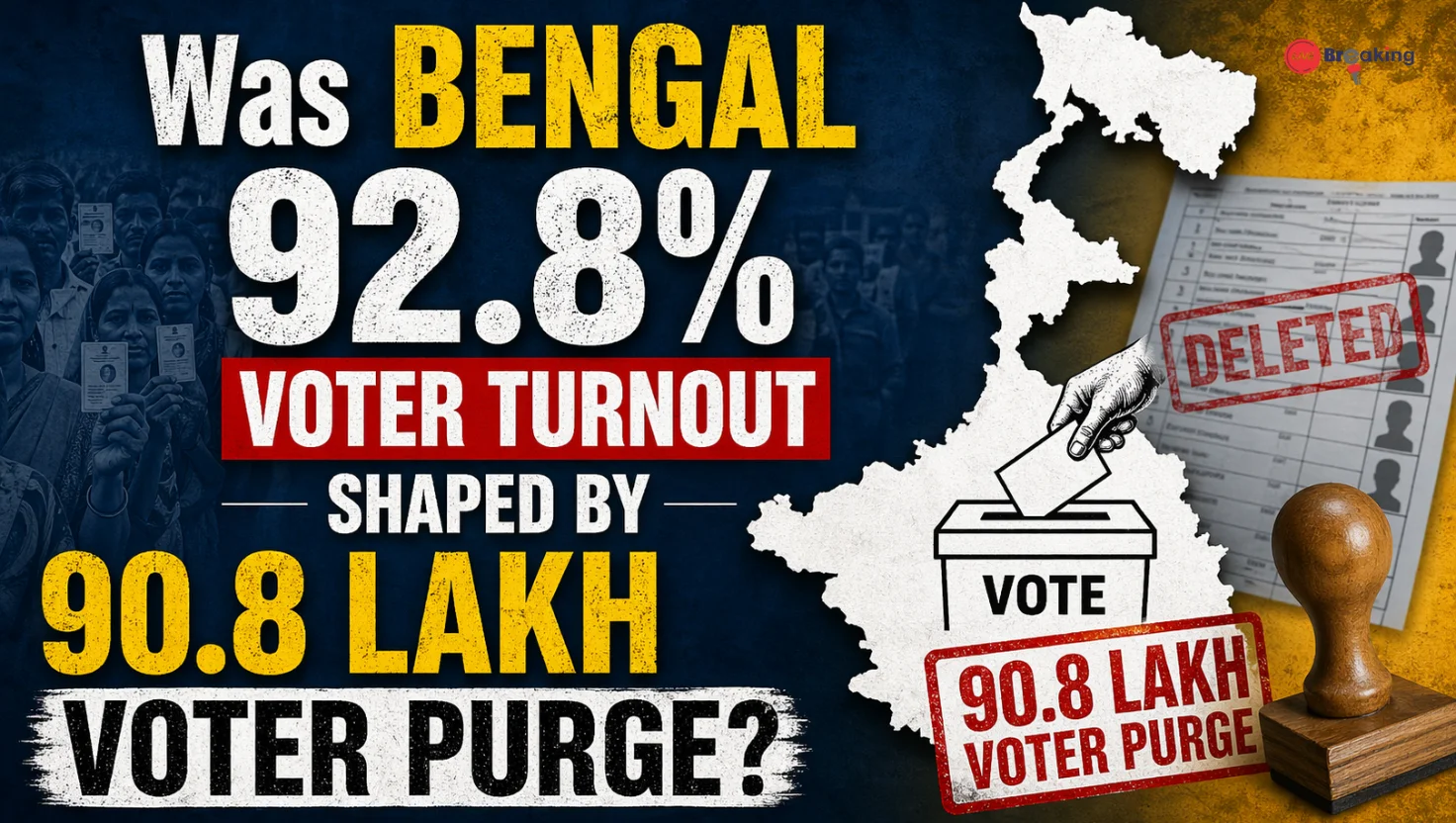
Bengal Voter Turnout 92.8%: Was It Influenced by 90.8 Lakh Voter Deletions?
The recent voter turnout of 92.8% in West Bengal has sparked widespread debate across political and public spheres. While such a high participation rate is often celebrated as a sign of strong democratic engagement, a parallel claim has raised eyebrows — the alleged removal of 90.8 lakh voters from electoral rolls.
This dual narrative has triggered a crucial question: Was the high turnout genuinely organic, or was it statistically influenced by a significant reduction in the voter base?
Understanding the Numbers: Turnout vs Voter Base
To grasp the controversy, it’s important to break down the figures:
| Metric | Value |
|---|---|
| Reported Voter Turnout | 92.8% |
| Alleged Voter Deletions | 90.8 lakh |
| Previous Turnout (Approx.) | 80–85% |
| Electoral Roll Revision Period | Recent cycle |
A high turnout percentage can sometimes be influenced not just by increased participation, but also by a reduced denominator — in this case, the total number of registered voters.
What Is a ‘Voter Purge’?
A “voter purge” refers to the removal of names from electoral rolls. This can happen for legitimate reasons such as:
- Death of voters
- Migration to other regions
- Duplicate registrations
- Data correction exercises
However, when the number of deletions is unusually high, it often leads to concerns about:
- Disenfranchisement
- Administrative transparency
- Political bias
In this case, the reported figure of 90.8 lakh deletions is significant enough to demand scrutiny.
How Could Voter Deletion Affect Turnout Percentage?
Let’s simplify the math:
- Suppose earlier there were 10 crore voters and 8 crore voted → 80% turnout
- If 1 crore voters are removed (leaving 9 crore), and still 8 crore vote → turnout becomes ~89%
Read More: No Supreme Court Relief for Bengal Voters Deleted in SIR Process – Key Updates & Impact
This illustrates how removing voters can inflate turnout percentages, even if the actual number of votes cast remains similar.
Political Reactions and Public Debate
Political parties across the spectrum have reacted strongly:
- Opposition leaders have questioned the legitimacy of the deletions
- Ruling authorities have defended the process as routine electoral roll revision
- Civil society groups are demanding transparency and audit trails
The issue has turned into a broader debate about electoral integrity in India.
Election Commission’s Role and Responsibility
The Election Commission of India is responsible for maintaining accurate electoral rolls. Their responsibilities include:
- Periodic revision of voter lists
- Verification of voter identity
- Ensuring no eligible voter is excluded
Read More: 1 War, 3 Bills: UAE’s Bailout, Iran’s $270 Billion, Trump’s Off-Ramp Search
In situations like this, the Commission is expected to provide:
- Detailed clarification on deletions
- Public access to revision data
- Mechanisms for re-registration
Ground Reality: Participation vs Representation
While a 92.8% turnout suggests enthusiastic participation, critics argue that true democratic representation depends on inclusion, not just percentages.
Key concerns include:
- Were genuine voters removed mistakenly?
- Did marginalized groups face higher deletion rates?
- Were proper notices issued before removal?
Without clear answers, the turnout figure alone cannot fully represent democratic health.
Read More: Iran Shuts Hormuz Again, Accuses US Of Violating Deal To Reopen It
Data Transparency: The Missing Piece
One of the biggest issues in this debate is the lack of publicly accessible granular data. Experts suggest:
- Publishing booth-level voter changes
- Sharing reasons for deletions
- Allowing independent audits
Transparency can help rebuild trust and clarify whether the turnout spike is genuine or statistical.
Historical Context of Voter Turnout in Bengal
West Bengal has traditionally recorded high voter participation compared to other Indian states. However:
- Past elections hovered between 80–85% turnout
- A sudden jump to 92.8% is statistically notable
- Such spikes often require deeper analysis
Read More: Pahalgam Attack: The Photograph That Shook India and Its Deeper Impact
Expert Opinions: Statistical vs Democratic View
Experts are divided:
Statistical Perspective:
- Reduced voter base can mathematically increase turnout
- Requires correlation analysis
Democratic Perspective:
- Even legitimate deletions must ensure no eligible voter is excluded
- Trust in electoral systems is paramount
Conclusion: Numbers Tell a Story, But Not the Whole Truth
The 92.8% voter turnout in West Bengal is undoubtedly impressive at face value. However, when juxtaposed with the alleged deletion of 90.8 lakh voters, it opens up a complex narrative.
Read More: “China, India Or Some Other Hell-Hole…”: Trump Reposts Anti-India Rant Over Birthright Citizenship
The key takeaway is simple:
High turnout is meaningful only when it reflects inclusive participation.
Until detailed data is made public, the question remains open — was this a democratic milestone or a statistical illusion?
FAQs
Q1: What does a 92.8% voter turnout mean?
It means that 92.8% of registered voters cast their votes. However, this depends heavily on how many voters are on the rolls.
Q2: What is a voter purge?
A voter purge is the removal of names from electoral rolls due to reasons like death, duplication, or migration.
Read More: Trump Vindicated? Iran Crisis Turning US Crude Into World’s Safe Bet
Q3: Why is the 90.8 lakh deletion controversial?
Because such a large number raises concerns about whether all deletions were legitimate and fairly conducted.
Q4: Can voter deletion increase turnout percentage?
Yes. If the total number of registered voters decreases, the turnout percentage can rise even if the number of votes stays the same.
Q5: Who manages voter lists in India?
The Election Commission of India is responsible for maintaining and updating electoral rolls.