

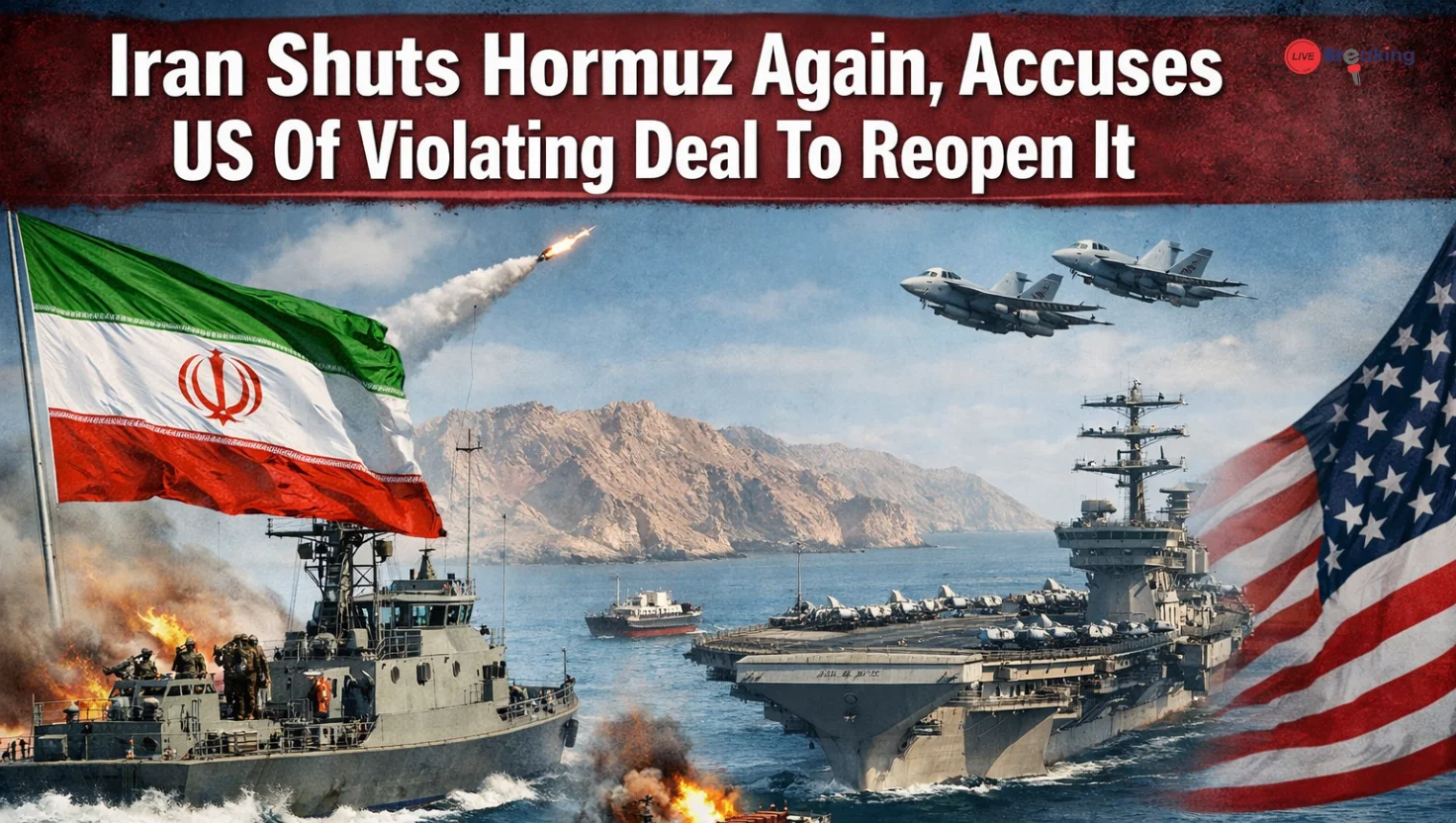
Iran Shuts Hormuz Again, Accuses US Of Violating Deal To Reopen It
Iran has once again imposed restrictions on the Strait of Hormuz, reversing its earlier decision to reopen the crucial global oil transit route. Tehran has accused the United States of violating an agreement by continuing a naval blockade, triggering fresh geopolitical tensions in an already volatile region.
The Strait of Hormuz is one of the world’s most critical maritime chokepoints, handling nearly 20% of global oil shipments. Any disruption in this region has immediate ripple effects on global energy markets, shipping routes, and geopolitical stability.
Why Did Iran Shut the Strait Again?
Iran’s military leadership stated that the decision to reimpose restrictions came after the US allegedly failed to uphold its commitment to ease pressure on Iranian shipping. According to Tehran, Washington continued its naval blockade, which it views as a direct violation of the agreement.
Reports suggest that Iran has now resumed “strict management” of the strait, meaning ships must seek approval before passing through.
Additionally:
- Iran warned that continued US interference would lead to tighter control.
- Some vessels were reportedly forced to turn back or reroute.
- The situation escalated with reports of Iranian forces firing on a tanker attempting to cross.
Background – The 2026 Strait of Hormuz Crisis
The current situation is part of a broader conflict often referred to as the 2026 Strait of Hormuz crisis, triggered by escalating tensions between Iran, the US, and its allies.
Key developments leading up to the closure:
- February 2026: Conflict erupts involving Iran, the US, and Israel
- Iran retaliates by targeting shipping routes and laying sea mines
- Tanker traffic drops drastically, with many ships avoiding the route
- Temporary ceasefire leads to limited reopening
- Now: Renewed restrictions amid accusations and mistrust
The crisis has already damaged multiple ships and disrupted global trade significantly.
Impact on Global Oil Markets
The Strait of Hormuz is vital for transporting crude oil from major producers like Saudi Arabia, UAE, and Iraq. Any closure leads to immediate supply concerns.
Read More: MP Woman Kills Husband After Affair Row: ‘Tum Kaale Ho’ Remark Sparks Shocking Crime
Effects observed:
- Oil prices initially dropped when the strait briefly reopened
- Markets remain volatile due to uncertainty
- Shipping companies are hesitant due to safety concerns
Even during reopening, experts warned that full normalization of oil flow was unlikely due to risks like mines, insurance issues, and political instability.
US vs Iran – The Core Dispute
At the heart of the issue lies a disagreement over:
- US naval blockade of Iranian ports
- Iran’s demand for unrestricted maritime movement
- Disputes over nuclear commitments and sanctions
While the US claims progress toward a deal, Iran has rejected several American assertions, calling them misleading.
The standoff highlights a deeper geopolitical struggle for control and influence in the Middle East.
Read More: A Missile On One Soldier’s Shoulder Could Ground The US Air War In Iran
Global Reactions and Diplomatic Efforts
The international community has expressed concern over the renewed escalation.
Key responses:
- Calls for de-escalation from global leaders
- Ongoing negotiations reportedly mediated by Pakistan
- Temporary ceasefires in related conflicts (e.g., Lebanon)
Despite diplomatic efforts, the situation remains fragile, with both sides unwilling to fully compromise.
What This Means for India and the World
India, being a major oil importer, is directly affected by disruptions in the Strait of Hormuz.
Potential consequences:
- Increase in fuel prices
- Supply chain disruptions
- Pressure on inflation and economy
Read More: No Supreme Court Relief for Bengal Voters Deleted in SIR Process – Key Updates & Impact
Indian oil tankers have reportedly continued navigating the region cautiously, highlighting the delicate balance between risk and necessity.
Key Facts Table
| Aspect | Details |
|---|---|
| Location | Strait of Hormuz (Persian Gulf) |
| Global Oil Flow | ~20% of world supply |
| Current Status | Restricted again by Iran |
| Main Cause | US naval blockade dispute |
| Risk Factors | Military conflict, mines, tanker attacks |
| Global Impact | Oil prices, trade disruption, geopolitical instability |
What Happens Next?
The future of the Strait of Hormuz depends largely on diplomatic negotiations between Iran and the US.
Possible scenarios include:
- De-escalation: Agreement leading to full reopening
- Status quo: Controlled access with restrictions
- Escalation: Complete shutdown and military confrontation
Experts warn that even temporary disruptions can have long-term consequences for global energy security.
Read More: Nashik TCS ‘Conversion’ Accused Nida Khan Claims She’s Pregnant, Wants Court Relief
FAQ
Q1. Why is the Strait of Hormuz important?
It is a critical global oil transit route, carrying about 20% of the world’s petroleum supply.
Q2. Why did Iran shut it again?
Iran claims the US violated an agreement by continuing its naval blockade, prompting renewed restrictions.
Q3. Is the strait completely closed?
Not entirely—access may be restricted and controlled, but uncertainty remains.
Q4. How does this affect oil prices?
Any disruption causes volatility, often pushing prices higher due to supply fears.
Q5. Will the situation improve soon?
It depends on ongoing diplomatic talks; however, tensions remain high.
Read More: Women Quota Bill Fails in Parliament: PM Modi Slams Opposition, Warns of Consequences
Conclusion
The renewed closure of the Strait of Hormuz underscores the fragile nature of global geopolitics and energy security. With Iran accusing the US of violating agreements and both sides holding firm positions, the risk of escalation remains real.
For the world, especially oil-dependent economies like India, the situation is a stark reminder of how geopolitical tensions can directly impact everyday life—from fuel prices to economic stability. The coming days will be crucial in determining whether diplomacy prevails or the crisis deepens further.