

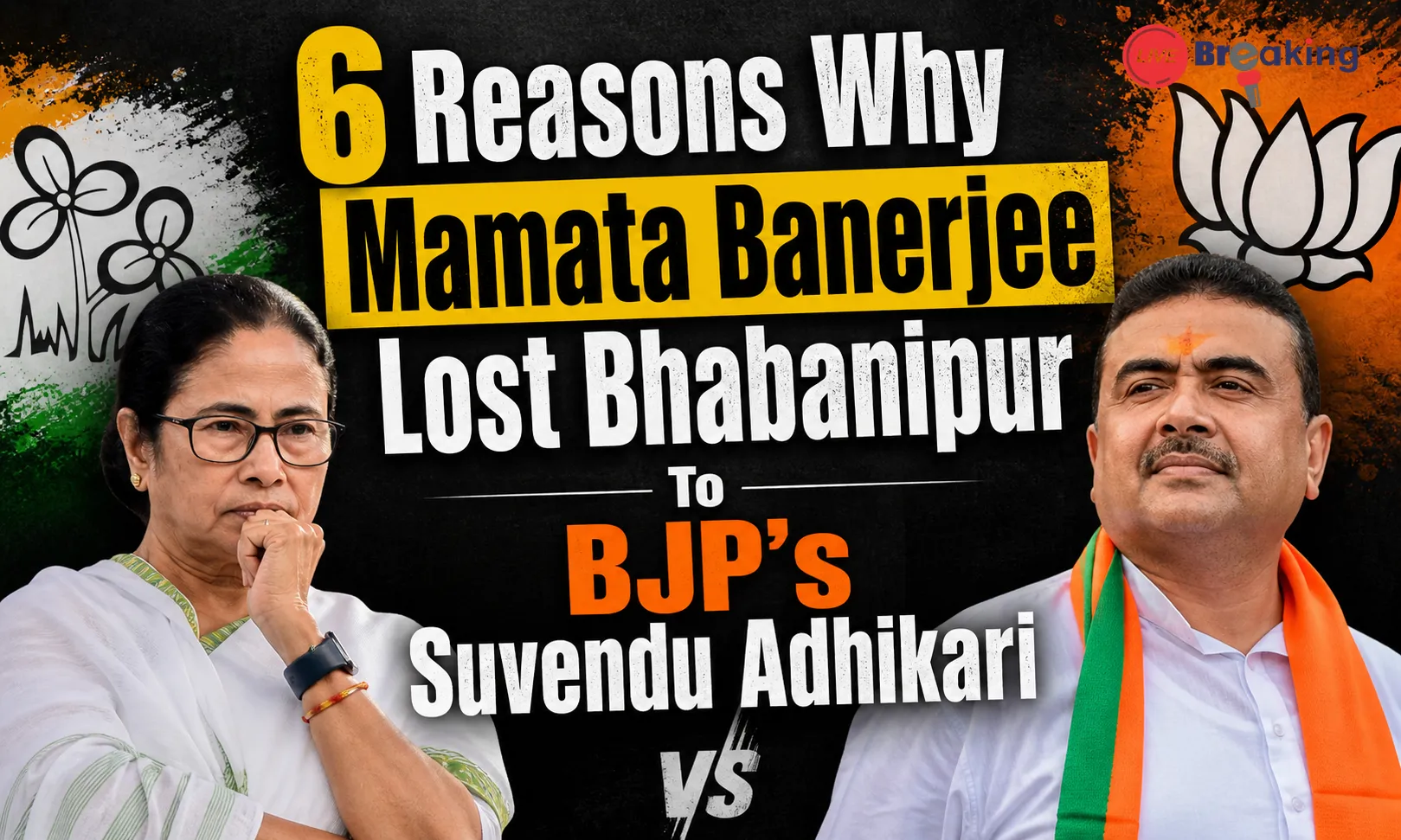
6 Reasons Why Mamata Banerjee Lost Bhabanipur To BJP’s Suvendu Adhikari
The 2026 West Bengal election results delivered a political shocker when Mamata Banerjee, a dominant force in Bengal politics, lost her stronghold Bhabanipur to Suvendu Adhikari of the Bharatiya Janata Party. This unexpected result has sparked intense debate among political analysts, party workers, and voters alike.
Bhabanipur, long considered a safe seat for the All India Trinamool Congress, witnessed a dramatic shift in voter sentiment. Let’s break down the six key reasons behind this historic political upset.
1. Anti-Incumbency Sentiment
One of the most significant factors behind Mamata Banerjee’s loss was growing anti-incumbency. After years of governance, sections of voters expressed dissatisfaction over issues such as local infrastructure, unemployment, and governance fatigue.
Even loyal voters began seeking change, and the BJP capitalized on this sentiment by positioning itself as a strong alternative.
2. Suvendu Adhikari’s Strong Ground Campaign
Suvendu Adhikari is known for his grassroots political style. His campaign in Bhabanipur focused heavily on door-to-door outreach, booth-level management, and direct voter engagement.
Read More: Pawan Khera Gets Anticipatory Bail in Case Linked to Himanta Biswa Sarma’s Wife Remarks
Unlike traditional top-down campaigning, Adhikari’s approach resonated with local voters who felt personally connected to his campaign narrative.
3. Strategic BJP Positioning
The Bharatiya Janata Party strategically targeted Bhabanipur as a prestige battle. High-profile campaigning, national-level support, and focused messaging helped the party consolidate votes across multiple communities.
The BJP also successfully framed the election as a symbolic contest, increasing voter turnout among its supporters.
4. Fragmentation of Minority and Urban Votes
Bhabanipur has historically seen consolidated voting patterns favoring Mamata Banerjee. However, in 2026, there were signs of vote fragmentation among key voter groups, including minorities and urban middle-class voters.
Read More: Actor Vijay Political Rise in Tamil Nadu: TVK, 2026 Elections & Future Ambitions
Shifts in local alliances, dissatisfaction with specific policies, and evolving political priorities contributed to this fragmentation.
5. Local Issues Overshadowed State Leadership
While Mamata Banerjee remains a powerful state leader, local constituency issues played a crucial role in Bhabanipur. Concerns about civic infrastructure, traffic congestion, and municipal services became central election issues.
Voters appeared to prioritize local governance over broader state-level leadership, which worked in favor of the BJP candidate.
6. Narrative Shift and Political Messaging
The BJP effectively changed the narrative from a personality-driven election to a performance-driven one. Campaign messaging focused on accountability, governance, and development benchmarks.
Read More: West Bengal Election 2026: Repolling, BJP-TMC Clashes & Falta Protests – Full Story
This shift challenged Mamata Banerjee’s traditional campaign style and forced voters to reconsider their choices based on measurable outcomes rather than political legacy.
Key Comparison Table
| Factor | Mamata Banerjee (TMC) | Suvendu Adhikari (BJP) |
|---|---|---|
| Campaign Style | Centralized leadership | Grassroots outreach |
| Voter Sentiment | Anti-incumbency impact | Change-driven momentum |
| Key Strength | Strong legacy & recognition | Local connect & strategy |
| Messaging | Welfare & continuity | Development & accountability |
| Vote Consolidation | Fragmented in 2026 | Strong consolidation |
What This Means for West Bengal Politics
This result is more than just a constituency loss—it signals a shift in West Bengal’s political landscape. The victory of Suvendu Adhikari indicates that the BJP is strengthening its foothold in regions previously dominated by the All India Trinamool Congress.
Read More: Will Vijay Join AIADMK in Tamil Nadu Elections 2026? Alliance Buzz Explained
For Mamata Banerjee, this defeat could prompt a strategic reassessment of campaign methods, governance priorities, and voter engagement strategies.
FAQs
1. Why did Mamata Banerjee lose Bhabanipur in 2026?
Mamata Banerjee lost due to a combination of anti-incumbency, fragmented voter support, strong BJP campaigning, and local governance issues that influenced voter decisions.
2. Who defeated Mamata Banerjee in Bhabanipur?
She was defeated by Suvendu Adhikari from the BJP.
3. Was Bhabanipur considered a safe seat?
Yes, Bhabanipur was traditionally a stronghold of Mamata Banerjee and the TMC, making this loss highly significant.
4. What role did BJP play in this victory?
The Bharatiya Janata Party executed a focused campaign strategy, strong ground-level outreach, and effective messaging that resonated with voters.
Read More: West Bengal Election Results 2026 Live Updates: BJP Leads Big, TMC Trails
5. What impact will this have on future elections?
This result could reshape political strategies in West Bengal and boost BJP’s confidence in challenging TMC in other constituencies.
Conclusion
The defeat of Mamata Banerjee in Bhabanipur marks a turning point in West Bengal politics. It highlights the growing importance of local issues, voter expectations, and strategic campaigning in modern elections.
As political dynamics evolve, both the All India Trinamool Congress and the Bharatiya Janata Party will need to adapt to changing voter behavior and expectations.