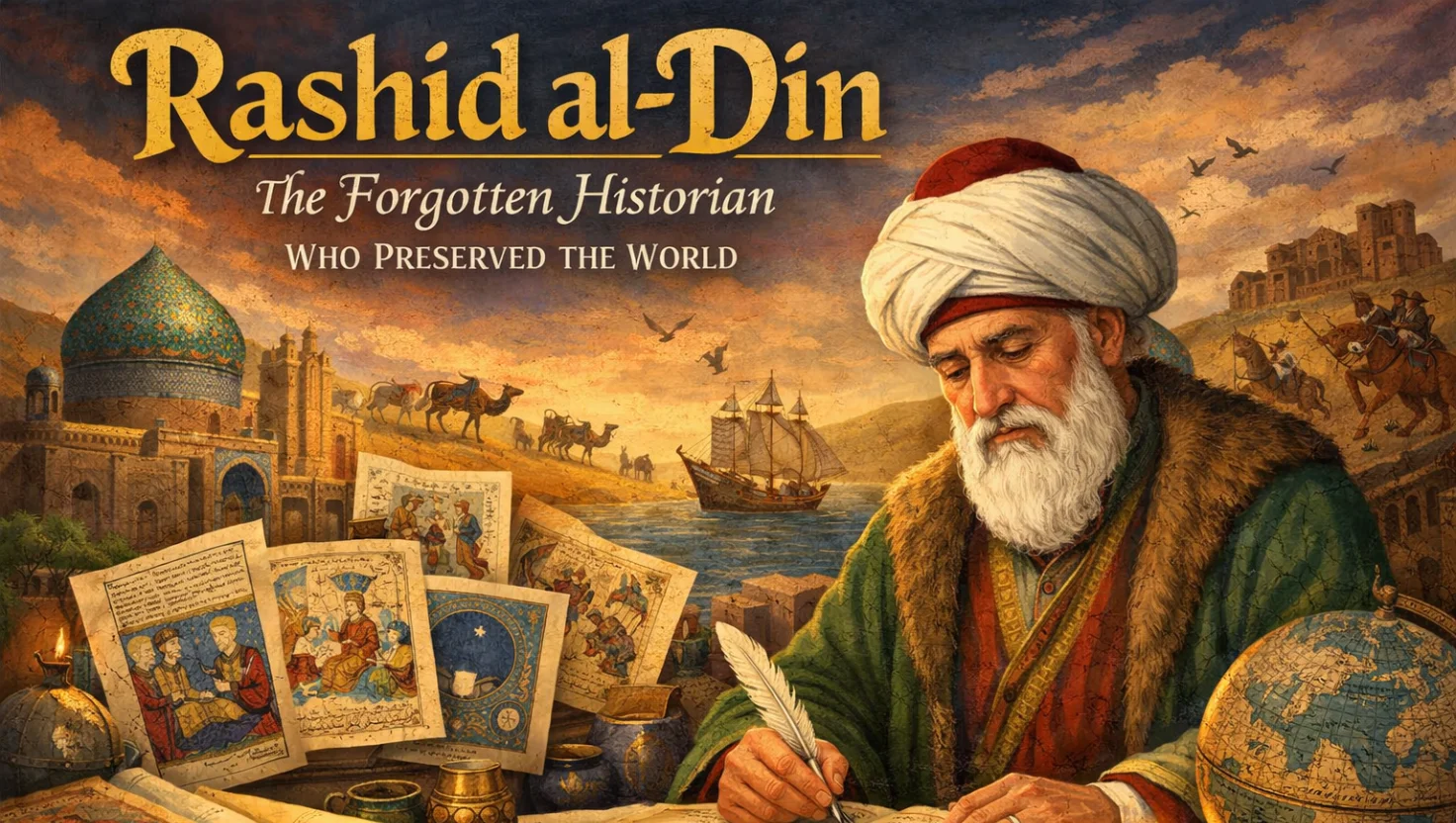
Rashid al-Din: The Forgotten Historian Who Preserved the World
In the vast timeline of human history, certain individuals emerge as silent guardians of knowledge—preserving stories, cultures, and civilizations for generations to come. One such remarkable yet often overlooked figure is Rashid al-Din Hamadani. A polymath, physician, and statesman of the 13th–14th century, he is best remembered for his monumental work that attempted to document the history of the entire known world.
Despite his immense contributions, his name rarely appears in mainstream historical discussions. Yet, his legacy continues to influence how we understand interconnected global histories today.
Who Was Rashid al-Din?
A Man of Many Talents
Born in 1247 in Persia (modern-day Iran), Rashid al-Din was not just a historian but also a physician, scholar, and high-ranking official in the court of the Mongol Ilkhanate. His career flourished under rulers like Ghazan Khan, where he served as a trusted advisor.
From Physician to Historian
Initially trained in medicine, Rashid al-Din’s intellectual curiosity led him to explore theology, science, and history. His transition into historiography was fueled by his exposure to diverse cultures under Mongol rule, which spanned vast regions from East Asia to the Middle East.
The Masterpiece: Jami’ al-Tawarikh
A Universal History Project
Rashid al-Din’s most significant contribution is the Jami’ al-Tawarikh (Compendium of Chronicles), one of the earliest attempts at writing a comprehensive world history.
This monumental work documented:
| Region/Civilization | Details Covered |
|---|---|
| Mongolia | Origins and expansion of Mongol tribes |
| China | Cultural and political systems |
| India | Traditions, religions, and rulers |
| Europe | Accounts of Western kingdoms |
| Middle East | Islamic dynasties and history |
Why It Was Revolutionary
At a time when most historians focused on local or regional narratives, Rashid al-Din took a global perspective. His work integrated information from travelers, scholars, and official records across continents.
This makes Jami’ al-Tawarikh one of the earliest examples of global historiography.
A Cultural Bridge Between Civilizations
Collaboration Across Borders
Rashid al-Din worked with scholars from different parts of the Mongol Empire, including Chinese, Persian, and Arab intellectuals. This collaboration allowed him to create a multi-dimensional historical account.
Read more: Sister Nivedita: The Irish Woman Who Dedicated Her Life to India
Promoting Knowledge Exchange
His work symbolizes the intellectual exchange that flourished under Mongol rule—a period often misunderstood as purely destructive. Instead, it also facilitated cultural and scholarly interactions across vast territories.
Challenges and Controversies
Political Intrigue and Downfall
Despite his achievements, Rashid al-Din’s life ended tragically. He was accused of poisoning a ruler and executed in 1318. Many historians believe these accusations were politically motivated.
Loss and Survival of Manuscripts
Over time, parts of his work were lost or scattered. However, surviving manuscripts are preserved in prestigious institutions and continue to be studied by historians worldwide.
Why Rashid al-Din Matters Today
A Pioneer of Global Thinking
In today’s interconnected world, Rashid al-Din’s vision feels remarkably modern. He recognized the importance of documenting multiple perspectives and cultures within a single narrative.
Read more: Best Ayurvedic Remedies for Menstrual Pain Relief
Lessons for Modern Historians
- Embrace diverse sources
- Avoid cultural bias
- Understand global interconnections
His work serves as a reminder that history is not isolated—it is shared.
Key Contributions at a Glance
| Contribution | Impact |
|---|---|
| Jami’ al-Tawarikh | First global history compilation |
| Cultural Collaboration | Integrated knowledge from multiple civilizations |
| Administrative Role | Influenced governance in the Ilkhanate |
| Preservation of Knowledge | Documented cultures that might have been forgotten |
Read More: What Pregnant Women Should and Shouldn’t Eat in Winter, Healthy Winter Pregnancy Diet
FAQs
1. Who was Rashid al-Din?
Rashid al-Din was a Persian historian, physician, and statesman known for writing one of the first comprehensive world histories.
2. What is Jami’ al-Tawarikh?
It is a historical encyclopedia that documents the history of various civilizations across Asia, Europe, and the Middle East.
3. Why is Rashid al-Din important?
He pioneered global historiography by compiling knowledge from multiple cultures into a single work.
4. How did Rashid al-Din die?
He was executed in 1318 following political accusations, widely believed to be unjust.
5. Where can his work be found today?
Fragments of his manuscripts are preserved in museums and libraries around the world.
Read more: Understanding IVF Treatment, Costs and How to Choose the Right IVF Centre
Conclusion
The story of Rashid al-Din Hamadani is a testament to the enduring power of knowledge and curiosity. At a time when the world was divided by geography and culture, he envisioned a unified narrative that connected civilizations.
Though history may have sidelined his name, his work continues to echo through time—reminding us that understanding the past requires a global perspective.